


A recruiter may spend only seconds on a first resume scan. One eye-tracking study reported an average of 7.4 seconds. Hiring managers and an applicant tracking system quickly look for evidence matching the job description.
Resume scope and scale give your work a useful frame. They show the size, reach, complexity, and stakes behind an accomplishment, not only the task completed.
Your professional summary should frame your level, while the experience section proves it through key accomplishments and context. This evidence-based approach applies to an executive resume too, where seniority doesn’t replace specific proof. Turn familiar responsibilities into evidence a reader can picture.
Make each example clarify:
- What you owned and where your responsibility began and ended
- How much work, activity, or volume it covered
- What changed because of your contribution
Key Takeaways
- Resume scope shows the boundaries of your responsibility, while scale shows its size, volume, reach, or complexity.
- Strengthen resume bullet points with the structure action verb + responsibility + scope or scale + measurable result.
- Use the SSIP method—Scope, Scale, Impact, Proposition—to check whether each accomplishment proves ownership and business value.
- Quantify impact with accurate evidence such as team size, customers, locations, budgets, cycle time, quality, reach, or duration, even when revenue is not your metric.
- Show career progression through expanded ownership, larger projects, more complex stakeholders, and stronger results rather than repeating the same duties.
What Resume Scope and Scale Actually Mean
Scope describes the boundaries of your responsibility. Scale shows its size or volume. Achievement describes what changed because of your work.
“Managed customer onboarding” is a vague job duty. It leaves unanswered questions: How many customers? Which markets? How complex was the process? What improved?
Add context before the result
Strong resume bullet points usually follow this order:
action verbs + responsibility + scope or scale + measurable result
For example:
- Before: Managed customer onboarding.
- After: Improved onboarding for 120 mid-market customers across three product lines, cutting average activation time by 18%.
The second bullet shows ownership, customer volume, product complexity, and a measurable result. Compare each bullet with the relevant job description as you edit. If you lack an outcome, retain the context: “Coordinated onboarding for 120 mid-market customers across three product lines.” That is still more credible than a vague duty.
Use SSIP to pressure-test each bullet
SSIP is a practical review method: Scope, Scale, Impact, Proposition. The STAR method connects the work to its result. SSIP complements it by checking whether the bullet shows clear ownership, size, impact, and employer value.
- Scope identifies what you owned, such as a launch, process, territory, program, or workflow.
- Scale captures the size, including people, dollars, locations, volume, or duration.
- Impact states the result, such as cost reduction, faster turnaround, quality gains, or retention.
- Proposition explains why it mattered to the employer and ties your contribution to business outcomes.
A number without context can look decorative. Pair it with the work you performed and the business reason it mattered.
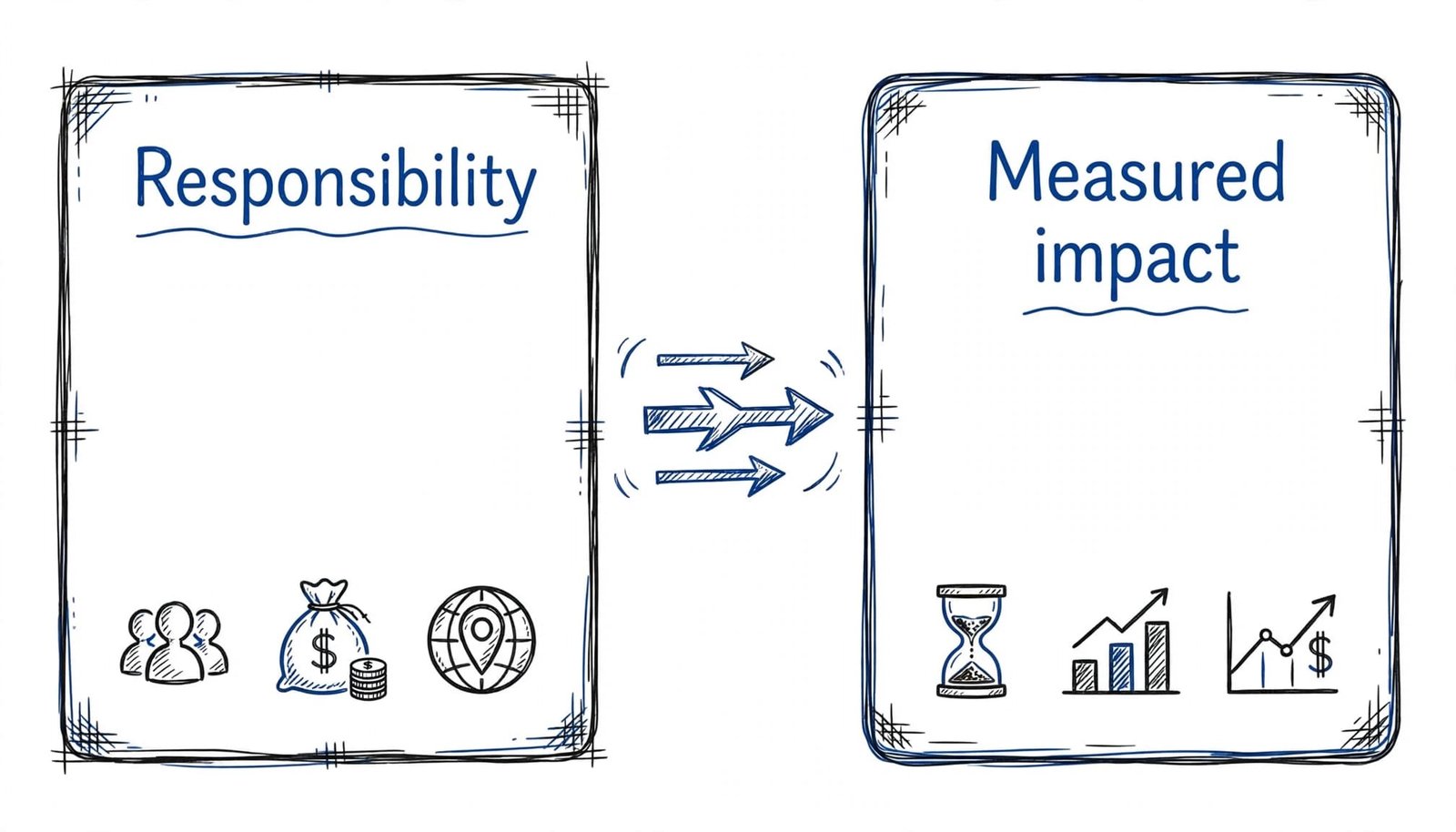
Turn Job Duties Into Credible, Quantifiable Evidence With Resume Bullet Points
Build bullets from real records, not memory alone. To quantify your impact, review project plans, quarterly reports, calendars, CRM dashboards, and performance metrics. Check budget files, team rosters, and performance reviews, then use the job description to select relevant evidence. Your old emails may reveal launch dates, stakeholder groups, or customer counts you had forgotten.
Start with the STAR method, then tighten it
The STAR method, Situation, Task, Action, and Result, helps you retrieve the full story and connect a business problem to your response. Columbia Career Education’s guidance on impact bullet points recommends using this structure to develop concise, accomplishment-focused descriptions.
You don’t need to fit every STAR detail into one line. Use the STAR method to draft the full story, then tighten it until only the strongest evidence remains.
For example:
- Situation and task: A support team faced a growing backlog during a new product launch.
- Action and result: “Created triage rules and trained eight support specialists during a product launch, reducing unresolved tickets by 32% in six weeks.”
That bullet shows team size, project context, process ownership, and a verified result.
Avoid numbers that cannot be defended
Don’t estimate revenue, claim a percentage you cannot trace, or round a figure upward to sound stronger. Unsupported numbers can damage your credibility, and interviewers may ask about every metric in an interview.
If exact data is unavailable, use accurate ranges, operational facts, or clear comparisons to show project scale. You can still show measurable achievements through volume, duration, stakeholders, or other operational facts:
- “Supported a regional territory covering 14 retail locations.”
- “Prepared weekly reports used by sales, finance, and operations leaders.”
- “Managed a six-month archive migration involving thousands of records.”
These details show meaningful responsibility without pretending every role produces revenue.
Quantify Your Impact When Revenue Is Not Your Metric
Revenue growth is only one proof point. Many individual contributors, educators, coordinators, creatives, and public-sector professionals show quantifiable impact through quality, speed, reach, risk reduction, service levels, or consistency. Match those measures to the target job description. They can demonstrate business outcomes without forcing every role into a dollar figure.

Match the metric to the work
Use dimensions that fit your job:
| Type of work | Evidence of scope and scale |
|---|---|
| People management | Team size, hiring volume, coaching cadence, shifts covered |
| Marketing or design | Campaigns, assets, channels, markets, approval groups |
| Operations | Orders, cases, locations, cycle time, error rate, compliance |
| Education or nonprofit | Learners, programs, grant size, events, communities reached |
| Technology | Users, systems, integrations, releases, uptime, data volume |
Revenue growth may matter in marketing, while process efficiency can define operations and technical impact can clarify technology roles. A designer might write: “Produced launch materials for 12 product releases, maintaining brand consistency across web, email, and sales collateral.” An administrative professional could write: “Managed scheduling and travel for five executives across two time zones.” Both bullets establish scale without a dollar amount.
For further structure, MIT’s PAR statement guidance uses Project, Action, and Result. It works well when a project name or business problem gives the bullet a sharper opening.
Show Career Progression at One Company
A long tenure can look static when every role reads the same. Show career progression through promotions, expanded ownership, larger projects, or tougher stakeholders.
Place each title and date clearly under the company name. Then make the change in responsibility visible in your resume bullet points, especially when it mirrors the target job description.
Make growth easy to scan
An early-career bullet may show reliable execution: “Processed vendor invoices and resolved payment discrepancies.”
A later bullet can show team leadership and broader ownership: “Led the monthly invoice-close process for 40 vendors, trained two new coordinators, and reduced recurring discrepancies through a revised review checklist.”
The job duties may remain in the same function, but ownership has expanded. You now own a process, guide others, manage more complex stakeholders, and prevent recurring problems. The STAR method can help you compare an early execution bullet with a later leadership or improvement bullet.
On an executive resume, show how responsibility grows through larger teams, higher-risk decisions, and more complex cross-functional work. An AI Resume Builder can help identify weak bullets, but every suggestion needs fact-checking. Use AI resume tailoring without exaggerating experience to keep resume edits grounded in your records. CareerScribeAI’s resume tools, Cover Letter Generator, and Interview Prep Tools can also help a resume writer carry the same verified stories into applications and interviews.
Frequently Asked Questions
What is resume scope and scale?
Resume scope describes what you owned and where your responsibility began and ended. Scale shows the size, volume, reach, duration, or complexity of that work.
How can I show scope and scale in a resume bullet point?
Combine an action verb and responsibility with specific context and a truthful result. For example, include the number of customers, team members, locations, systems, or projects involved, followed by a measurable improvement when available.
What if I do not have revenue or exact performance metrics?
Use other defensible evidence, such as cycle time, error rate, service volume, stakeholder groups, project duration, or locations covered. Accurate operational facts can show meaningful impact without forcing your experience into a dollar figure.
How do I avoid making resume numbers sound exaggerated?
Use figures you can trace to records such as reports, calendars, CRM dashboards, budgets, project plans, or performance reviews. If an exact number is unavailable, use an accurate range or clear operational description instead of estimating.
How can I show career progression at one company?
List each title and date clearly, then show how your ownership expanded through larger teams, more complex projects, tougher stakeholders, or broader business outcomes. Compare earlier execution-focused bullets with later examples of leadership, process improvement, and strategic responsibility.
Write for the Reader Who Must Hire You
The best evidence of responsibility size helps a busy reader understand your level quickly. It connects a task to the people, budget, territory, volume, or complexity behind it, then shows a truthful result.
Review each bullet against the job description and ask whether it proves the size of your work. Clear context turns experience into evidence, helping hiring managers see how your job duties addressed a business problem. Use these resume tips for a final review:
- Can you quantify your impact without overstating the result?
- Does each bullet show the work’s reach, complexity, or result?
- Can a reader understand the value without guessing?
As a final check, use the STAR method to confirm each example includes a situation, task, action, and result. A resume writer or AI-assisted editor can improve clarity, but should preserve your facts.