

A strong research record can still disappear in a 30-second resume review. Hiring managers may spend only seconds assessing whether your experience is relevant to their needs.
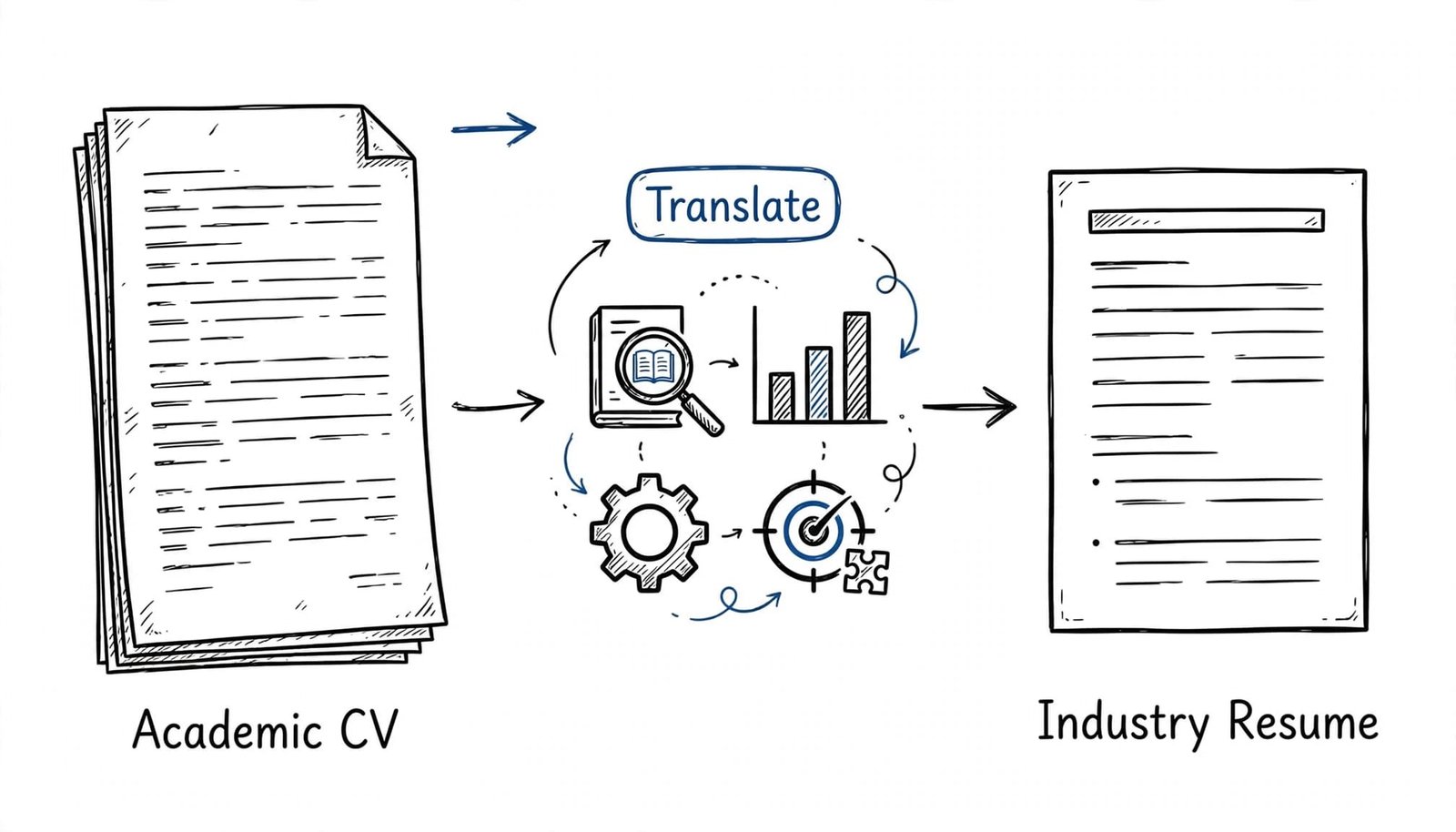
The academic CV industry resume conversion changes the document’s purpose, not just its length. Your academic CV documents your scholarly career. Your industry resume argues that you can deliver business, technical, operational, or customer value in a specific role.
Start by treating the job description as your brief, then translate your academic achievements into evidence an employer can use.
Key Takeaways
- An academic CV records your complete scholarly history, while an industry resume selects evidence that supports one target role.
- Start with the job description and translate research, teaching, grants, and service into relevant skills, outcomes, scope, and business value.
- Use quantified proof whenever possible, but never invent metrics; accurate details about project size, budgets, timelines, or teams are effective alternatives.
- Keep the resume concise, readable, and ATS-friendly with standard headings, simple formatting, relevant keywords, and selected academic achievements.
- Create a master resume, then tailor the order, language, and strongest evidence for each application while keeping your claims truthful.
Academic CV industry resume: change the message
An academic CV is comprehensive by design. It records publications, grants, teaching appointments, conference presentations, committee work, and education in depth. A faculty search committee often wants that full history.
An industry resume has a narrower task. It must show why you match one opening and why your past work predicts success in it. Hiring managers look for relevant evidence quickly, including soft skills that academic terminology can sometimes hide.
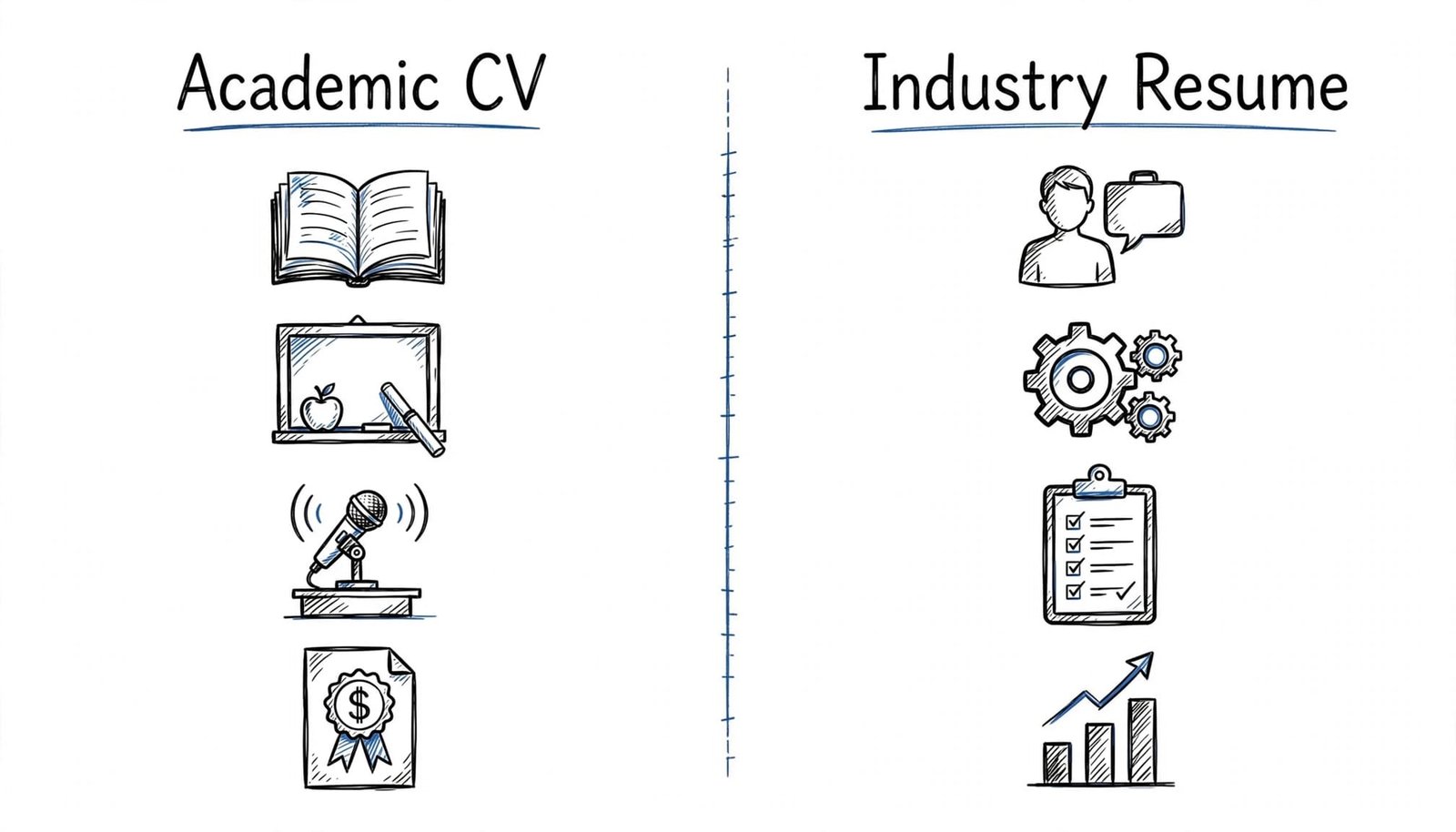
| Academic CV | Industry resume |
|---|---|
| Provides a complete scholarly record | Selects evidence relevant to one role |
| Gives prominence to publications and teaching | Gives prominence to skills, outcomes, and experience |
| Uses discipline-specific terminology | Uses language understood across the company |
| Often runs several pages | Usually fits one or two pages |
| Describes intellectual contribution | Describes business, technical, or operational value |
This doesn’t mean you should hide your academic work. Corporate positions usually reward selected evidence, so edit your history with purpose. For a clinical operations role, study coordination and data integrity may matter more than your dissertation title.
A resume is not an archive. Every line needs to support the job you want next.
Read the job description before editing a word
A generic resume turns your application into a guessing game. Before editing your academic CV, audit it against the posting. Pull the employer’s needs apart first.
Identify the work behind the job title
Job titles vary across organizations. “Research scientist” might mean experimental design at one company and client-facing analytics at another. Read the responsibilities, required tools, reporting relationships, and stated goals.
Use a simple three-step audit. First, highlight responsibilities and required tools. Next, group them into themes. Finally, map each theme to evidence from research, teaching, grants, or service. University career services can help decode unfamiliar industry titles or requirements.
Common themes might include customer research, cross-functional communication, prioritization, and roadmaps for a product manager role. A data science role may focus on SQL, dashboards, experimentation, and clear reporting. Include soft skills such as collaboration or stakeholder management when the posting emphasizes them.
Write those themes in plain language. They become the filter for every section of your resume.
Match terms without copying a keyword list
Use the posting’s key terms when they accurately describe your work. If a role asks for “stakeholder management” and you coordinated faculty collaborators, external partners, and student researchers, that term can fit.
However, don’t insert tools you haven’t used or claim ownership you didn’t have. These systems parse resume text, but employers still interview the person behind it. Workday’s overview of applicant tracking systems explains how these systems support the hiring process from job posting through candidate management.
A tailored resume makes relevant evidence easy to find. Use the job description to connect your qualifications and experience to employer needs without turning your background into fiction.
Translate research experience into business outcomes
Your research experience already contains valuable evidence. Reframe academic achievements around outcomes employers recognize.
The challenge is describing them without assuming the reader understands your field, methods, or journal rankings. A dissertation topic matters less than the project’s scope, methods, stakeholders, or decisions enabled by the work.
A non-academic reader may not know why a specialized technique matters. Explain the method and result in a non-academic context.
Replace research jargon with the work performed
Start with the action, then name the scope and result. Name hard skills, such as statistical analysis or laboratory techniques, alongside transferable skills employers recognize.
Communication, facilitation, collaboration, and adaptability are soft skills that can make those capabilities easier to see. Teaching experience can also demonstrate facilitation, communication, and adaptation for different audiences.
Here are common translations:
- Designed a dissertation study becomes “Designed and managed a multi-phase research project with defined milestones and data-quality controls, supporting consistent analysis.”
- Conducted archival research becomes “Synthesized complex primary-source data to identify patterns and produce evidence-based recommendations.”
- Led discussion sections becomes “Facilitated training sessions for groups of 25 students, adapting materials for varied learning needs and clarifying complex concepts.”
- Managed a lab becomes “Coordinated equipment, schedules, purchasing, and research workflows for a multi-person laboratory, keeping projects organized and procedures consistent.”
Select research experience that matches the target role. Then connect its method and scope to a decision, process, deliverable, or operational need.
The strongest version remains truthful while naming capabilities an employer recognizes.
Add scale, scope, and proof
Numbers help readers picture your work. You can quantify participants recruited, datasets analyzed, project duration, grant dollars supported, team members mentored, workshops delivered, or reports produced.
Quantified examples can also prove soft skills, rather than merely listing them as traits.
Write bullet points that lead with an action and finish with evidence or impact. Compare these academic and industry versions:
Academic version:
“Conducted research on microbial resistance and presented findings at conferences.”
Industry-focused version:
“Planned and executed laboratory studies on microbial resistance, analyzed results, and presented findings to interdisciplinary audiences to support next-stage decisions.”
Academic version:
“Analyzed survey responses to study community attitudes.”
Industry-focused version:
“Analyzed survey responses, identified audience patterns, and produced a report to support market-insight planning.”
Academic version:
“Managed a laboratory and maintained equipment.”
Industry-focused version:
“Coordinated equipment, purchasing, schedules, and quality-control workflows for a multi-person laboratory, maintaining consistent procedures across projects.”
Each industry-focused bullet still reflects the same work. These versions show project execution, analysis, communication, quality control, and decision support.
If you lack a percentage or revenue figure, don’t invent one. Use accurate scope instead: “analyzed 12 years of survey data,” “managed a $40,000 equipment budget,” or “trained six graduate students.”
Decide what stays and what becomes a link
A two-page resume can’t reproduce a complete academic CV. Selection shows judgment, especially when you’re changing careers.
Condense publications and presentations
Remove full publication lists unless the role directly values them. This often applies to research and development, medical writing, scientific communications, policy, and specialized consulting roles.
Treat publications, grants, talks, and awards as academic achievements to select, not items to list exhaustively. For roles that value scholarly credibility, include two or three relevant peer-reviewed publications.
For most corporate positions, create a short “Selected Publications” section, or link to your Google Scholar, ORCID, personal portfolio, or LinkedIn profile. Use a clean hyperlink in your contact line when the application system allows it.
Conference talks follow the same rule. Keep presentations that demonstrate topic expertise, client communication, or recognized thought leadership. For management consulting, prioritize evidence of synthesis, problem solving, and clear communication.
Recast teaching experience, service, and grants
Teaching experience can support learning and development, customer success, sales enablement, consulting, and people management. Describe curriculum design, facilitation, mentoring, feedback, and learning outcomes. These examples also make your soft skills easier to recognize.
Grant work can show budgeting, proposal writing, resource planning, and collaboration. Committee service can show process improvement or governance. Still, delete entries that don’t reinforce the target role.
Your industry resume shouldn’t make a recruiter decode a decade of academic terminology. It should help them quickly spot the evidence that meets the target employer’s needs.
Build an ATS-friendly resume that people can scan
Applicant tracking systems need readable text, while recruiters need a layout that makes key evidence visible. Simple formatting supports both needs.
Use a familiar resume structure
Place your name, phone number, professional email, city and state, LinkedIn URL, and portfolio link at the top. Follow with a short professional summary that connects your background to the target role.
Next, add a core skills section with hard skills such as technical tools, methods, programming languages, laboratory systems, and analytics platforms. Support soft skills with evidence, including communication and collaboration, rather than unsupported self-descriptors.
Use the professional experience section to list academic and industry roles. Arrange them in reverse chronological order, including research roles, teaching experience, internships, consulting, volunteer work, and postdoctoral research appointments. Use mentoring graduate students or training colleagues to show leadership when relevant.
Use standard headings such as “Professional Experience,” “Education,” “Skills,” and “Selected Publications,” with plain text that applicant tracking systems can parse. Avoid text boxes, graphics, decorative fonts, and essential details in headers or footers.
Keep the document concise and readable
One page works well for many graduate-level candidates and early-career professionals. Two pages are reasonable when you have substantial relevant experience, technical depth, or leadership history.
Use a standard font such as Arial, Calibri, or Times New Roman. Keep dates, locations, and job titles consistent, and maintain reverse chronological order within the experience section. A one-column document is often the safest choice for parsing and review.
If you’re applying through Greenhouse, a Greenhouse ATS formatting guide can help you check common parsing issues before submitting, but confirm that it reflects current 2026 practices. Formatting won’t replace strong content, but poor formatting can hide it.
Tailor each application without rewriting your history
Start with a master resume that preserves your complete academic CV and full range of achievements. Then create a targeted version for each serious application.
Change the order before changing the facts
For data science, move hard skills, including Python, R, SQL, model development, visualization, and data governance, higher. For management consulting, prioritize client communication, ambiguous problem solving, project timelines, and cross-functional collaboration.
Keep each role in reverse chronological order, but present the same research experience differently by role. Change its order, language, and strongest proof by role; move relevant professional experience higher, and condense less relevant material.
An AI resume tailoring workflow can compare your draft with the job description and surface missing key terms or weakly supported claims. Review every suggestion against the posting and your actual experience, then remove unsupported claims.
After tailoring, ask career services, a trusted mentor, or an industry contact to review the result.
Connect the resume to the application and interview
Your resume opens the door, but your cover letter and interview should carry one coherent message. Use CareerScribeAI’s Cover Letter Generator to adapt your motivation to the company and role. Don’t repeat resume bullet points; add context about the company’s product, mission, or customer problem.
Then prepare stories that prove the soft skills you claim. Focus on moments when you handled setbacks, persuaded collaborators, managed deadlines, learned a new method, or made a recommendation from incomplete evidence.
CareerScribeAI’s job-description and interview preparation tools can connect resume language, application themes, and practice questions to the posting. Its AI Resume Builder can organize a targeted draft, and its Interview Prep Tools can generate questions from the same posting. That consistency makes the next step in your career trajectory easier to explain.
Frequently Asked Questions
What is the difference between an academic CV and an industry resume?
An academic CV provides a comprehensive record of publications, teaching, grants, presentations, and scholarly service. An industry resume is shorter and focuses on evidence that shows how you can deliver value in a specific role.
How should I describe research experience on an industry resume?
Lead with the work performed, then explain its scope, methods, and results in language employers recognize. Emphasize project execution, analysis, collaboration, communication, quality control, and decisions or deliverables supported by your work.
Should I include publications on an industry resume?
Include only selected publications when they demonstrate expertise relevant to the target role, such as research and development, medical writing, policy, or scientific communications. For most corporate positions, use a short selected list or link to a professional scholarly profile.
How long should an industry resume be after an academic career?
One page is suitable for many graduate-level and early-career candidates, while two pages are reasonable for substantial relevant experience or technical depth. Remove details that do not support the target role rather than trying to reproduce your complete academic CV.
How can I make my academic resume ATS-friendly?
Use standard headings, plain text, readable fonts, a one-column layout, and keywords that accurately match the job description. Avoid text boxes, graphics, decorative fonts, and essential information in headers or footers.
Final thoughts on moving beyond the academic CV
Starting with an academic CV, build an industry resume that serves as a bridge to your next career trajectory. It should make relevant evidence easy for hiring managers to act on, especially in a non-academic context.
Your academic achievements still matter, but their value must connect to the role. Lead with relevant skills, follow with quantified proof, and remove distracting detail so your qualifications and experience are obvious for the target role.