

One embellished line can unravel an otherwise strong application when an interviewer asks for proof. That is why AI resume tailoring should sharpen your evidence, not decorate it.
Most applicant tracking systems parse your document into fields, while some assess language alignment with role criteria. A tailored resume helps relevant evidence surface and keeps the resume ATS friendly, but keyword overlap can’t prove you did the work. Start with your records, then let AI organize, prioritize, and rewrite only what you can defend.
Key Takeaways
- Start AI resume tailoring with a private evidence bank containing only verifiable employers, dates, responsibilities, skills, projects, and outcomes.
- Use AI to reorder, clarify, and prioritize proven experience, but never allow it to invent metrics, credentials, tools, employers, dates, or accomplishments.
- Map each job requirement to real proof from your background, and leave unsupported claims out of the tailored resume.
- Choose tools that provide editable suggestions, ATS-friendly formatting, and visibility into what changed rather than relying on autopilot.
- Fact-check every AI-edited line, preserve a clear employment timeline, and review the final resume as if you were answering interview questions about it.
Begin Resume Tailoring With Evidence
AI can reorganize your experience around a job description, spot relevant resume keywords, and remove vague phrasing. It cannot know what happened at your previous job unless you give it the facts.
For a job seeker, keep a private evidence bank before you tailor anything. Include employers, job titles, dates, projects, tools, responsibilities, work experience, and hard and soft skills supported by records or verifiable training. Add confirmed outcomes and performance data you can explain, with context such as the report, dashboard, or manager who can verify each metric.
What AI may change, and what it must never create
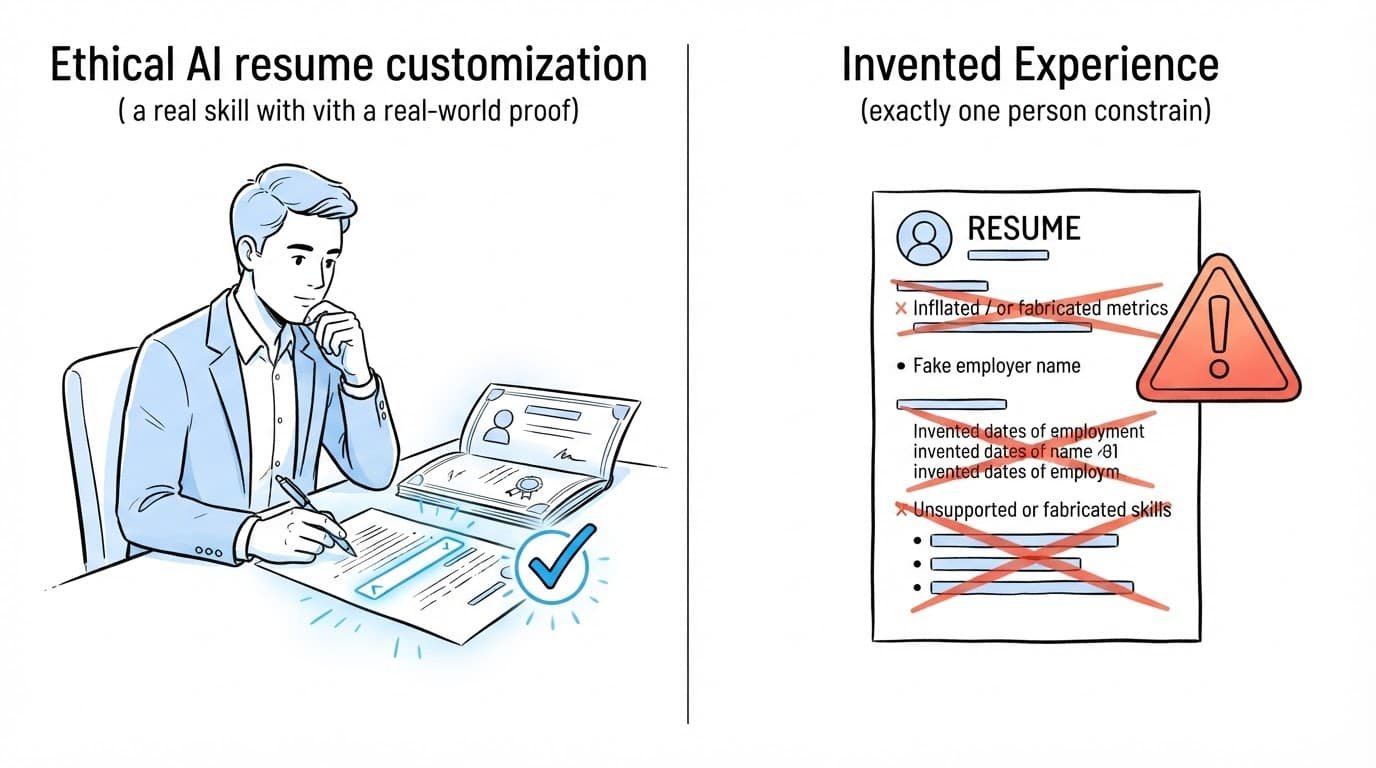
AI may reorder bullets, tighten wording, mirror a job title, and surface skills already supported by your work history. It can also suggest a clearer professional summary.
However, it must never invent accomplishments, qualifications, metrics, employers, dates, credentials, certifications, or skills you cannot substantiate. A polished lie is still a lie, and it can damage your credibility long after an ATS scan.
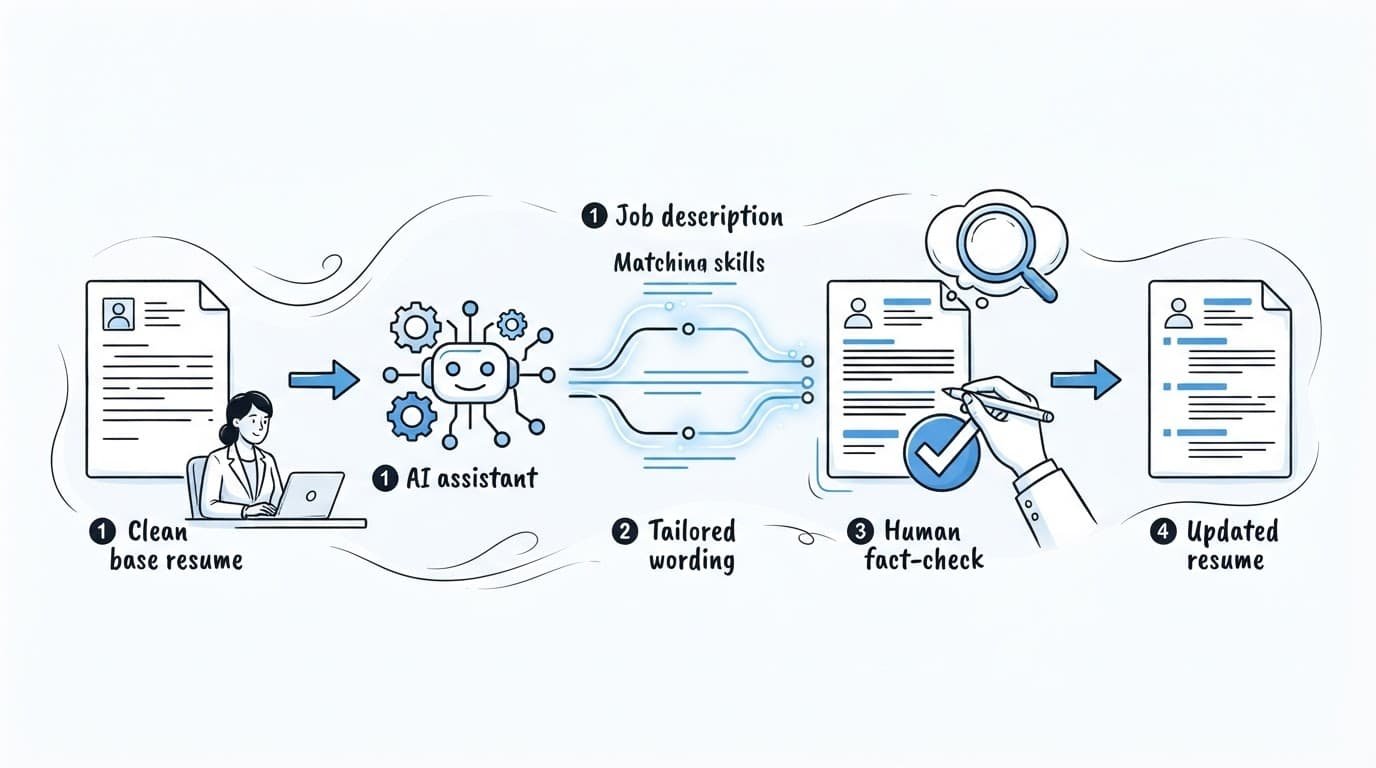
A match score measures language alignment. It does not verify that a candidate has the experience behind those words.
Map the Job Description to Real Proof
Read the job description once before editing your resume. Mark the required tools, recurring responsibilities, industry terms, and stated outcomes. Then match each item to a line in your evidence bank.
The MIT guidance on ATS-friendly resumes describes applicant tracking systems as databases that parse resume information, reinforcing an ATS friendly approach. Clear headings and accurate terminology support evidence-based keyword optimization better than stuffing every phrase into your document.
Build a simple proof map
Create two columns: “job requirement” and “proof from my background.” This simple map makes resume tailoring a direct match between requirements and proof. List a supporting project, task, or training for each job description requirement, and leave unsupported claims out of your tailored resume.
This process reveals genuine skill gaps. You might have adjacent experience, such as maintaining customer data in HubSpot rather than Salesforce. AI may frame that experience as relevant to Salesforce, but it shouldn’t present it as direct experience.
Keep a chronological resume as your anchor
A reverse-chronological resume gives recruiters a quick view of employers, titles, and progression. It also keeps dates easy to verify, which supports recruiter expectations for a clear timeline.
Functional resumes can help explain a career change or nontraditional background. Still, don’t replace a clear employment history with a generic resume; include employer names and dates. Hiding a timeline often creates more questions than it answers.
Use Prompts That Set Firm Boundaries
Vague AI prompts invite vague output. Give an AI resume writer the job description, your evidence bank, and explicit limits. Ask for a draft, then require a human edit before treating it as final copy.
A prompt for truthful resume writing
“Using only the evidence below, identify requirements I can support. Rewrite my bullets with relevant keywords and concise action verbs. Suggest a professional summary only from verified evidence. Do not add metrics, tools, employers, dates, credentials, responsibilities, or outcomes. Flag unsupported requirements as gaps.”
Save the AI prompts alongside each draft so you can audit or reproduce the rewrite later.
For a bullet rewrite, provide the original fact first. A basic line such as “Documented recurring setup questions for the support team” can become “Created onboarding documentation from recurring setup questions, giving support staff a shared reference.” The revision improves clarity without claiming an unmeasured business result.
The CAR method also keeps bullets grounded:
- Challenge: State the real problem, need, or situation.
- Action: Describe what you personally did.
- Result: Include quantifiable results only when you can verify them.
If you lack a number, use a concrete result without inventing one. “Reduced duplicate support requests” is only valid if you know that happened. Otherwise, write “Maintained a troubleshooting guide for recurring support questions.”
Choose AI Tools for Control, Not Autopilot
A tool that produces suggestions in seconds still needs your review. Look for tools that analyze a job description, offer editable keyword suggestions, support version control, and use ATS-safe formatting. They should show each AI enhancement and what changed, rather than rewrite your materials on autopilot.
Published plan details in August 2026 show how features vary. Verify current plans, prices, and feature availability before publication.
| Tool | Useful starting point | Published plan detail |
|---|---|---|
| Rezi | Keyword targeting and ATS checking | Free plan includes one resume; Pro lists $29 per month |
| Teal | Resume parsing and job matching | Its Resume Parser is free; Teal+ lists plans from $13 per week |
| CareerScribeAI | Resume analysis, cover letter, and interview practice | Compare your resume with a posting before rewriting |
CareerScribeAI’s resume and job-description workflow can help you identify must-have skills, missing requirements, and likely interview topics. Its AI Resume Builder and Interview Prep Tools can compare your resume with a job description before rewriting. The ATS match score is directional, so review the result against verified career facts.
Run a Final Fact-Check Before Applying
Before submitting the job application, inspect every AI-edited line from resume tailoring:
- Confirm each number against a report, spreadsheet, or reliable record.
- Check that every skill appears in your actual work, education, or training.
- Verify employer names, job titles, dates, and certification details.
- Remove any keywords or terminology that don’t describe your experience.
Finish with a human edit. Read the resume aloud and replace phrasing you wouldn’t use in an interview.
Fact-checking is the final stage of resume optimization. Formatting matters too. For an ATS friendly resume, Indeed’s ATS resume advice recommends clear section labels, standard fonts, and avoiding tables or graphics. Save a clean one-column version for online applications. After a PDF export, open the file and confirm that dates, spacing, headings, and text remain readable.
Frequently Asked Questions
Can AI tailor my resume without inventing experience?
Yes, if you provide verified facts and set firm boundaries in the prompt. Review every suggested change and remove anything you cannot explain or substantiate.
What information should I give an AI resume tool?
Provide the job description and an evidence bank with your employers, titles, dates, projects, responsibilities, tools, skills, and confirmed outcomes. Do not rely on the tool to infer facts that are missing from your records.
How can I improve ATS matching ethically?
Use accurate terminology from the job description when it reflects your real experience. Clear headings, standard formatting, and relevant keywords are more reliable than stuffing unsupported phrases into the resume.
Should I include a skill I have used in a different tool?
You can describe adjacent experience accurately, but do not present it as direct experience with the employer’s tool. For example, explain that you maintained customer data in HubSpot rather than claiming Salesforce experience.
How do I fact-check an AI-tailored resume?
Verify every number, skill, employer, title, date, and credential against a reliable record. Then read the resume aloud and remove wording you would not be able to defend in an interview.
Let AI Clarify Your Record
The strongest application is easy to scan and easy to defend. AI resume tailoring can make relevant work visible without changing the facts.
Use AI enhancement to clarify how your proven experience is presented, not to change the underlying record. Clearer evidence may improve a reader’s response and support interview callbacks, but no tool guarantees an interview. Keep the evidence, details, and voice unmistakably yours.