

When deciding whether to include GPA resume details, remember that a GPA, or grade point average, can support an entry-level application. It demonstrates academic performance, but it shouldn’t outweigh current evidence of ability or become the headline for a hiring manager.
Academic results may still matter for students and a recent graduate applying for entry level roles. A college GPA summarizes performance across courses, rather than representing one letter grade. A high school GPA is generally relevant only with limited college or professional history. Once you build professional experience, current qualifications usually offer stronger evidence than academic performance.
Key Takeaways
- Include your GPA when it is recent, strong, required by the employer, or useful for an early-career application.
- Use your cumulative GPA by default, or list a clearly labeled major GPA when it is materially higher and directly relevant to the role.
- Place the GPA in the Education section, use an ATS-friendly text format, state the grading scale, and match your official transcript exactly.
- Don’t round up or convert an international GPA without an approved basis; accuracy protects your credibility.
- If your GPA is low, emphasize relevant coursework, honors, projects, internships, certifications, leadership, and other evidence of ability.
When to Include GPA Resume Information
Use the “include GPA resume” decision if you’re a student, recent graduate, or see a GPA request in a posting. Industry, seniority, and employer requirements should guide you. Campus-recruited fields may place more emphasis on academic performance, including investment banking, consulting, accounting, engineering, research, and some legal roles.
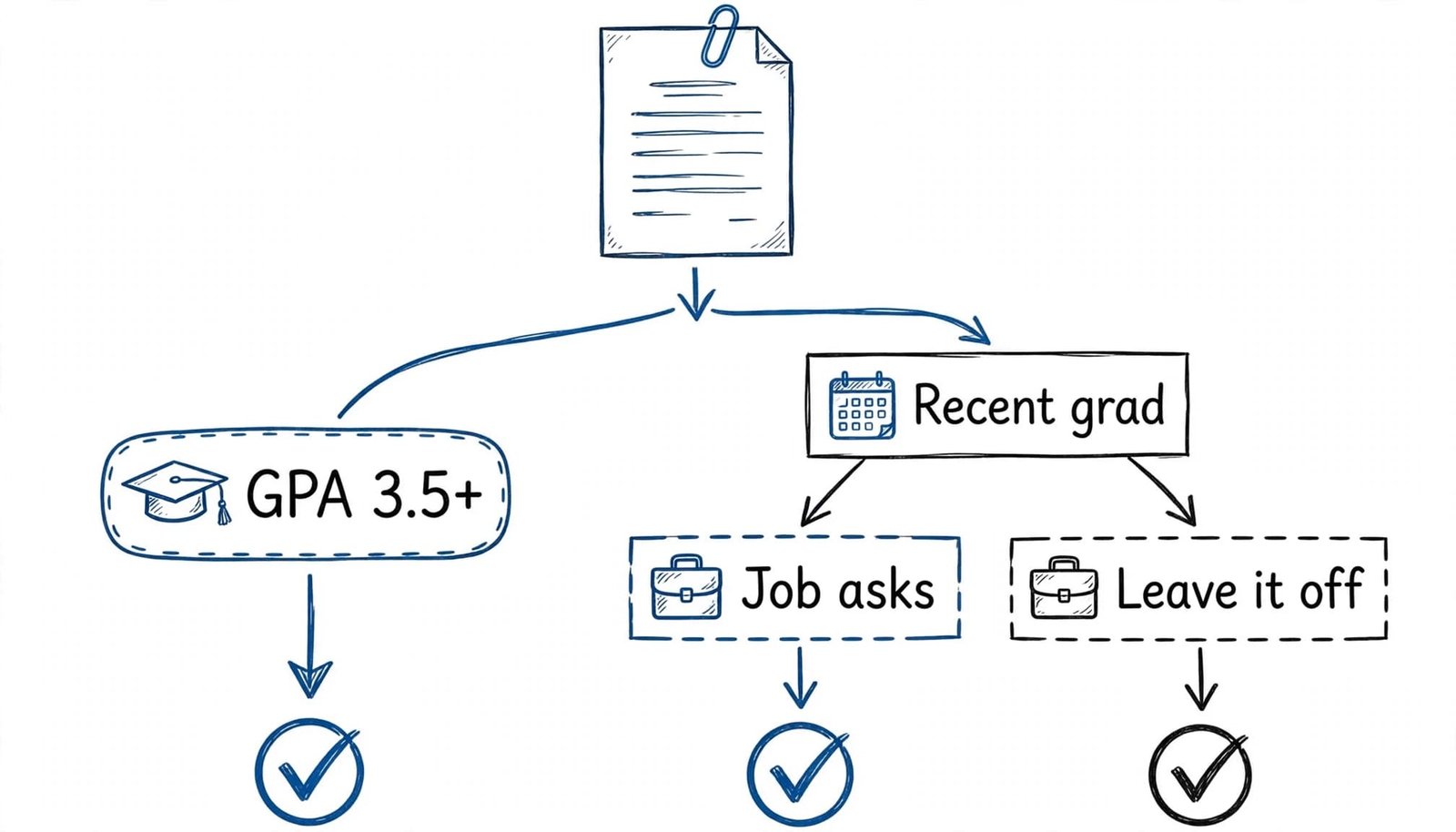
A grade point average of 3.5 or higher on a 4.0 scale is a useful guideline, not a universal hiring rule. Some university career centers recommend listing above 3.0, but standards vary, and some employers don’t screen by GPA. A hiring manager may view a strong GPA favorably, while a weak one can make other evidence more important.
High school GPA is usually relevant only if you lack a college record or substantial work history.
Keep GPA for early-career applications
Your GPA is most useful when you have limited experience. A current student with one internship may need it to show academic performance, discipline, and subject knowledge. After several years, strong work experience usually matters more.
Remove it after about three years of full-time professional experience, unless a position explicitly asks for it. In that period, prioritize achievements such as revenue generated, projects delivered, patients served, process improvements, or technical skills.
Follow the job description
Some graduate programs, rotational programs, and analyst positions request a minimum GPA. When a job application requests a number or transcript, list it clearly and provide transcripts if requested later.
Before submitting in a technical or finance role, check the posting. If the employer doesn’t ask and your GPA is weak, leave it off and use the space for stronger qualifications.
A GPA is optional unless an employer requests it. Once work accomplishments tell a stronger story, let them take the space.
Choose Between Cumulative GPA and Major GPA
Your grade point average summarizes your course performance. Your cumulative GPA includes every class you completed. It’s the default choice because an unlabeled GPA usually implies this figure.
A major GPA can make more sense when it’s materially higher and directly related to the role. For finance, engineering, data, and other specialized applications, it can highlight academic performance in relevant coursework. For example, an economics graduate applying for a financial analyst role may list a 3.8 major GPA, even if the overall average is lower.
Label every GPA accurately
A numeric GPA provides more precise context than a letter grade, so don’t replace it with one. Never write GPA: 3.8 when 3.8 applies only to your major. Clear labels protect your credibility and help recruiters understand the context.
Use one of these formats:
Cumulative GPA: 3.72/4.00Major GPA: 3.80/4.00Overall GPA: 3.45/4.00 | GPA for major coursework: 3.82/4.00
If you list both, label the cumulative GPA and the major-specific figure separately. Don’t add a weaker overall figure beside a stronger major-specific figure unless an employer requests both.
International graduates should follow the grading scale shown on their academic transcripts. Report the original scale instead of performing an unsupported conversion. For example, write GPA: 8.6/10.0 rather than converting it yourself to a U.S. 4.0 scale. Letter grade equivalents vary by institution, so employers can interpret the record or request an approved credential evaluation.
Format GPA in the resume education section
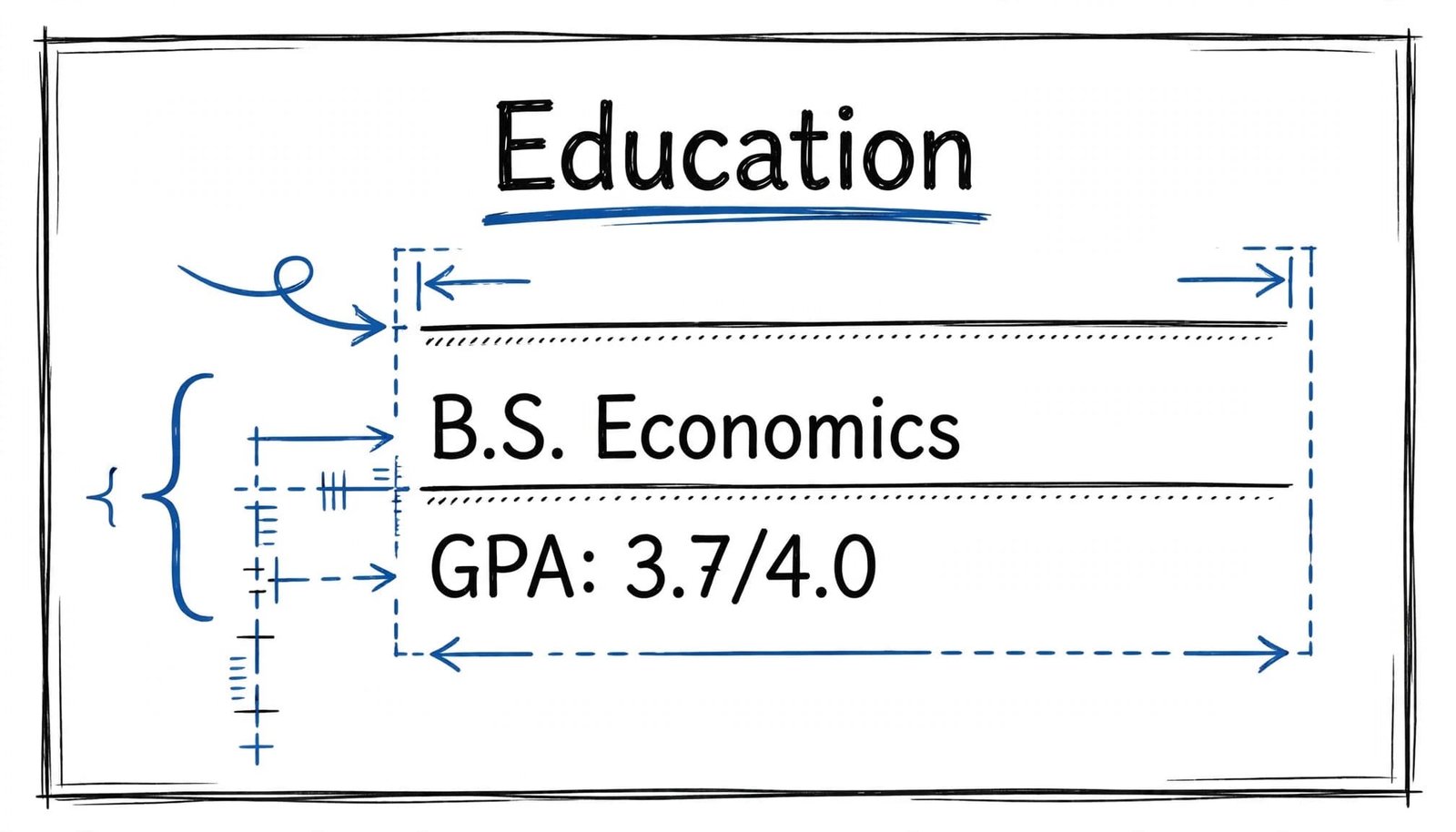
Place your GPA below your degree and graduation date in the Education section. Keep the entry compact so it doesn’t distract from academic honors, such as a dean list distinction, relevant coursework, or internship experience.
Use a simple, ATS-friendly layout
A clear entry might look like this:
University of Michigan, Ann Arbor, MI
Bachelor of Science in Data Science, May 2026
GPA: 3.74/4.00, Honors: Dean’s List, 2024-2026
Relevant Coursework: Machine Learning, Data Visualization
Use a standard text layout instead of graphics, tables, or a separate GPA heading. Applicant tracking systems read standard section labels more reliably, and recruiters can find your education quickly.
CareerScribeAI’s AI resume-tailoring guide can help you match coursework, projects, and skills to a job description without inventing experience. Review every suggested line against your actual academic record before applying.
Don’t round up your GPA
Use the number shown on your official transcript. A 3.46 isn’t a 3.5, and a 3.67 isn’t a 3.7 unless your school officially rounds it that way.
Employers can request verification during hiring, and background checks may verify education details. FERPA restricts schools from releasing non-directory student records without appropriate consent, as explained in the U.S. Department of Education’s student records FAQ. You may still need to provide a transcript directly or authorize an employer’s verification request, so report the figures accurately.
What to Use Instead of a Low GPA
A low GPA does not end a job search. It means your resume should emphasize evidence that better reflects your readiness and academic performance.
Choose the strongest evidence of academic performance for each job application:
- Relevant coursework, capstone projects, research, or a senior thesis can show job-related knowledge and academic achievement.
- Academic honors such as cum laude and magna cum laude can add value without displaying your overall number.
- Internship experience, campus employment, volunteer work, certifications, and other work experience give employers proof that you can perform in a work setting.
- Leadership in extracurricular activities, student organizations, or campus service can demonstrate initiative, collaboration, and responsibility.
If you have limited college or work history, decide whether your high school GPA belongs on the resume. Otherwise, replace it with stronger, job-related evidence.
When listing education, report your school, degree, dates, and honors accurately. Keep the focus on verifiable details and relevant accomplishments.
CareerScribeAI’s AI Resume Builder, Cover Letter Generator, and Interview Prep Tools are optional ways to organize factual examples and keep application materials consistent.
Frequently Asked Questions
Should I include my GPA on my resume?
Include it if you are a student or recent graduate with a strong GPA, or if the job posting requests it. A GPA is usually less important after you have several years of full-time professional experience.
What GPA is worth putting on a resume?
A GPA of 3.5 or higher on a 4.0 scale is a useful guideline, but there is no universal cutoff. Employer expectations vary by industry, role, and application process.
Should I list my cumulative GPA or major GPA?
List your cumulative GPA by default because it represents all completed coursework. A major GPA may be more effective when it is significantly higher and directly related to the position, but label it accurately.
Where should GPA appear on a resume?
Place it below your degree and graduation date in the Education section. Use a simple text format such as GPA: 3.74/4.00 so recruiters and applicant tracking systems can read it easily.
What should I include instead of a low GPA?
Emphasize relevant coursework, academic honors, projects, internships, certifications, leadership, and measurable work achievements. These details can provide stronger evidence of your skills and readiness for the role.
Final Thoughts
The best strategy for your grade point average is simple: include it when it’s recent, strong, or required. A recent graduate can use it strategically, formatting it clearly, stating the scale, and matching the official transcript exactly.
As work experience grows, academic performance matters less than professional results. Update your resume as professional growth continues, giving professional experience and current achievements priority.