

Your strongest project may be the one you cannot name. A confidential work resume should show your judgment and results without exposing information protected by an employer, client, or agreement.
The answer isn’t bland job descriptions. Describe your role, methods, scope, and verified outcomes, such as authorized revenue growth or a generalized result. Keep those results public, approved, or generalized enough to protect the project. Separate what you did from the confidential context around it. Executive resume writers can support your executive job search without requesting protected details, while you control the facts shared.
Key Takeaways
- Review NDAs, employment documents, client terms, and post-employment obligations before adding confidential work to your resume.
- Replace protected names, codenames, exact figures, proprietary methods, and unreleased details with truthful generalized descriptions.
- Preserve credibility by showing your ownership, scope, skills, and verified outcomes without inventing metrics or implying work you did not perform.
- Use approved keywords, standard headings, and ATS-friendly formatting while keeping confidential details out of public profiles and job boards.
- Discuss responsibilities, tools, leadership, and safe outcomes in interviews, but calmly maintain boundaries around protected information.
Build a Resume That Still Shows Results
An NDA resume can list your employer, title, dates, team leadership, and broad responsibilities. However, the definition of confidential information in your documents controls what you can share.
UTA’s NDA FAQ describes the core obligation clearly: recipients must protect covered information and avoid disclosing it. Review applicable non disclosure agreements, your offer letter, client terms, employee handbook, project policies, and severance agreement before adding a detail. Check post-employment obligations rather than assuming they ended.
Know what needs to disappear
Remove client names when they are not public, along with internal codenames, proprietary data, business secrets, source code, algorithms, unreleased product plans, pricing, profit margins, internal dashboards, and non-public financial figures.
A customer listed in your employer’s press release may be safer to mention, but only if your agreement permits it and your involvement is already public. Confidentiality clauses can also reach further than traditional trade secrets, as the Yale Law Journal’s discussion of confidentiality agreements makes clear.
If a detail lets an outsider identify the client, product, strategy, or unpublished result, treat it as sensitive until you confirm otherwise.
Obligations vary by agreement, industry, jurisdiction, and applicable law, and an unauthorized disclosure may lead to legal action. Healthcare, legal, financial, government, and defense work can involve added restrictions. Review your documents and consult qualified counsel when the boundary is unclear.
Should This Detail Go on Your Resume?
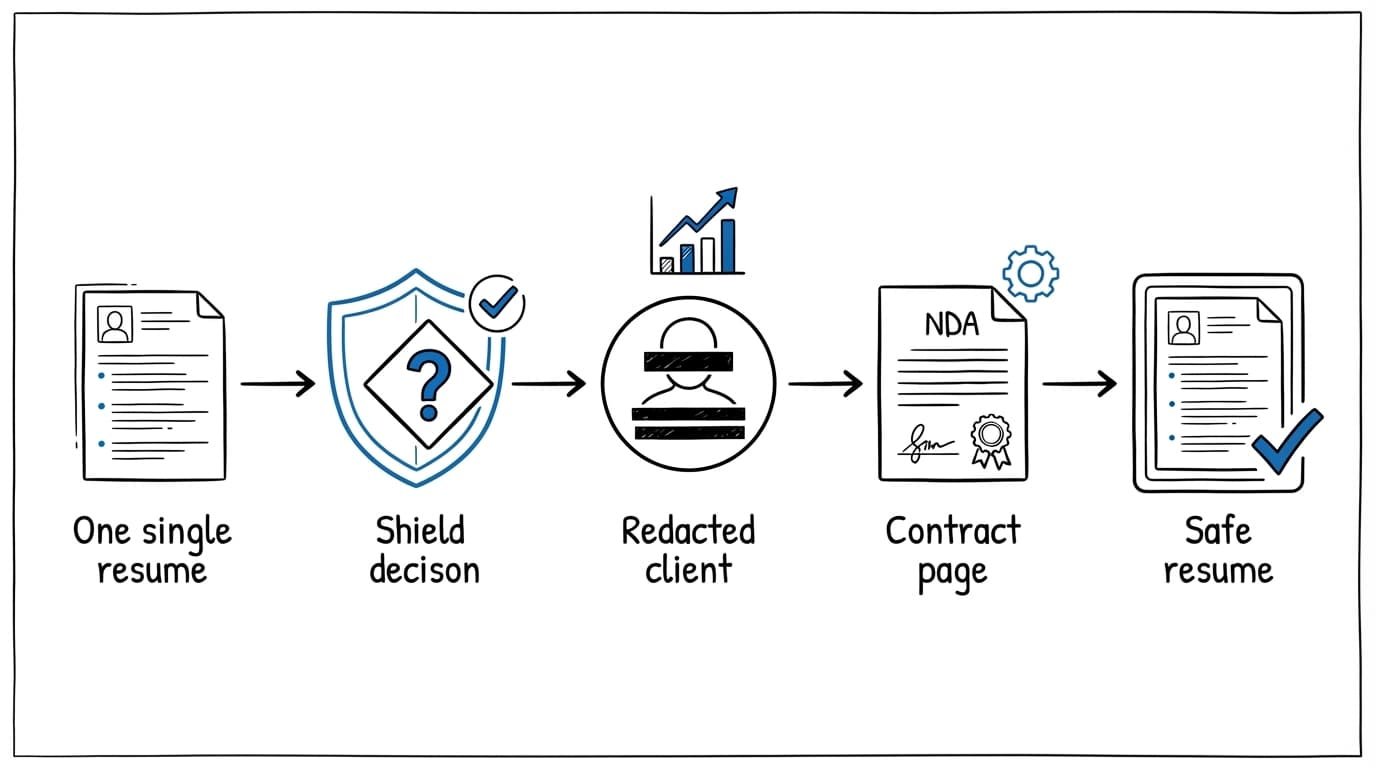
Resume confidentiality deserves a short review before every new bullet, especially during an executive job search. One distinctive bullet can expose a recognizable project, so preserve credible evidence without creating a clue sheet.
Complete this review on personal time rather than company time.
Use this review sequence
- Identify the protected element. It might be a client identity, an internal baseline, an unreleased feature, or a unique process.
- Replace names with broad, truthful generic descriptors, such as “multinational retailer,” “regional health system,” or “private financial-services client.”
- Convert exact figures into approved percentages, rounded ranges, or operational outcomes to preserve quantified achievements. A percentage can still expose sensitive data, so remove it if the project was small or the result was unpublished.
- Read the bullet as a competitor would. If the industry, location, team size, and result point to one obvious project, broaden the language again.
- Keep the skills that employers search for, but only when accurate. Tools such as SQL, Salesforce, Python, budgeting, stakeholder management, or Agile delivery are often safe to name.
The approved wording should also support honest answers to interview questions without revealing protected details.
Turn Confidential Work Into Safe Resume Bullets
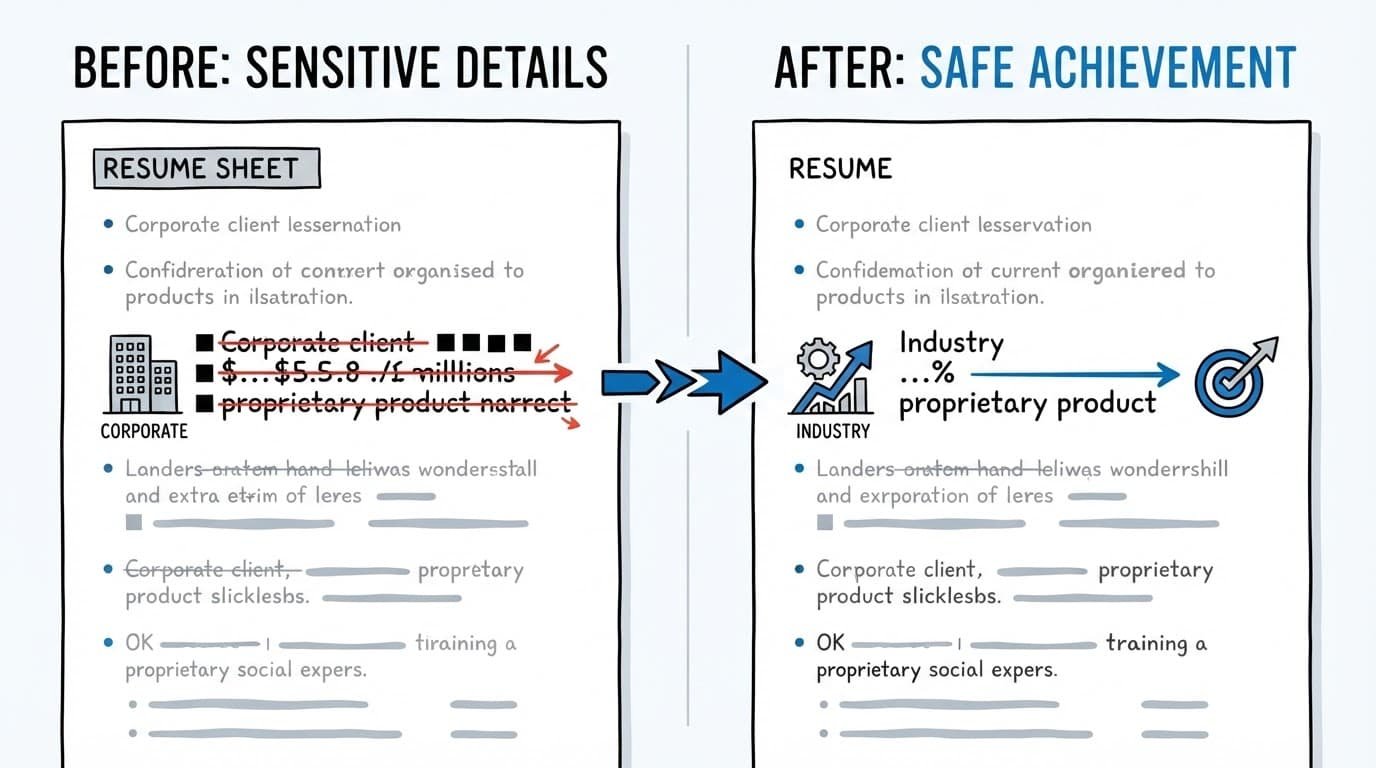
Strong anonymized resume bullets keep the action, scope, and outcome. They remove protected subject matter, exact internal data, and unique identifiers.
Keep the achievement, remove identifiers
| Risky wording | Safer resume wording |
|---|---|
| Led Project Ember for Acme Bank, using the firm’s fraud algorithm to prevent $4.8M in losses. | Led a 12-person engineering team for a financial-services client; reduced manual-review time by about 30%. |
| Built an unreleased feature for the company’s 2027 product launch. | Coordinated a cross functional team for a pre-launch B2B software product and met launch-readiness milestones. |
| Renegotiated Vendor X’s contract, saving $1.2M against the internal procurement target. | Improved a vendor onboarding process and cut approval-cycle time by 25%. |
Each sanitized resume bullet should still answer three questions for hiring managers: What did you own? How large or complex was the work? What changed because of your effort?
Avoid vague phrases such as “worked on confidential projects.” They tell employers nothing. Use outcomes such as revenue growth only when they’re public or approved. If metrics are off limits, show scope through team size, user type, delivery cadence, system complexity, or responsibility level. Never invent a number or imply ownership you didn’t have. A resume lie can end candidacy quickly and create a larger problem during reference checks or interviews.
Protect Resume Confidentiality Without Losing ATS Keywords
Sanitized language can still perform well in applicant tracking systems. ATS software reads plain text for role titles, tools, certifications, and job-related skills. It doesn’t need a client name to recognize your experience.
Match role language with truthful skills
Keep standard headings such as “Work Experience,” “Skills,” and “Education.” Use a clean, single-column layout and keep key details in selectable text. Avoid common resume mistakes, especially formatting mistakes involving graphics, headers, footers, or non-selectable text.
Then mirror the job description’s truthful wording for tools and skills you actually used. For example, a data analyst can write “SQL reporting and dashboard development” to describe the role’s tech stack. They can add “stakeholder analysis” without exposing the company’s data model. CareerScribeAI’s AI resume tailoring without fabrication can help compare sanitized experience with a posting while keeping your own facts in control.
Professional resume services, including executive resume writers, should work from generalized, approved notes rather than requesting client files or unreleased documents. Never upload client files, internal dashboards, code, an NDA, or unreleased documents into an AI tool. Use the AI Resume Builder only with safe, generalized notes. The Cover Letter Generator and Interview Prep Tools should also use the same approved language.
Keep your job search private
Use a personal email address and phone number for applications, and share your resume directly with vetted recruiters. Don’t broadcast sensitive project details on a public LinkedIn profile or job board. Vetted recruiters may also help you reach the hidden job market.
When an interviewer asks for more detail, state the boundary calmly. You can discuss your responsibilities, tools, leadership approach, and outcomes, but not protected client or product details. A practical job search plan for full-time workers can help organize applications and outreach outside company time, without drawing attention at your current job.
Frequently Asked Questions
Can I list confidential work on my resume?
Yes, you can describe confidential work when the wording protects restricted information and complies with your agreements. Focus on your role, scope, methods, skills, and public, approved, or safely generalized outcomes.
Should I name a confidential client or project?
Do not name a client, project, product, or internal codename unless the information is public and your agreement permits you to share it. Use broad descriptors such as “multinational retailer” or “financial-services client” when appropriate.
How can I show results without sharing exact numbers?
Use approved percentages, rounded ranges, or operational outcomes only when they cannot identify the project or expose protected data. If metrics are not safe to share, demonstrate scope through team size, user type, delivery cadence, system complexity, or responsibility level.
Can confidential resume language still work with ATS software?
Yes, ATS software can recognize truthful job titles, tools, certifications, and skills without needing confidential client names. Keep standard headings, use selectable text in a clean layout, and mirror relevant wording from the job description.
Final Thoughts
A credible confidential work resume is specific about your contribution and careful about what belongs to someone else. Broad client descriptors, safe metrics, and clear skills give employers enough evidence to assess your fit.
Keep resume drafting, applications, and outreach outside company time. If you hire a resume writer or executive resume writers, vet their judgment and confirm they respect approved facts and confidentiality boundaries.
Protecting proprietary information doesn’t make your experience less valuable. It shows sound judgment, and that judgment belongs on the page.