

Your resume format can make strong experience look scattered or make a career change look more credible. The best layout makes relevant evidence easy to verify during your job search and supports your career goals.
The chronological vs functional resume choice comes down to one question: does your experience already tell a clear story for the job you want? If neither approach provides enough context, a hybrid resume can balance both.
Key Takeaways
- A chronological resume is usually the clearest choice when your recent experience aligns with the role and shows steady progression.
- A functional resume can help organize genuinely fragmented experience, but it should not hide employers, dates, or employment gaps.
- A hybrid resume combines targeted skills with a visible reverse-chronological work history, making it useful for career changers.
- Any format should use standard sections, job-description keywords, quantifiable achievements, and an ATS-friendly layout.
Chronological vs Functional Resume: The Real Structural Difference
A resume is more than a record of past jobs. It is a short, evidence-based case for why you can do the next job. Each resume format makes that case in a different way.
How a chronological resume is organized
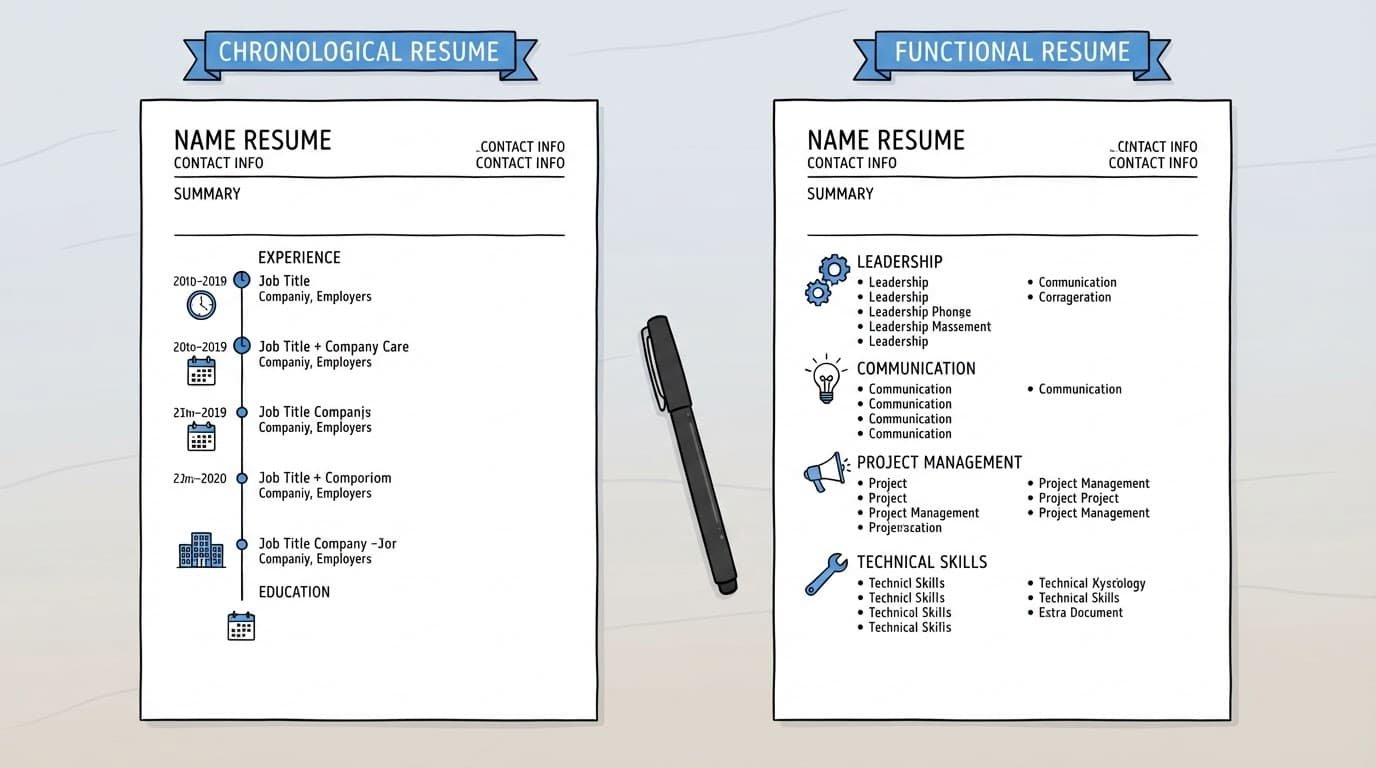
A chronological resume, usually written in reverse-chronological order, puts your most recent position first. Each job entry includes the employer, job title, location, dates, and accomplishment-focused bullet points.
Most chronological resumes follow this order:
- Contact information and a professional headline.
- A short professional summary.
- Core skills that match the target role.
- Professional experience in reverse-chronological order.
- Education, certifications, and relevant training.
This layout makes promotions, increased responsibility, and steady performance easy to spot. For someone applying for a similar role in the same field, it is usually the clearest option.
How a functional resume is organized
A functional resume, also called a skills-based resume, puts capabilities ahead of employers and dates. This resume format puts skill categories such as “Project Management,” “Client Relations,” or “Financial Analysis” first. Dates and employers move behind those capabilities, while bullets describe related achievements.
Work history may appear near the bottom in a shortened list. That structure can bring relevant skills forward, but it removes the context a hiring manager needs to judge where and when those skills were used.
The central tradeoff is simple: the functional format spotlights abilities, while the chronological format shows the career path behind them. A hybrid resume can bridge those priorities, as the next section explains.
Why the chronological format remains the default
Recruiters often need to answer practical questions quickly. What have you done recently? How long did you hold each role? Did your responsibilities grow? A chronological resume presents your experience in reverse-chronological order, so this resume format answers those questions without making the reader hunt.
Career progression becomes easy to see
A clear timeline works in your favor when you have advanced within an organization or moved into roles with greater scope. For example, a progression from coordinator to manager to senior manager shows momentum without needing extra explanation.
Even if job titles changed little, accomplishment bullets can show growth. A later role might include a larger budget, more direct reports, a wider territory, or ownership of a new process.
Keep bullets tied to quantifiable results. “Managed monthly reporting” is vague. “Reduced the monthly reporting cycle from eight days to five” gives the reader evidence.
A work history adds useful context
Dates and employers do not merely fill space. They tell a hiring manager whether your skills are recent, whether they were used in a regulated setting, and how your responsibilities fit the organization.
Reverse chronology also tends to work well with an applicant tracking system. Resume.io’s ATS format guide explains that job titles and dates in a familiar pattern are easier for parsing software to recognize.
That does not mean every chronological resume is effective. A long list of duties still reads flat, even when recent work history appears first. Use the structure to show a sequence of results, not a job-description archive.
When a functional resume can help, and when it can hurt
A functional resume is useful in a narrow set of situations. This resume format can organize relevant skills from several short projects, contract work, volunteer leadership, training, military service, or independent work. It can document a fragmented work history clearly.
Use functional sections when experience is genuinely fragmented
A candidate returning after years of caregiving may have recent training, volunteer work, and previous roles that support the target position. Grouping those transferable skills can create a stronger picture.
The same approach can help an early-career job seeker whose relevant work came through internships, coursework, campus leadership, and freelance assignments. In that case, a skills-based resume may be more useful than a sparse employment timeline.
Still, grouped professional skills need evidence. Pair every claim with a date, employer, result, tool, project, or setting. “Communication” is not evidence. “Prepared onboarding guides for new volunteers” gives the skill a credible foundation.
Why recruiters may question it
A skills-first structure can make employers wonder what the document leaves out. A hiring manager may prefer a chronological resume with dates, employers, and levels of responsibility.
A skills-first format works best when it adds context to a nontraditional background, not when it removes the employment timeline altogether.
Do not use a functional resume to conceal short tenures or employment gaps. Those dates may surface on an application, during the interview stage, or in a background check. Unexplained omissions can create red flags.
A compact work history section is more credible than an unexplained omission. A hybrid resume can add skills while keeping dates visible.
If a gap needs acknowledgment, keep the wording factual. “Career break, 2024-2025, full-time family caregiving” is enough when that context supports your story. You don’t need to disclose personal details.
Use a hybrid resume for a career change
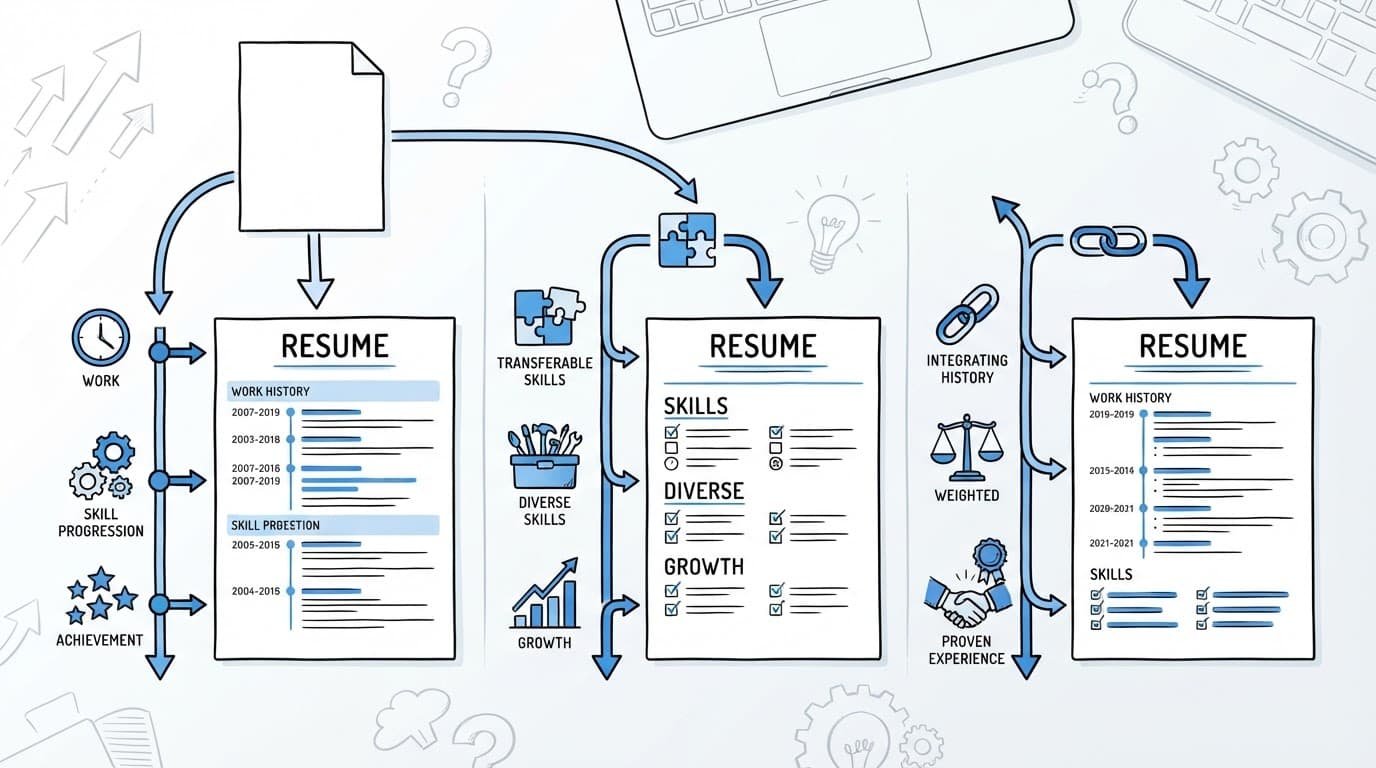
For many job seekers, a hybrid resume is the stronger middle ground between a chronological resume and a functional resume. This resume format combines a targeted skills section with a standard work history.
Put transferable skills near the top
A career changer needs to connect past work to the employer’s current needs. A teacher moving into learning and development can feature transferable skills near the top. These may include curriculum design, facilitation, stakeholder communication, and performance measurement.
The experience section should reinforce those claims with bullets from actual roles. This hybrid resume preserves both context and skills, giving the hiring manager the connection and proof behind each claim.
A focused professional summary can also help. Name the target function, years of related experience, and two or three relevant professional skills. Avoid a generic objective statement, such as “results-driven professional seeking a new challenge.”
Keep dates, titles, and employers visible
The hybrid format does not bury your timeline. Keep dates, titles, and employers visible as you present your professional experience in reverse-chronological order.
Use a “Selected Skills” or “Relevant Expertise” section with six to 10 job-specific terms. Follow it with achievement bullets that connect the skills you can prove to quantifiable results. This resume format often persuades more effectively than a purely functional layout.
CareerScribeAI can help you tailor this structure through its AI Resume Builder, job-description match analysis, and achievement enhancement tools. Its Cover Letter Generator and Interview Prep Tools can also help you explain a career transition with the same clear message.
Make either format easy for an ATS to read
An applicant tracking system doesn’t reject a resume because it’s chronological or functional by name. A chronological resume, functional resume, or hybrid resume can work when the structure is simple and the evidence matches the role.
Use simple, predictable resume sections
A resume format is readable when it uses standard headings such as “Experience,” “Skills,” “Education,” and “Certifications.” Keep your contact details in the document body, not inside a header or footer.
Avoid text boxes, decorative graphics, unusual fonts, and columns that force key information into an unpredictable order. Indeed’s ATS resume guidance also recommends clear section labels, standard fonts, and job-description keywords.
Save the document in the file type requested by the employer. When no format is specified, a clean PDF usually preserves layout, while a DOCX file may work better for systems that prefer editable documents.
Match the language of the job posting
Read the job description closely. If it asks for “customer retention,” “Salesforce,” and “pipeline reporting,” use those exact terms where they accurately describe your work.
Don’t paste a block of keywords into a skills section. Instead, place them in relevant sections and accomplishment bullets where they belong. A comparison of templates tested across Workday, Taleo, and Greenhouse can also help you check whether a layout is built for common hiring platforms.
A resume format alone can’t compensate for weak evidence. Relevant terms must connect to credible experience, which is essential to effective resume writing.
Choose your format based on your evidence
The right resume format depends on how directly your recent evidence supports the target role and your career goals. For a job seeker whose recent evidence aligns closely, a chronological resume is often the clearest starting point. Use the following guide as a starting point for your job search.
| Your background | Best starting format | What the resume should show |
|---|---|---|
| You are seeking a similar role in the same field | Chronological | Recent accomplishments, stable career progression, and increasing responsibility |
| You are moving into a related field | Hybrid resume | For a career changer, relevant capabilities supported by a visible work timeline |
| You have brief, explainable employment gaps | Chronological | Honest dates, strong recent results, and brief context if needed |
| Your relevant work comes from projects, contracts, or volunteer roles | Functional or hybrid | Skill clusters supported by work history, clear examples, employers, and dates |
A functional resume can fit an unusual background, but it shouldn’t obscure your professional history. If you choose a functional resume, keep employers, dates, and accomplishments easy to find. When in doubt, start with a hybrid resume.
Before applying, compare your resume against the job posting line by line. Use focused resume writing to remove unrelated details, add quantifiable results for relevant professional skills, and tailor your summary to the role you want now.
Frequently Asked Questions
Which resume format is best for most job seekers?
A chronological resume is the best starting point when your recent work supports the job you want. It makes your employers, dates, responsibilities, and career progression easy to verify.
When should I use a functional resume?
Use a functional resume when relevant experience comes from projects, contracts, volunteer work, training, or other genuinely fragmented sources. Support each skill with specific evidence and keep a concise work history visible.
Is a hybrid resume good for a career change?
Yes. A hybrid resume places transferable skills near the top while preserving dates, job titles, employers, and accomplishment bullets in a standard work history.
Can a functional resume pass an ATS?
An ATS can read a functional resume when it uses simple formatting, standard headings, and relevant job-description language. The format alone is not enough; the resume must also connect keywords to credible experience and measurable results.
How should I show an employment gap?
Keep the timeline honest and add brief, factual context when it supports your application. For example, you can list a career break for full-time family caregiving without disclosing personal details.
Choose clarity over camouflage
The strongest resume format makes your value easy to verify and your career path easy to follow. A clear timeline helps employers understand your work history.
A chronological resume is usually best when your recent work aligns with the job. A functional resume can organize genuinely scattered experience, but it still needs an honest timeline.
For a career changer, a hybrid resume offers the best balance during a career transition. It highlights relevant capabilities while presenting the timeline employers expect to see.