


Leaving a degree program off your resume can create more doubt than the pause itself. An unfinished degree resume can show relevant training and commitment, provided every detail is accurate.
Your goal is not to disguise missing credentials. Use clear dates and truthful status language to present your credentials with transparency. This helps employers evaluate role-specific degree requirements while supporting skills-first hiring.
Key Takeaways
- List the school, program, attendance dates, and accurate status without suggesting that you earned the degree.
- Use wording such as “Expected,” “Completed coursework toward,” or verified credit hours to make your academic standing clear.
- Include relevant coursework, projects, certifications, and skills only when they support the target role.
- List multiple institutions separately and use conventional formatting so applicant tracking systems can read the information accurately.
- Keep your resume, application, and interview explanation aligned, and omit unrelated unfinished study when stronger experience provides better evidence.
Build an unfinished degree resume with clear facts
An incomplete degree should describe your studies without suggesting graduation. Keep the entry easy to scan, and match its detail to the role.
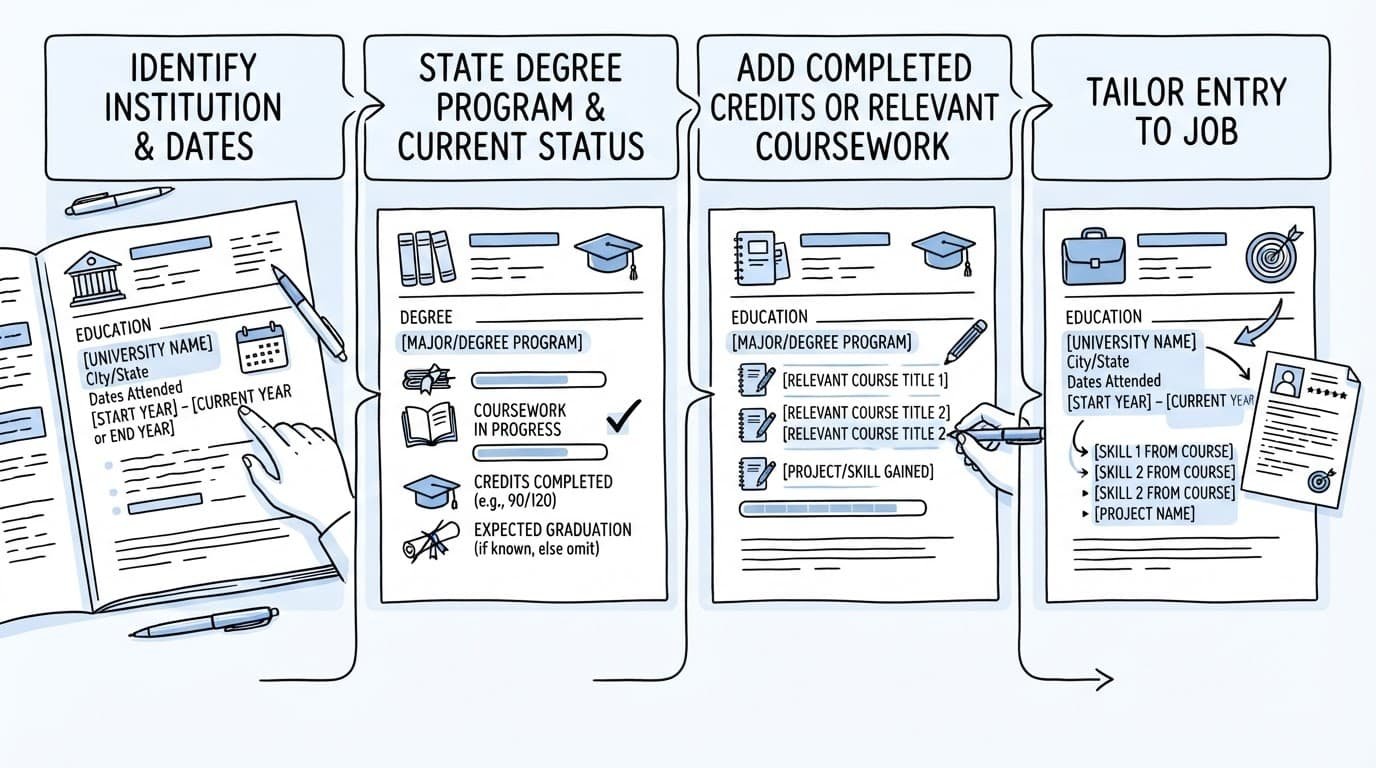
Name the school, program, and attendance dates
List the institution’s name, location, degree program, and attendance dates. Place education near the top if you’re a student, recent graduate, or applying for your first professional role.
Otherwise, put it after your strongest evidence. Let your career stage and evidence strength guide placement. A simple, conventional resume template keeps relevant skills and training easy to find for skills-first hiring.
For a useful reference on education formatting, review these education section resume examples.
Use a status recruiters cannot misread
State whether you’re enrolled, provide an expected graduation date if applicable, or note that you completed coursework without earning a degree. Start with a direct status line so readers don’t have to infer your standing.
Use wording such as:
B.S. in Information Systems, Expected May 2027
Completed coursework toward a B.A. in Psychology, 2019-2021
72 of 120 credits completed toward a bachelor’s degree
Never write “B.A. in Marketing” by itself if you didn’t earn it. If you have no plan to return, don’t list a future graduation date. A clear status prevents guesswork about whether you met the degree requirements and can show continuous learning.
Add details that support the role
For the education entry, coursework and credit hours should strengthen your candidacy, not fill empty space. Choose details that connect directly to the job description.
Include relevant coursework only when it proves relevant skills
Relevant coursework helps early-career applicants, career changers, and candidates entering technical fields. A data analyst candidate might list statistics, SQL, database design, or business analytics courses.
Keep the selection short. A long course list can bury your work history and make the education section feel defensive. Add a GPA only when it is strong, recent, and helpful, usually 3.5 or higher.
- An actively enrolled candidate can state the degree program and expected graduation month.
- A student on a break can state “coursework toward” the program with accurate attendance dates.
- A former student can list verified completed credit hours when the total shows academic progress and supports the role or transfer eligibility. Select courses to demonstrate capabilities, not simply subjects, in a skills-first hiring market.
Treat multiple institutions as separate records
Fragmented education needs careful formatting. List each school separately, with its own degree program, attendance dates, and study details. Don’t combine credits from several schools unless a receiving institution has officially accepted them as transfer credit.
For example, show community college coursework in one entry and university study in another. This prevents an incomplete degree on a resume from looking like a degree earned at either institution.
Use official program names where possible, and pair study with projects or other evidence of continuous learning when relevant. Monster’s degree-format examples can help you check common education-section conventions.
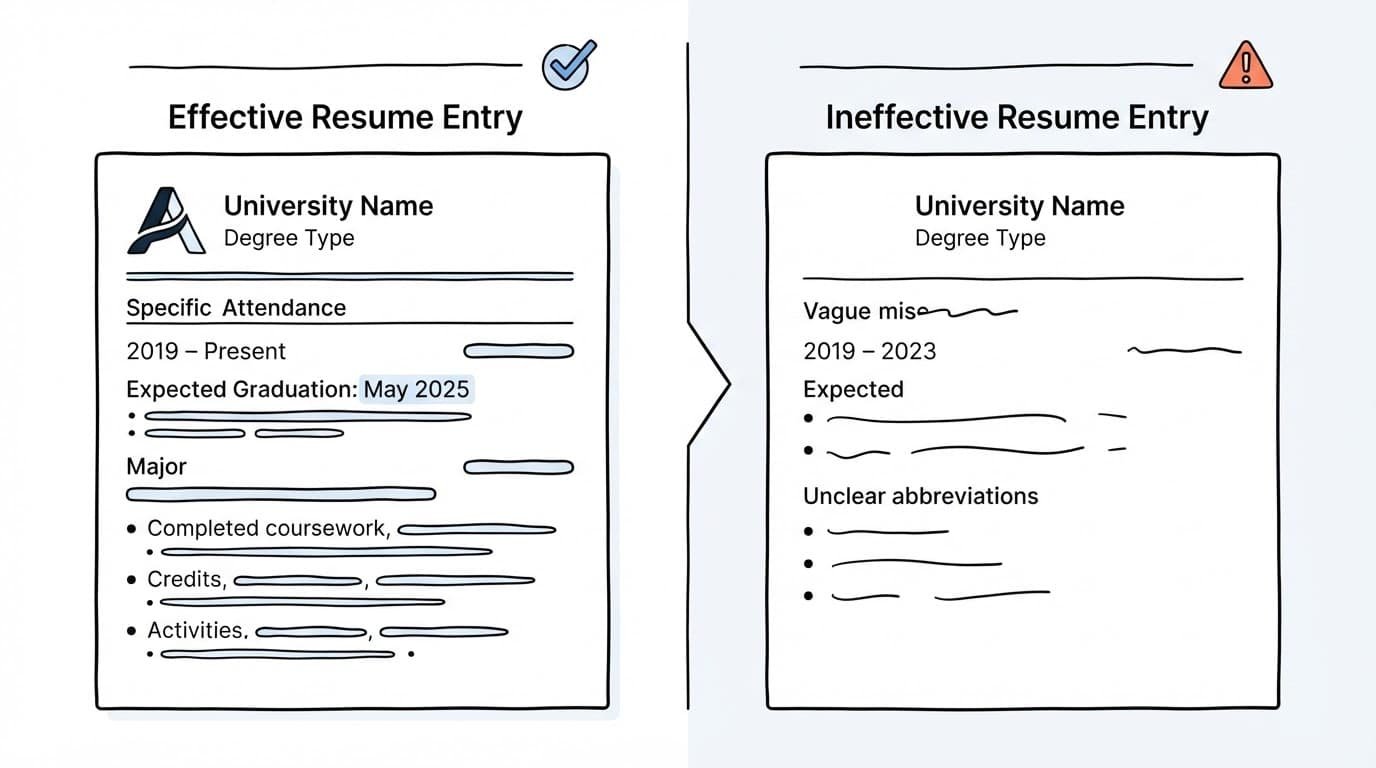
Handle ATS filters and degree requirements honestly
Applicant tracking systems can read standard headings such as “Education,” degree program names, school names, and dates. Use conventional resume formatting and a one-column resume template instead of text boxes or graphics, so the information parses cleanly.
An education entry should never claim that you meet a credential requirement when you do not. If a posting says “bachelor degree required,” answer any direct knockout question about degree completion truthfully. Skills-first hiring may still favor relevant experience for roles where a degree is preferred, not required.
Know when to omit unfinished college
Sometimes leaving an incomplete degree off the education section is the stronger choice. Use this quick decision guide.
| Situation | Best resume choice |
|---|---|
| Recent, role-related study | Include the school, program, dates, and status |
| A few unrelated credits and extensive work experience | Omit it and emphasize experience |
| A role requires a completed license or degree | Do not imply you hold the credential |
If you omit the education entry, replace it with stronger proof where appropriate, such as certifications, portfolio projects, apprenticeships, or completed professional courses. Career changers should place those credentials near the skills section when they support the target role.
Explain the degree pause with confidence
Keep your application story and interview answer aligned
Recruiters and hiring managers may ask about your education during a screening call. Keep your resume and application materials aligned with your interview explanation for transparency. Give a short answer, then explain what you did next.
“I completed coursework in business administration before stepping away from the program. Since then, I’ve built customer operations experience, improved case workflows, and completed certifications, including Salesforce Administrator.”
Connect what you did next to demonstrable capabilities. This supports skills-first hiring and shows continuous learning through hands-on work or other development.
Mention the reason only when it adds context or helps explain employment gaps. A pause doesn’t automatically create one. Examples include military service, caregiving, or a planned career shift. A cover letter can address a major transition in one sentence, but it shouldn’t apologize for it.
CareerScribeAI’s AI Resume Builder can help you compare education and skills against a job posting. Its Cover Letter Generator can keep your explanation consistent, while Interview Prep Tools help you practice it aloud through the AI resume and interview preparation walkthrough. For later stages, use this recruiter screen and hiring manager interview guide to adjust your answer for conversations with hiring managers.
Frequently Asked Questions
Should I include an unfinished degree on my resume?
Include it when the coursework is recent, relevant, or demonstrates useful skills for the role. If you have extensive experience and only a few unrelated credits, omitting it may be stronger.
How do I list a degree I did not complete?
Name the school, program, attendance dates, and a clear status such as “Completed coursework toward a B.A. in Psychology.” You can also list verified credit hours when they show meaningful progress and support the position.
Can I list an expected graduation date if I paused my studies?
Only include an expected graduation date if you are currently enrolled and genuinely plan to complete the program. If you have no plan to return, state that you completed coursework without earning the degree instead.
Should I explain why I left my degree program?
You do not need to explain the reason on your resume unless it adds important context or clarifies an employment gap. If asked in an interview, give a brief, honest explanation and connect it to the skills or experience you gained afterward.
A clear entry earns more trust
Your education history is one part of your professional story. State the facts, include training that supports the role, and show continuous learning. Stronger work experience can carry more weight.
A well-written unfinished degree resume doesn’t hide the missing diploma. It makes your current qualifications easy to understand.