


A board resume changes how recruiters read your leadership record, foregrounding governance judgment unlike a conventional career document. Yet board membership history buried beneath day-to-day wins can look like a side activity.
Your board memberships resume should communicate your board value proposition, not simply list another role. It should show the judgment you bring to governance. For a board seat or senior job, surface board membership details, committee remit, organizational context, and oversight before earlier leadership roles.
That distinction helps recruiters find board membership evidence in your board resume before they reach earlier operating roles.
Key Takeaways
- Lead your board resume with a clear board value proposition that highlights governance judgment, strategic oversight, and relevant executive experience.
- Create a dedicated Board and Advisory Service section near the top, including organization context, board membership dates, committee roles, and governance outcomes.
- Translate operational achievements into board-level evidence by focusing on risk, strategy, fiduciary oversight, CEO succession, and long-term stakeholder value.
- Keep board membership details, committee appointments, service dates, certifications, and keywords consistent across your resume, LinkedIn profile, and interview story.
What a Board Resume Must Prove
An executive resume centers on operating results: teams led, revenue delivered, systems launched, and targets met. A board resume centers on governance, with board membership tied to strategy, CEO oversight, fiduciary duties, risk, and long-term stakeholder value.
Those themes align with core board responsibilities, which include setting strategy and overseeing risk, compliance, and leadership. A board of directors also evaluates corporate governance and risk management, so your document should show the board membership context behind your contribution.
Start with a board value proposition
Place a three- to four-line summary below your contact details. State your industry experience, company scale, functional expertise, leadership at the executive level, strategic thinking, and board membership scope to build a credible board value proposition.
For example, a finance leader might connect board membership impact to public-company reporting, audit readiness, capital allocation, succession planning, and executive leadership. A technology executive could focus on cybersecurity, digital transformation, data governance, and enterprise risk.
NACD recommends a concise summary and advises candidates to avoid resume objectives. Use neutral language and proof to demonstrate governance experience, including board membership evidence, rather than making the unsupported claim that you are “board-ready.”
Change operational bullets into oversight
A traditional bullet might read, “Managed a 200-person operations team and reduced costs by 12%.” That result matters, but it doesn’t explain your board membership contribution.
For a board-focused document, connect it to strategic oversight: “Brought enterprise operations expertise to board discussions on cost structure, supply-chain risk, and management reporting.” Use this framing only when it accurately describes your role.
Where to Place a Board Resume
For a board application, create a dedicated Board and Advisory Service section near the top of a board resume. Place it after your value proposition, so a board director sees relevant board membership quickly. For a conventional senior-level job application, keep directly relevant career experience first and place board service after it.
NACD describes two to three readily navigable pages as workable for a board resume. Most candidates can make their case in two pages. A third page may fit extensive board, executive, and public-service experience in a board resume.
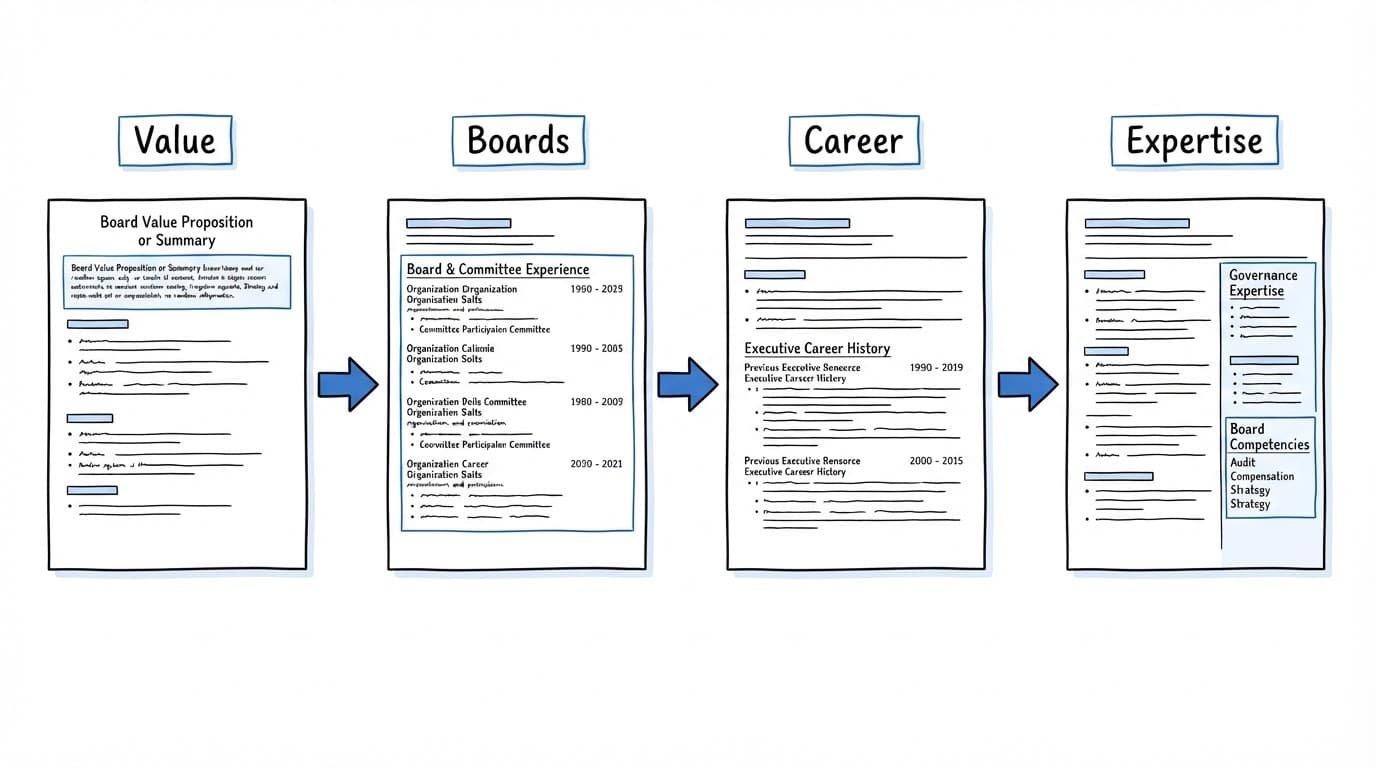
Create a dedicated board service section
Each board membership entry should provide enough context for someone unfamiliar with the organization:
- Name the organization, its sector, and whether it is public, private, or nonprofit.
- Include your title, board membership dates, and committee roles.
- Add one or two bullets showing governance decisions, oversight areas, or measurable organizational results.
- Include the organization’s scale or public-company ticker when it strengthens the board membership context.
Put committee experience in the first line, not in fine print. “Director and Chair, Audit Committee” carries more meaning than a generic “Board Member” label.
Integrate or omit memberships when needed
Move a board membership into professional experience when it involved substantial hands-on leadership, such as an interim executive assignment. If you only attend meetings or hold a passive affiliation, list the board membership lower under Community Leadership, Affiliations, or an advisory board.
Leave a board membership off your resume when it creates a conflict of interest, has no connection to the target role, is outdated, or could distract from stronger qualifications. Never list a title after your term ends without identifying that former board membership as former service.
Turn Operational Experience Into Governance Evidence
Many first-time directors transition from senior leadership roles. A board resume gains strength when operating experience becomes board membership evidence tied to real decisions, risks, and oversight.
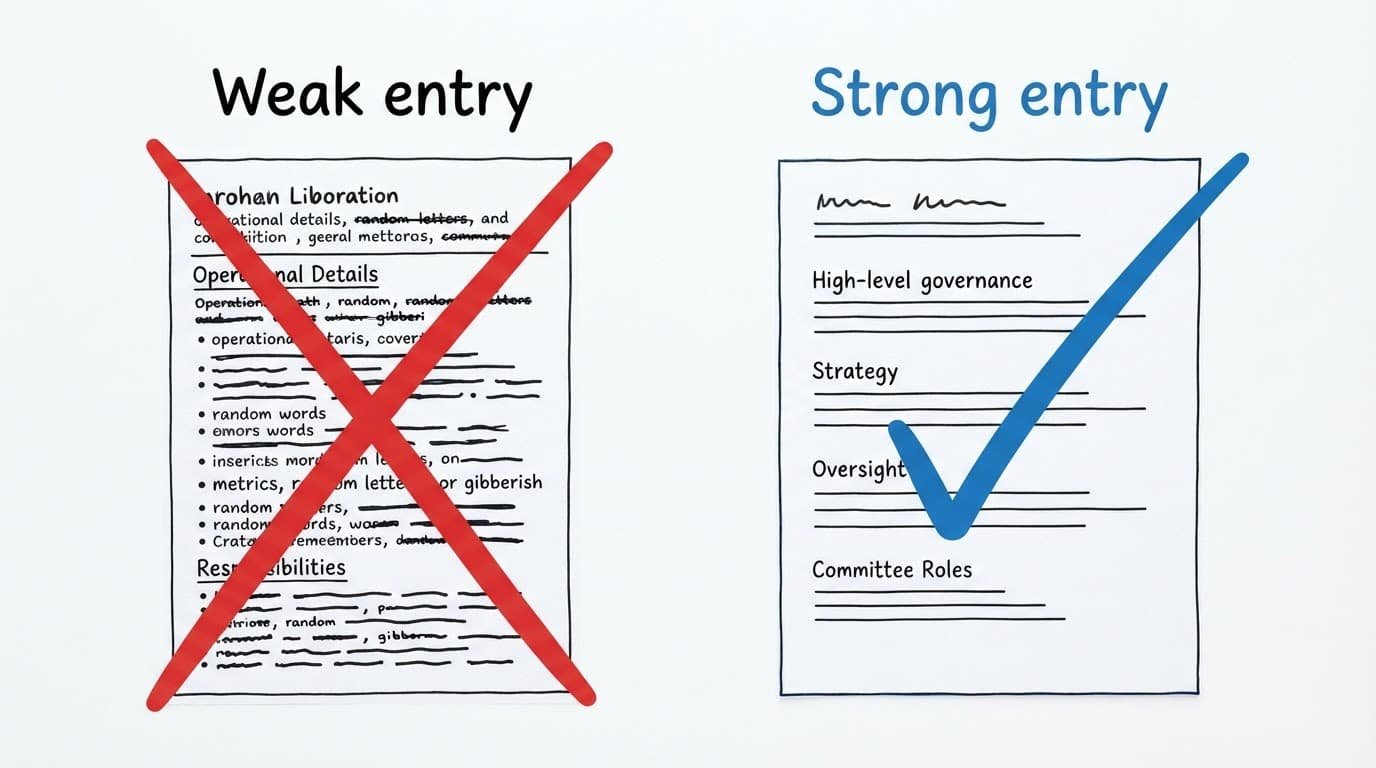
State scope, committee role, and board-level action
Lead each entry with its board membership scope, then name the question or risk you helped assess. Add the board membership context, including the committee remit and your role in the decision.
Replace “Managed the annual budget and fundraising events” with “Provided Finance Committee oversight of the annual budget, liquidity assumptions, and fundraising risk.”
Add a real outcome where you can support it, such as a balanced budget, stronger controls, successful CEO succession, or an approved strategic plan. Describe the board membership outcome you can verify, not an unsupported management result.
A board member contributes judgment through strategic oversight, while management handles day-to-day operational responsibilities. Avoid claiming management actions that belonged to staff.
A board title alone doesn’t show governance depth. Committee work and the decisions you influenced make the role credible.
Build a bridge from operational leadership
You don’t need a formal governance certification to pursue your first board seat. However, a first-time board director must show governance experience and explain how their expertise helps directors make better decisions.
To document board membership, a CISO can connect security operations to cyber-risk reporting and incident readiness. A CHRO can highlight succession, executive compensation, and culture metrics in a board membership context, with executive leadership accountability in view. A COO can frame supply-chain work around resilience, capital investment, and management accountability as board membership concerns.
Your board memberships resume should show the link between what you know and the strategic guidance you can provide to directors. That link helps your board resume invite a productive conversation.
Show Committee Experience and Credentials Clearly
Board membership committee work often separates a broad leadership profile from a targeted board resume. Audit committee and compensation committee service signal distinct value, while governance, risk, technology, and nominating committees show other areas of oversight.
For example, ISACA’s board structure shows how a board of directors may organize Audit & Risk and Compensation committees. Use the exact committee name held by each board director, and show whether that board membership included Chair status.
Add certifications without letting them dominate
List board membership credentials, such as NACD Directorship Certification (NACD.DC), ICD.D, or C.Dir., in a short Professional Designations section on your board resume. A governance certification demonstrates formal study in corporate governance. It supports a board member’s credibility, but a governance certification doesn’t replace evidence of sound judgment.
Likewise, a non-profit board, subsidiary board, advisory board, or chapter board can provide useful board membership context. Give each board membership type the same honest, concise treatment, and explain how the board membership reflects relevant, diverse experiences.
Keep Your Resume, LinkedIn, and Interview Story Aligned
Don’t assume board searches bypass software. A board resume still needs recognizable headings, a text-based PDF, and clear keywords such as governance, fiduciary oversight, risk management, audit, and succession. Board searches may also follow the parsing and readability principles of an executive resume. Recruiters and executive search firms may review it, but human readers still need a clear story.
Keep each board membership title consistent across every version. Match each board membership’s service dates and organization names across all channels. List each board membership’s committee appointments clearly. Use consistent formatting across a professional resume and LinkedIn profile. Align every board membership detail on LinkedIn, including any governance certification.
Then prepare a concise explanation of how your leadership roles transfer to governance. In interview preparation, connect each board membership to a specific example and use the same language across your resume, LinkedIn, and interviews.
CareerScribeAI’s resume and interview tools can help you tighten board-focused bullets with the AI Resume Builder. The Cover Letter Generator carries the same board resume themes into LinkedIn and applications; Interview Prep Tools help you rehearse them in interviews.
Frequently Asked Questions
How is a board resume different from an executive resume?
An executive resume emphasizes operating results, such as revenue growth, teams led, and systems launched. A board resume emphasizes governance judgment, strategic oversight, fiduciary duties, risk, and long-term stakeholder value.
Where should board memberships appear on a resume?
For a board application, place a dedicated Board and Advisory Service section near the top, directly after your board value proposition. For a conventional senior-level role, put directly relevant career experience first and position board service afterward.
What should each board membership entry include?
Include the organization’s name, sector, public or private status, your title, service dates, and committee roles. Add one or two bullets describing governance decisions, oversight areas, or measurable organizational outcomes.
Can operational leadership experience support a first board application?
Yes. Connect your operating expertise to board-level concerns such as cyber risk, succession, executive compensation, supply-chain resilience, financial oversight, or management accountability. The goal is to show how your knowledge helps directors make better strategic decisions.
Build a Resume That Invites a Board Conversation
A strong board resume makes your governance value easy to find. Lead with your board proposition, name committee responsibilities, and translate operational success into oversight evidence.
Each board membership entry should show how your contributions create stakeholder value and improve long-term decisions. That board membership story helps your board resume invite a conversation before you enter the interview room.