


A resume rarely fails because you lack experience. It fails because your strongest results are buried in daily tasks, old calendars, and half-forgotten projects. Tracking your professional achievements aids in self-advocacy and career advancement during a job search, and a career achievement inventory gives those details one reliable home.
Instead of staring at a blank document before every application, you build a bank of proof: problems solved, scope owned, tools used, and results achieved. That makes this template a core asset for resume writing, leading to tailored bullets that are faster and far more credible.
Key Takeaways
- Record professional achievements as they happen, before metrics and project details fade.
- Capture context, actions, evidence, and outcomes for every meaningful contribution using the CAR technique.
- Document every business problem you solve with clear numbers when you can verify them, but don’t invent percentages.
- Turn one inventory entry into different bullets for different job targets to highlight your measurable impact.
- Keep your best examples ready for interview storytelling as well as resumes.
Build a Career Achievement Inventory That Captures Proof
Your inventory is a working document, not a polished resume. It should be messy enough to hold the full story and organized enough to search later.
Create a spreadsheet, notes database, or document with one row for each accomplishment. Add entries after a project ends, during a regular performance review, or whenever you solve a problem worth remembering through effective problem solving. Small wins belong here too. Cutting a weekly report from three hours to one hour can become a strong bullet when the role values continuous improvement.
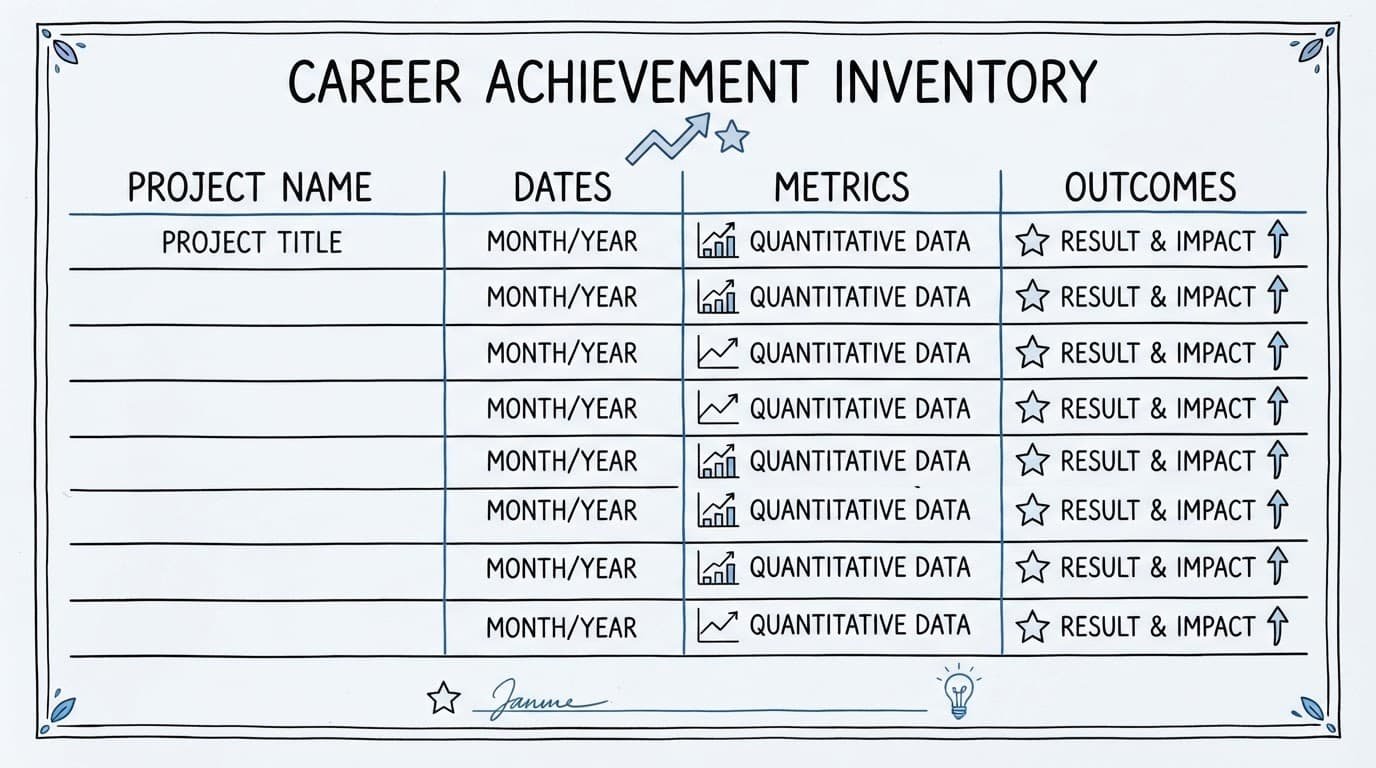
Use this career achievement inventory template for each entry:
| Field | What to record |
|---|---|
| Role and dates | Job title, employer, project period |
| Starting situation | The issue, goal, customer need, or missed target |
| Your action | What you personally did, including tools or methods |
| Scope | Budget, volume, team size, account count, frequency, or audience |
| Result | Revenue, time saved, errors reduced, adoption, quality, or risk avoided |
| Evidence | Dashboard, report, manager feedback, ticket history, or project file |
| Target skills | Keywords such as Excel, SQL, onboarding, forecasting, or client retention |
Write enough detail to jog your memory. “Improved onboarding” is too thin. “Rebuilt new-hire checklist after support tickets showed repeated setup errors” gives you material to shape later using the CAR technique.
A resume bullet needs only a concise result. Your inventory should preserve the surrounding evidence that makes the result believable.
Numbers don’t always mean percentages. Record dollars, hours, customer volume, turnaround time, ranking, error counts, cycle time, satisfaction scores, and the size of the work to capture quantitative results. When tracking professional achievements, you should also note key performance indicators, risk management details, and skill development milestones. If you don’t own the final metric, describe your contribution accurately. For example, write “prepared weekly pipeline analysis used by six account executives” rather than claiming credit for all revenue growth.
Turn Each Accomplishment Into a Resume Bullet
A useful resume bullet follows a clear sequence: action, scope or method, and outcome. Start with what you did, then show the scale, and close with the business result.
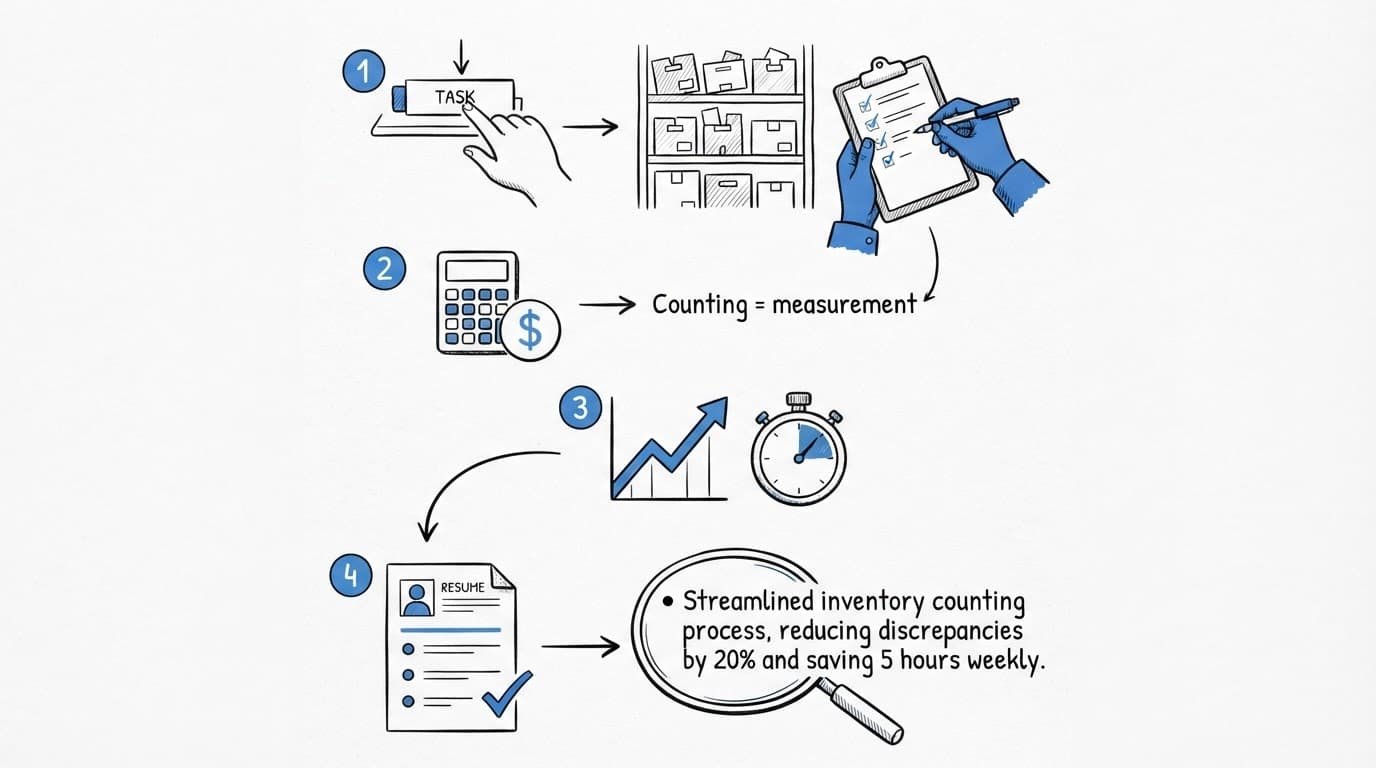
For example, an inventory note might read:
“Monthly customer report took five hours. I created an Excel template with automated formulas and validation checks. The account team used it for 40 clients. Preparation time dropped to two hours, and recurring data errors stopped.”
That becomes:
- Built an automated Excel reporting template for 40 client accounts, reducing monthly preparation time by 60% and eliminating recurring data-entry errors.
The bullet works because it names the tool, the scope, and a result. Applying the CAR technique in resume writing translates problem solving and time management into quantitative results and customer satisfaction gains. A good guide to quantifiable resume results also shows how workload, time, and quality measures can support roles without direct revenue responsibility.
Keep the language precise. Showcase your professional achievements and dedication to continuous improvement by avoiding passive phrasing. Avoid “helped,” “worked on,” and “responsible for” when your records show ownership. Choose verbs that match the work, such as analyzed, resolved, coordinated, redesigned, negotiated, trained, or implemented.
Match Inventory Entries to the Job You Want
One career achievement inventory can support several job searches, but your selection changes with every new job posting.
A customer success role may need retention, adoption, renewal, and customer satisfaction examples. An operations role may need cost control, workflow, operational excellence, and turnaround time examples. For finance roles, prioritize decisions supported, reporting accuracy, and budget scope. Review financial analyst resume bullets for examples of how time saved, variance reduction, and reporting improvements can become measurable outcomes.
Read the job description twice during your job search. First, mark the responsibilities that appear most often. Then filter your professional achievements by matching skills, tools, and business outcomes. If a listing asks for project management, strategic planning, or strategic execution, do not lead with an unrelated success just because it has a large number.
This is also where a career achievement inventory prevents exaggerated tailoring during a job search. You are selecting real evidence, not rewriting your history to fit a title. Keep the original notes and skill development evidence attached to each entry, especially when an achievement depends on shared team work.
Keep the Template Useful Over Time
Set a repeating reminder for the last Friday of each month. Spend 15 minutes adding projects, feedback, training, awards, and examples of problem solving to your ongoing tracking document. Save screenshots of dashboards when company policy permits, along with sanitized notes on the metric and date to support continuous improvement.
Update old entries after every performance review. Managers often use language that identifies your impact more clearly than your first draft, which helps document your professional growth. If a colleague or leader gives you positive written feedback, record the project, the action they noticed, and any measurable outcome behind it to aid in future goal setting and salary negotiation discussions.
Your inventory also improves interview preparation through better interview storytelling. Each entry can become a concise STAR story or map directly to the CAR technique, providing solid evidence of skill development over time. That link between resume bullets and interview answers matters because recruiters often ask about the exact claim that caught their attention, and maintaining this record with a supportive, trauma-informed approach to self-reflection keeps the process grounded and stress-free.
Frequently Asked Questions
What is a career achievement inventory?
A career achievement inventory is a working document where you track your professional wins, problems solved, tools used, and measurable results as they happen. Instead of starting from scratch before every application, this bank of proof gives you reliable material to build tailored resume bullets.
How often should I update my inventory?
Set a repeating reminder for the end of each month to add recent projects, metrics, and positive feedback. Updating it regularly prevents details from fading and makes performance reviews, resume updates, and interview prep much easier.
What if my role doesn’t have direct revenue numbers?
You don’t need sales figures to show impact. Record time saved, error counts, customer satisfaction scores, process improvements, or the scale of the work to capture quantitative results for any type of role.
Final Thoughts
A strong resume begins with accurate raw material. Your career achievement inventory turns scattered work memories into evidence you can tailor for each opportunity, supporting your ongoing career advancement and professional growth.
By tracking professional achievements, you simplify resume writing and make every future job search much easier. This documented proof also empowers your salary negotiation and goal setting efforts. Whenever you tackle a business problem using strategic planning or project management, or improve key performance indicators through time management and risk management, record that measurable impact immediately.
Keep recording outcomes while they are fresh. When a promising job appears, you will have proof ready to shape into clear, focused resume bullets for your job search.