


Hiring managers scan a financial analyst resume in seconds. If your bullets read like a job description, they won’t carry much weight.
The best financial analyst resume bullets in 2026 showcase measurable achievements that prove business impact. A strong career summary or resume objective sets the stage for these detailed bullet points. They connect analysis to better forecasting, lower costs, faster reporting, and stronger decisions. That’s the difference between “did the job” and “moved the business.”
Key Takeaways
- Replace generic duties with measurable achievements that prove business impact, such as cost savings, improved forecast accuracy, faster reporting, or higher decision adoption.
- Structure each bullet to cover the issue addressed, your action and tools used (e.g., SQL, Power BI, financial modeling), and quantifiable results like percentages, dollars, or time saved.
- Highlight 2026 skills like FP&A, forecasting, variance analysis, automation, and business partnering only when tied to real outcomes in money, speed, accuracy, or risk reduction.
- Use strong action verbs and ATS-safe formatting to ensure bullets stand out to hiring managers scanning in seconds.
Why finance resumes need results, not duty lists
In a financial analyst resume, you do not get hired just for typing reports into Excel or basic data analysis. You get hired for helping leaders act on numbers. So each bullet in your work experience section should answer three things: what you did, how you did it, and what happened next.
That shift matters more in 2026 because analyst roles now blend FP&A, automation, dashboarding, and business partnering. Employers want proof that you can spot a gap, explain it clearly, and help fix it. If you want a benchmark, these financial analyst resume examples show how often strong resumes lead with quantifiable metrics instead of vague duties.
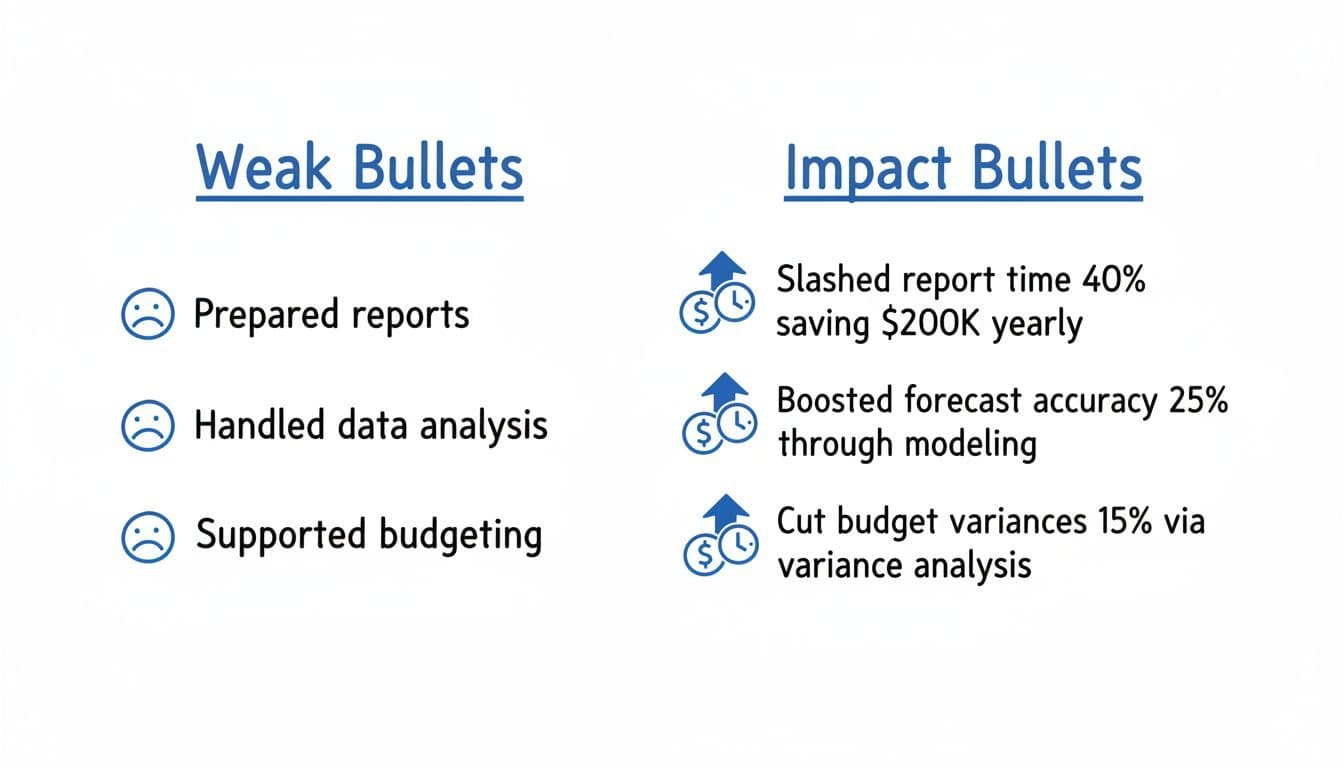
A weak bullet says what you were assigned. A strong bullet shows scope and outcome. Start with strong action verbs to transform them.
- “Prepared monthly financial reports” becomes “Built monthly P&L financial reporting packs using technical tools like SAP for 12 business units, cutting delivery time by 2 days and giving leaders earlier visibility into margin swings.”
- “Assisted with forecasting” becomes “Created a rolling 12-month revenue forecast model that improved forecast accuracy from 84% to 93%.”
- “Supported budgeting process” becomes “Partnered with operations on a $45M budgeting process, identified $1.2M in controllable spend reductions, and improved budget adherence.”
- “Analyzed variances” becomes “Led monthly variance analysis across five cost centers, found recurring overspend drivers, and reduced unfavorable variance by 18%.”
- “Built dashboards” becomes “Launched Power BI dashboards for sales and finance leaders, cutting manual reporting hours by 30 per month.”
Numbers do not need to be huge to matter. Percentages, cycle time, headcount scope, budget size, and user adoption all count. Also, keep the format clean. Even great bullets can get lost in a messy layout, so an ATS-safe resume structure for Lever ensures ATS compatibility and proper resume format to keep your content readable.
The 2026 skills that belong in your bullets
Current hiring trends point to a clear mix of finance and data skills. The highest-value bullets now feature FP&A, financial modeling, forecasting, data analysis, financial reporting, budgeting, variance analysis, trend analysis, automation, dashboarding, risk management, business partnering, and decision support. Those terms matter, but only when they are tied to a real result.
For example, saying you used SQL or Power BI isn’t enough. Hiring teams want to know whether those tools saved time, improved accuracy, or helped leaders make faster calls. The same goes for executive reporting. A bullet about board materials means more when it shows that your analysis shaped spend controls, pricing moves, or hiring plans.
Good finance resume bullets often quantify one or more of these outcomes: money, speed, accuracy, adoption, or risk. That gives the reader a concrete reason to trust your work.
Current FP&A resume examples and this 2026 financial analyst ATS guide show the same pattern. Whether you are a senior financial analyst or an entry-level financial analyst, your financial analyst resume stands out when you connect technical work to business action, especially hard skills like SQL and Power BI alongside soft skills like business partnering in the work experience section. In practice, that might mean better forecast precision, fewer manual steps, cleaner dashboards for executives, or lower exposure to compliance errors.
So if you’ve done monthly close support, long-range planning, pricing analysis, capex review, or board reporting, don’t stop at the task. Finish the thought with the result.
How to turn raw responsibilities into achievement-focused bullets
Most raw bullets on your financial analyst resume can be fixed with a simple process. Review a financial analyst job description to identify the business problems it highlights, then start with that issue or decision. Add the action, the tool, and the measurable outcome. Organize your work experience in a clear resume format, such as reverse chronological order, for maximum impact.
- Identify the issue you addressed, such as budget overruns, slow reporting, poor forecast visibility, or weak margin tracking.
- Name what you did and how you did it, using the real tool or method, such as financial modeling, data analysis, forecasting, driver-based forecasting, variance analysis, SQL pulls, SAP queries, or Power BI dashboards.
- End with the result, using dollars, percentages, time saved, error reduction, forecast accuracy, decision speed, or ROI.
If a bullet could fit almost any analyst, it’s too generic.
Here are strong examples you can adapt to your own work:
- Built a driver-based opex forecast model using financial modeling for a $60M business unit, improving quarterly forecast accuracy by 11%.
- Automated monthly sales reporting and financial reporting with SQL, Excel macros, and SAP, reducing manual prep time from 8 hours to 2.
- Partnered with procurement and operations to analyze vendor spend via data analysis, uncovering $850K in annual savings opportunities.
- Developed executive dashboards in Power BI with Bloomberg Terminal data, lifting weekly report adoption across leadership teams from 40% to 90%.
- Produced board-ready variance summaries focused on revenue recognition, helping leadership reallocate spend and avoid a 6% budget overrun.
- Reviewed pricing and margin trends by product line through forecasting, leading to changes that lifted gross margin by 1.8 points and improved ROI by 15%.
If you’re starting from flat responsibilities, CareerScribeAI’s AI Resume Builder can help tighten wording and add missing metrics based on the job posting. Its Cover Letter Generator can carry the same proof points into your letter, and Interview Prep Tools can help you turn your strongest bullet into a story you can say out loud. That’s useful because your best resume line should also support your tell me about yourself answer formula.
Frequently Asked Questions
What separates weak resume bullets from strong ones for financial analysts?
Weak bullets list duties like ‘prepared reports,’ while strong ones show business impact, such as ‘built P&L packs in SAP for 12 units, cutting delivery by 2 days.’ They answer what you did, how, and the result with metrics. This proves you drive decisions, not just tasks.
Why do financial analyst resumes need quantifiable results in 2026?
Roles now blend FP&A, automation, and business partnering, so employers seek proof of spotting gaps and fixing them. Numbers like forecast accuracy gains or time savings show you connect analysis to better outcomes. Generic duties get overlooked in ATS scans and quick reviews.
How do you transform raw responsibilities into achievement bullets?
Start with the business issue (e.g., slow reporting), add your action and tool (e.g., automated with SQL), and end with the metric (e.g., cut prep from 8 to 2 hours). Review job descriptions for context and adapt examples like driver-based forecasting that boosted accuracy by 11%. Tools like AI resume builders can refine wording.
Which skills should appear in financial analyst resume bullets?
Prioritize FP&A, financial modeling, forecasting, data analysis, SQL, Power BI, variance analysis, and business partnering—but always link to results like savings or adoption lifts. Avoid listing skills alone; show how they improved money, speed, accuracy, or risk. This matches current resume examples and hiring trends.
Do achievement metrics need to be massive to impress?
No, percentages, cycle times, headcount scope, budget sizes, or adoption rates all count as proof. Even small wins like 18% variance reduction or 30 manual hours saved demonstrate impact. Focus on relevance to the business problem you solved.
Conclusion
Strong resume bullets don’t list tasks. They show what your analysis changed for the business.
A high-performing financial analyst resume focuses on these outcomes within the work experience history, connecting back to your career summary for a consistent narrative of value. For finance roles in 2026, the clearest proof is measurable: better forecasts, lower costs, faster reporting, cleaner dashboards, and sharper decision support via technical tools. When each bullet links your work to a result, your resume reads like evidence that passes applicant tracking system filtering, not admin history.