

A language can move your application from the maybe pile to the interview list, but only if you describe it honestly. Recruiters need to know whether you can greet customers, write reports, or lead a client meeting without translation.
The strongest candidates understand that linguistic ability is a professional asset rather than a decorative extra. By providing clear proficiency levels and relevant context, you ensure your languages on resume prove your actual value to a potential employer.
Key Takeaways
- Include a separate language section on your resume whenever knowing another language helps you perform the target job.
- Use recognized proficiency scales such as CEFR, ILR, or ACTFL, as well as specific exams like JLPT, HSK, or TOPIK, when they are relevant to the employer.
- Place required languages near the top of your resume and list your strongest or most relevant skills first.
- Avoid using visual elements like stars, skill bars, or percentages, and do not use inflated labels such as fluent if you cannot effectively work in that language.
- Support a critical language skill with a professional certification or a specific work-based example.
Decide Whether a Language Belongs on Your Resume
List a language when it affects how you can perform the role. For a bilingual customer support opening, Spanish may be a core qualification. For a supply chain role with suppliers in Germany, professional German can set you apart. For a local internship with no international duties, basic French may take valuable space from your skills section.
Read the job description closely before adding a language section. Terms such as bilingual, multilingual, French-speaking clients, international markets, and translation all signal that language ability matters. A required language should also appear in your resume summary or core skills area, provided the claim is accurate.
Native language ability deserves a clear listing, too. Hiring teams should not infer your language skills from your name, country of origin, or education history. Write it plainly when it has value for the position.
Language skills can also strengthen applications for hospitality, health care, sales, education, nonprofit work, immigration services, travel, public relations, and global technology companies. Still, relevance beats volume. A concise, targeted resume usually performs better than a long inventory of beginner-level courses.
For broader resume decisions, these current resume-writing tips can help you keep every section focused on the role.
Only claim a level you could defend in a live interview, a writing test, or a work sample.
Choose a Language Proficiency Level Recruiters Understand
Vague labels create uncertainty. Claiming you have good Spanish could mean you can order lunch, handle a complaint call, or negotiate a complex contract. To avoid confusion, you should use a clear language rating system or a standardized framework to define your language proficiency levels. Providing concrete data helps recruiters understand exactly what you can do.
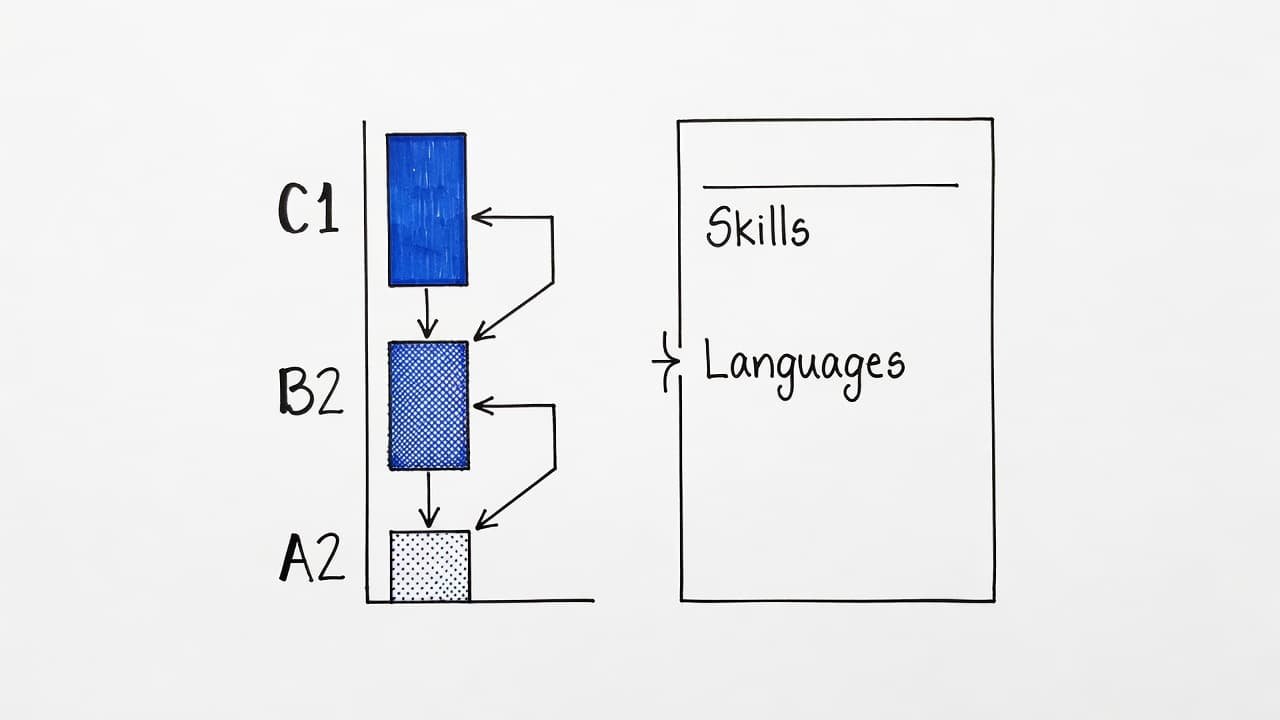
For international employers and many private-sector roles, CEFR levels are widely recognized. CEFR ranges from A1 for beginner ability to C2 for near-native command. Using CEFR to identify your skills clarifies that B1 and B2 indicate independent users, while C1 and C2 show advanced ability.
US government roles and defense contractors may prefer the Interagency Language Roundtable scale. ILR Level 3 signifies professional working proficiency, which is a specific benchmark for many federal positions. Academic and education roles may use ACTFL descriptions such as Intermediate High, Advanced Mid, or Superior.
For Japanese, Mandarin, and Korean roles, use the credential the employer recognizes. JLPT, HSK, and TOPIK scores can communicate ability more precisely than the vague term conversational.
Use this quick guide when selecting a resume label:
| Resume label | What you should be able to do |
|---|---|
| Native or bilingual | Work naturally across personal and professional settings as a native speaker |
| Advanced | Lead meetings, write detailed documents, and discuss complex topics |
| Professional working proficiency | Handle business emails, meetings, and routine client communication |
| Intermediate | Manage familiar work conversations with occasional gaps |
| Beginner | Use simple phrases and understand basic information |
Use the term fluent with care. While it is common in US resumes, it does not define a consistent standard. If you want to be more descriptive, use a format like French, Fluent (CEFR C1) or German, ILR Level 3, Professional Working Proficiency.
If you have no official test score, perform a honest self-assessment based on actual tasks. Can you write a follow-up email without software translation? Can you understand a fast video call? Can you explain your past work experience in the language? If you are between levels, choose the lower one to ensure your profile remains credible. Whether you are an intermediate learner or a fluent speaker, the goal is to align your skills with the requirements of the job.
Put Languages in the Right Resume Section
Most candidates should place a separate language section after your skills section, education, or certifications. This placement keeps the information visible without distracting from your professional experience.
Move this language skills section higher when a language is a stated requirement for the role. Place it directly below your professional summary and before your work history if the employer specifically needs bilingual ability for daily duties. A recruiter should not have to scan two pages to confirm that you possess the necessary language proficiency levels for a non-negotiable qualification.

List your languages by job relevance first. If you are applying for a role serving Spanish-speaking patients, put Spanish ahead of a stronger but unrelated language. Otherwise, list them in descending order of ability.
A clean section following the CEFR scale may look like this:
Languages Spanish, C1, professional working proficiency, DELE C1 language certification (2024) French, B2, independent user English, native or bilingual proficiency
Keep the wording simple. Commas, bullets, and standard headings all work well in applicant tracking systems. If space is tight, use one line to display your CEFR levels:
Languages: Spanish (C1), French (B2), English (Native)
Avoid placing languages in the footer, sidebar, or a graphic-heavy design. Some ATS platforms struggle to parse content inside text boxes, columns, icons, and images. Recruiters also need to find the information quickly, so prioritize clear, searchable text formatting.
Make Language Skills ATS-Friendly
ATS software searches for specific keywords found in the job posting. Therefore, mirror the employer’s phrasing when it accurately describes your ability. If the posting asks for professional working proficiency in Mandarin, do not write only Chinese, advanced. Write Mandarin Chinese, Professional Working Proficiency, then include your HSK certification if you have it. Using these specific terms helps the software identify you as a proficient candidate for the role.
Spell out both the language and any recognized abbreviation. For example, write Japanese, JLPT N2 rather than N2 only. The same principle applies to Mandarin Chinese, HSK 5 and Korean, TOPIK Level 5. When you provide these clear markers, it is easier for applicant tracking systems to identify you as someone who is proficient in the required language.
Do not use visual ratings. Five stars may look polished, but an ATS cannot reliably interpret them. The same goes for percentage bars and colored charts. Hiring managers cannot tell whether 80% means social fluency, grammar knowledge, or professional writing. Stick to standard text labels to ensure your qualifications are captured correctly by the system.
Keep your language fluency claims consistent across your resume, LinkedIn profile, cover letter, and application forms. Differing labels can create doubts for recruiters reviewing your skills section. Candidate discussions on describing language skills clearly often return to the same practical point: stating that you are fluent in a language is more credible than using an impressive-sounding but unclear adjective.
An ATS-friendly resume also needs the right section order and clean formatting. The CareerScribeAI resume builder can help you import an existing resume, tailor each version to a job description, and keep your Languages section readable.
Connect Language Ability to Real Work
A languages section states your level, but your experience section proves it. When language skills matter to the role, add a bullet point that shows how you used them.
A customer service representative might write:
- Resolved billing and service issues in English and Spanish for a high-volume customer queue.
A sales professional could write:
- Presented product demonstrations in French to prospects across Quebec and France.
An operations coordinator might use:
- Translated supplier updates from Mandarin Chinese and summarized delivery risks for US stakeholders.
These bullets are stronger because they name a work activity, the language, and the audience. Do not claim translation or interpretation work unless you performed it and can discuss your process.
Your cover letter can reinforce a relevant language skill without repeating the entire resume. Use the Cover Letter Generator to connect your multilingual experience to client needs, market knowledge, or team communication. Keep the claim factual and tied to the position.
Recruiters may test language ability during screening. Prepare for an honest discussion with Interview Prep Tools by practicing a short introduction, a job-related scenario, and a clear explanation of your conversational proficiency level in the language you listed.
Common Mistakes That Weaken a Language Section
The most damaging mistake is exaggeration. Hiring managers may switch languages mid-call, assign a written task, or ask a bilingual colleague to join the interview. If your resume claims a C1 level but you can only manage rehearsed topics, trust disappears quickly.
Another problem is listing every language you have ever studied. Two semesters of Italian can be personally meaningful, yet it rarely belongs on a professional resume. Only include languages at an intermediate level or higher unless the role involves relocation, a language learning program, or a specific local requirement.
Avoid using unexplained terms as well. Labels like basic, fair, or working knowledge can mean different things to different readers. It is best to pair a plain label with a recognized language rating system whenever possible to ensure clarity.
Finally, do not bury your credentials within your language skills section. If a job requires a specific language, add your language certification beside the proficiency level, for example: Spanish, C1 (DELE C1, 2024). Providing a current credential gives the recruiter a verified basis for your self-assessment.
Frequently Asked Questions
Should I include languages I learned in school but no longer use proficiently?
Generally, no. Only list languages on your resume if you have reached at least an intermediate level and can use the language effectively in a professional setting. Listing languages you cannot confidently speak or write can lead to awkward moments during interviews and may undermine your credibility.
How can I prove my language proficiency if I don’t have an official certification?
If you lack a formal certificate like a CEFR or HSK score, you can conduct an honest self-assessment based on your ability to perform job-related tasks, such as writing emails or conducting meetings. Clearly describe your level using recognized terminology like “Professional Working Proficiency” and be prepared to demonstrate these skills through a work sample or a language assessment during the interview process.
Is it better to list languages in a dedicated section or within my skills section?
For most professionals, a dedicated “Languages” section is best because it keeps your qualifications organized and easy for recruiters to identify. If a specific language is a mandatory requirement for the job, however, you may want to list it in both your summary and your languages section to ensure it is immediately visible to both human readers and applicant tracking systems.
Make Every Language Claim Count
Your resume needs language skills that match the work you want to do, not a long list of classroom exposure. When deciding how to list languages on your resume, put relevant skills where recruiters can find them, use a proficiency level you can support, and show the skill in your experience section whenever it shaped actual results.
A precise Languages section creates a simple promise: you can communicate at the level the job requires. Make sure every line of your application can back it up.