

A hiring manager may spend less than a minute deciding whether your job application deserves a closer look. Writing a short cover letter gives them a fast, credible reason to keep reading.
The goal is not to repeat your resume. Instead, it is to connect one or two relevant accomplishments to the role and show that you understand the employer’s immediate need. With the right details, 150 to 250 words can do more than a full page of general praise.
Key Takeaways
- Keep your short cover letter to three focused paragraphs and roughly 150 to 250 words.
- Open with the target role, your primary strength, and a clear reason for writing.
- Highlight one measurable achievement that showcases your relevant skills instead of listing every qualification.
- Mirror the language found in the job description without copying it word for word.
- Prioritize proofreading your final draft to ensure clarity and professionalism before you send your application.
Why Short Cover Letters Work in 2026
Recruiters often review a job application between meetings, interviews, and inbox triage. A dense letter creates unnecessary work for them. A short cover letter respects the time of your prospective employer and makes your strongest evidence easy to find. By using concise language, you ensure your value proposition remains front and center.
Short does not mean vague. Every sentence needs a specific purpose. Your opening identifies the position and establishes relevance. The middle section proves that relevance with tangible results. The close asks for the next conversation.
A letter also provides vital context that a resume cannot always convey. Perhaps you are changing industries, returning after a career break, relocating, or applying because you possess a deep understanding of the company product. Mention these facts briefly as they relate to your career goals, then bring the focus back to what you can contribute.
The University of Michigan’s cover letter resources recommend keeping the letter to one page. For most job seekers, a much shorter document is actually stronger because it requires sharper, more intentional choices.
A hiring manager should understand your fit after one quick scan.
Build a Short Cover Letter Around Three Paragraphs
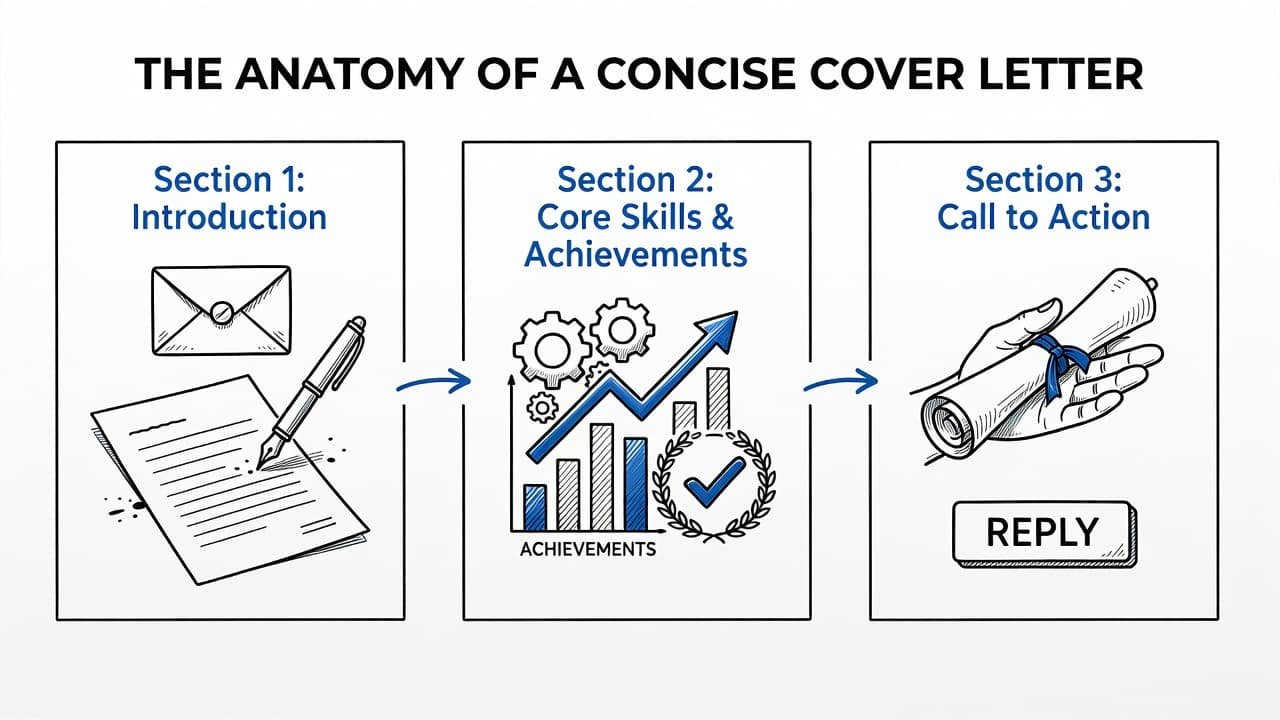
Start with a professional greeting whenever possible. Search the company website, LinkedIn page, or job post to personalize your greeting. If you cannot find the name of the hiring manager, use “Dear Hiring Manager” rather than an outdated generic greeting.
Your first paragraph should name the job title and lead with a relevant qualification. Skip statements such as “I am excited to apply” unless you immediately explain why. A stronger opening identifies a match between your experience and the employer’s need.
For example, if you are applying for a specific role that requires someone who improves customer retention, lead with a retention result, customer success background, or account-management experience. You can find more practical ideas in these cover letter opening line examples.
Use the second paragraph for proof. Choose one achievement that relates directly to the job description. Include a metric when you can support it, such as revenue earned, response time reduced, clients retained, projects delivered, or error rates lowered. A precise result carries more weight than a row of adjectives.
Close with a clear, calm final paragraph. This call to action should restate the value you would bring, thank the reader, and express that you welcome an interview. You do not need to demand a response or add a dramatic sales pitch.
A simple structure keeps the letter readable. Use these bullet points to guide your layout:
- State the role and your strongest connection to it.
- Show one relevant accomplishment with a clear outcome.
- Invite a conversation and close professionally.
Tailor the Letter to the Job Description

A short letter only works when it feels written for that employer, which is why tailoring your application is essential for success. Before drafting, read the job description twice. First, identify the core responsibility. Then, highlight the relevant skills, technical skills, and outcomes that appear more than once throughout the job description.
Match your professional background to these specific priorities. If the posting calls for Salesforce, stakeholder communication, and reporting, mention the one or two areas where you have direct evidence of success. Avoid simply repeating generic buzzwords; recruiters can spot copied language quickly, and they prefer specific examples over empty phrases.
Use the employer’s name once and refer to a real detail from the role, product, or mission when it connects to your background or company values. For instance, a customer-support candidate might mention experience improving help-center content if the position emphasizes self-service support.
CareerScribeAI’s AI Resume Builder can help you identify resume achievements that match a posting. Its Cover Letter Generator can turn those facts into a focused first draft, while the Interview Prep Tools help you prepare to explain the same accomplishments aloud. If you need a starting point, set up your personalized cover letter with your resume and target job description.
Still, review any AI-assisted draft line by line. Remove claims you cannot prove, add your natural voice, and check every company name.
Edit for Clarity Before You Send
Read the letter aloud once. Awkward phrasing, repeated words, and overly long sentences become obvious when you hear them. Then compare it against the job description and your resume.
Cut broad claims such as “I am a hardworking team player.” Replace them with evidence from your work experience, or remove them entirely. You should also trim details from your professional background that do not directly support the role. Whether you are applying for a permanent position or a competitive internship, a cover letter should provide a focused argument rather than serving as a second resume. If you need inspiration, check reputable sample cover letters to see how to balance brevity with impact.
Check these final details before submitting:
- Verify the company name, the correct job title, and the hiring manager’s name.
- Ensure your primary achievement is accurate and consistent with your resume.
- Use a clean, readable format that fits comfortably on one page.
- Save your document with a professional file name, such as
FirstName_LastName_CoverLetter.
MIT’s cover letter writing guidance also stresses a clear opening, role-specific interest, and a direct link between your experience and the employer’s needs.
Frequently Asked Questions
Is it acceptable to send a cover letter shorter than 150 words?
Yes, as long as the content is impactful and directly addresses the requirements of the job description. A shorter, well-crafted letter that highlights your most relevant achievement is far more effective than a longer document filled with filler text.
Should I include my contact information in a short cover letter?
Yes, your contact details should always be included in the header of your document or in your email signature. Even in a short format, recruiters need to know exactly how to reach you for an interview without having to hunt for your information.
How do I decide which accomplishment to highlight?
Choose the achievement that most closely mirrors the core responsibilities or pain points listed in the job description. If a role prioritizes revenue growth, focus on a project where you exceeded sales targets rather than listing unrelated achievements from different fields.
Can I use the same short cover letter for every job application?
No, using a generic template will significantly decrease your chances of standing out. You must tailor each letter by using the company name and referencing specific skills or requirements found in that particular job post to show genuine interest.
Final Thoughts
A short cover letter earns attention through relevance rather than length. Lead by clearly stating the role you want, prove your fit with one specific, high-impact result, and close with a professional invitation to discuss your candidacy. By balancing professional accomplishments with genuine enthusiasm for the position, you demonstrate to the recruitment manager that you are a serious contender.
When every line directly supports your application, brevity becomes your most persuasive tool. Keep your message focused, concise, and tailored to the needs of a potential employer to ensure your value is impossible to miss.