

A strong publication can demonstrate subject matter expertise faster than a generic skills bullet and show how you apply it.
Publications on resume sections should present selective evidence, not a complete bibliography. Prioritize entries that match the role, establish credible authorship, and make your contribution clear.
Key Takeaways
- Treat publications as selective proof of expertise, not a complete bibliography. Choose entries that match the role and strengthen your candidacy.
- Use a dedicated “Selected Publications” section for three to five relevant works; place one or two entries under Education, Research Experience, or Work Experience.
- Keep each citation compact and consistent, include the title, outlet, and date, and link the title to a DOI or publisher page when useful.
- Make your contribution to co-authored work clear, especially when author order does not show your role.
- Reserve full publication lists for an academic CV, and leave off older, unrelated, or merely in-preparation work.
Decide Which Publications Earn a Line
How to Choose Publications When Space Is Limited
Start with the job description. A clinical research role may value peer reviewed journal articles, while a product marketing role may favor broader research papers. Use the job description to choose a white paper, trade article, or report for a business audience.
Choose three to five relevant publications when they strengthen your candidacy. If you have only one or two strong entries, place them under the education section, Research Experience, or Work Experience instead of adding a dedicated section, especially at an early career stage. Use a dedicated section only when several entries reinforce the application.
| Your situation | Best placement |
|---|---|
| One or two directly relevant works | Add a compact line under the education section or Work Experience |
| Three to five relevant works | Create a “Selected Publications” section |
| Many academic publications | Keep a full list on your academic CV |
| Older or unrelated work | Leave it off the resume |
Give the most relevant entry the best position. Only the most relevant publications deserve space on a limited resume. Place that section after Experience for industry roles, or after the education section for early-career researchers and academic applications.
When space is tight, one relevant paper with a clear contribution beats five titles that need explanation.

A traditional resume is selective and usually stays within one or two pages. An academic CV documents the full record, including articles, abstracts, presentations, grants, and teaching. Maintain a master list separately, then tailor each resume to the opening.
Format Entries Like Proof Points, Not Footnotes
Your publication section needs a consistent, readable pattern. Use a dedicated section with one entry pattern throughout. List entries in reverse chronological order, starting with the author name, and include only credibility-building details, such as the title, outlet, and publication date.
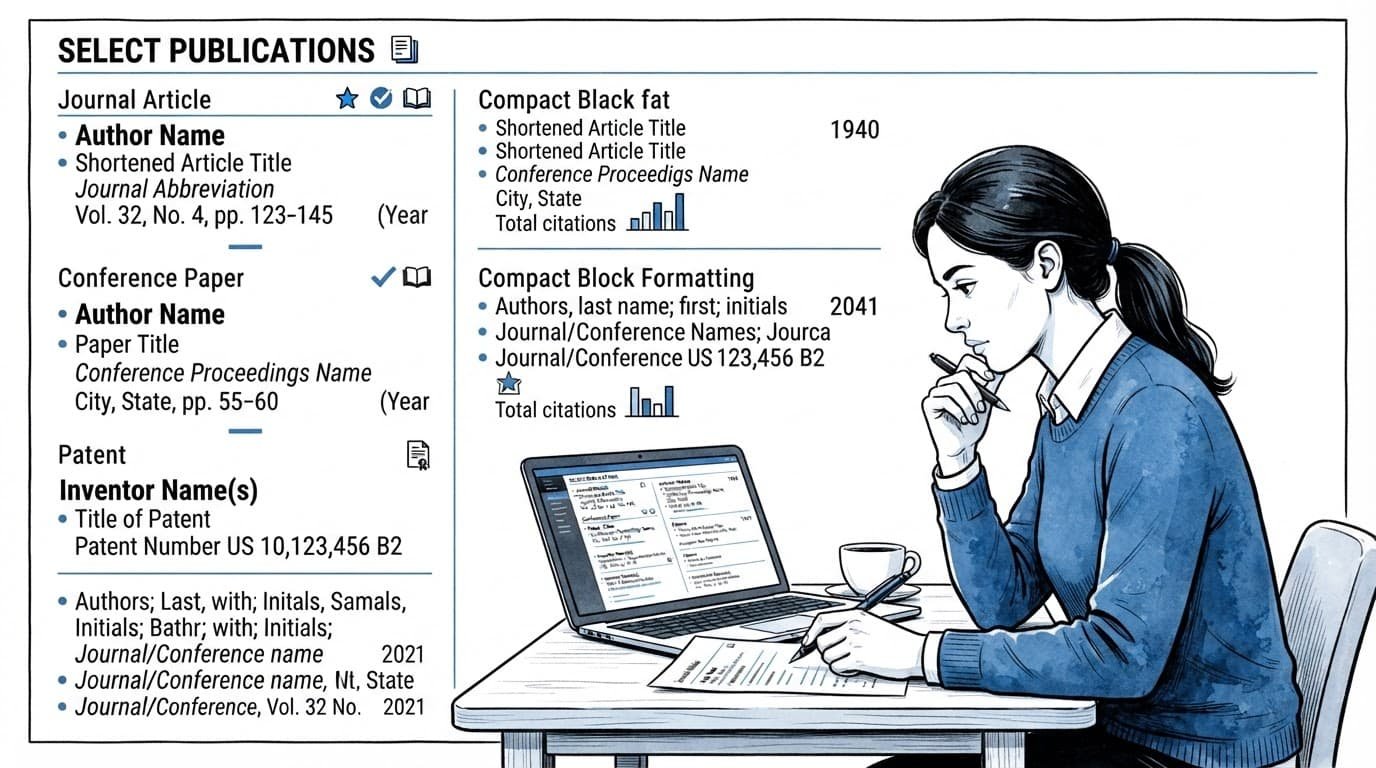
For example, a compact journal entry can read:
LeCun, Y., Bottou, L., Bengio, Y., & Haffner, P. (1998). Gradient-based learning applied to document recognition. Proceedings of the IEEE, 86(11), 2278-2324.
Bold your author name, not every author. This visual cue makes your authorship easy to spot, especially on a paper with multiple contributors.
Use the citation style your field expects. APA style fits many science, health, and social science roles. MLA format may fit humanities applications; humanities applicants should verify abbreviated entries against MLA format. Most industry roles don’t require full academic conventions. A clean, consistent format is often better than squeezing in every issue number and page range. See these APA, MLA, and Chicago examples before choosing a format.
Use these formatting tips to save space:
- Drop long author lists after your name when the employer doesn’t need every contributor.
- Link the publication title to a DOI, a digital object identifier, or the publisher page in a PDF resume. Use readable text labels and standard punctuation so applicant tracking systems can parse the entry, rather than pasting a long URL.
- Skip abstracts, keywords, and citation counts unless they directly support the job.
Use “in press” only after formal acceptance. Brock University’s APA publication citation guide also uses that designation for accepted work awaiting publication. Do not list manuscripts that are merely in preparation. Keep “under review” separate from published work in a Research Projects section, and use it only when the role makes active research central.
Give Co-Authored Work Recruiter Context
Co-authorship is common, and it still carries weight. Make your author name easy for hiring managers to find, then clarify your role without turning the resume into a methods section.
For a publication you co authored, add a short contribution clause when author order isn’t enough. Use an accurate phrase such as “First author; led mixed-methods analysis” or “Co-author; built the Python data pipeline.” Include that detail only when it supports a skill in the job description.
For technical and research-heavy roles, point to evidence from published research papers using terms such as causal inference, clinical trial design, natural language processing, or user research. Mirror a technical term from the job description only when the publication genuinely demonstrates it. Applicant tracking systems may scan publication titles and contribution descriptions, but accuracy matters more than adding unrelated terms.
citation counts can help non-specialist recruiters when substantial and current. State the source and check date, such as “Google Scholar citations, checked August 2026.” Otherwise, the journal name, conference, or publisher often gives enough context.
Include Industry Publications Without Turning It Into a Portfolio
Publications are not limited to academia. In industry roles, marketers can include bylined trade articles and research-backed white papers. Software engineers can include conference papers, technical reports, or documentation with recognized authorship. Consultants may include named reports when client confidentiality permits.
A corporate resume should favor work that demonstrates a business-relevant subject, an authoritative outlet, or measurable responsibility. Personal blog posts usually belong in a Portfolio or Projects section unless they have meaningful readership, editorial review, or direct relevance to the role.
Align Your Resume, Letter, and Interview Story
Early-career candidates should review publication placement alongside the education section and work experience, since a dedicated section may not be necessary. Review your publication section after you tailor the rest of the document.
CareerScribeAI’s getting started guide can help you import a resume into the resume builder and check whether the layout still protects your strongest experience.
Optionally, use the Cover Letter Generator to connect one publication to the employer’s needs. The Interview Prep Tools can help you rehearse a concise explanation of the question, your contribution, and the outcome.
Frequently Asked Questions
How many publications should I list on a resume?
Choose three to five publications when they directly support the role. If you have only one or two strong entries, place them under Education, Research Experience, or Work Experience instead of creating a dedicated section.
Should publications go on a resume or a CV?
A resume should include only selected, relevant publications and usually stays within one or two pages. An academic CV can document your complete record, including articles, abstracts, presentations, grants, and teaching.
How should I format publications on a resume?
Use a consistent citation pattern with your author name, the title, outlet, and publication date. Follow the conventions of your field when appropriate, but prioritize readable formatting over details that do not support the application.
How do I show my contribution to a co-authored publication?
Bold your name and add a short, accurate contribution clause when author order is not enough. For example, write “First author; led mixed-methods analysis” or “Co-author; built the Python data pipeline.”
Can I list a publication that is under review?
Keep work that is under review separate from published work, such as in a Research Projects section, and include it only when active research is central to the role. Do not list manuscripts that are merely in preparation, and use “in press” only after formal acceptance.
Make Every Publication Carry Its Weight
Limited space forces a useful decision: include only work that supports the next job. Early-career candidates can place a short list in the education section when it supports their academic or research background. That focused list shows research ability, technical depth, and professional voice; citation counts add context, not proof of relevance, authorship, or contribution.
Keep formatting consistent, make co-authored contributions clear, and reserve the complete record for your CV. Relevance earns more space than volume.