


This question looks simple until you try to answer it out loud. Then every deadline, request, and half-finished task seems to show up at once.
When preparing for a prioritize work interview, this question is inevitable. Hiring managers are not asking for a breakdown of your to-do list. Instead, they want to hear how you decide which tasks matter, how you handle trade-offs, and how you remain productive when dealing with shifting priorities. In 2026, that also means showing comfort with shared workflows, changing deadlines, and team-based decisions.
Key Takeaways
- Focus on Decision-Making: Hiring managers prioritize your ability to assess impact, deadlines, and dependencies over your specific task-management tools.
- Use a Structured Framework: Aim for a 60-90 second response that follows a clear process: assess goals, apply sorting rules, communicate proactively, and conclude with a specific result.
- Demonstrate Adaptability: Show that you can handle shifting priorities and mid-stream changes by confirming urgent tasks with stakeholders rather than working in isolation.
- Connect Efforts to Results: Use the STAR method to provide a brief, evidence-based example of how your prioritization system successfully managed a high-pressure situation.
What hiring managers want to hear
A strong answer demonstrates sound judgment and solid time management skills rather than mere busyness. When a hiring manager asks this question, they are not just looking for a checklist of tasks. They need to hear how you apply the urgent vs important principle to distinguish between competing needs, how you resolve conflicts, and how you protect key results.
Common advice in Indeed’s interview guide and Kathy Caprino’s LinkedIn article points to the same pattern: explain your method, then back it up with a real example.
Usually, the hiring manager is listening for four specific things:
- Clear criteria, such as impact, meeting deadlines, risk, and dependencies
- Adaptability when new work appears or conditions change
- Collaboration when two important tasks collide
- Results, because effort alone is not enough
Hiring managers do not need a perfect system. They want proof that you can make smart trade-offs under pressure.
That matters even more in hybrid teams. Utilizing systems like ticket queues, project boards, and AI-assisted planning is essential for effective workload management, as these tools make your process visible and ensure your performance remains transparent.
A reliable formula for your answer
Keep this answer to about 60 to 90 seconds. When you are asked how you prioritize work during an interview, a structured response works much better than a long, rambling story.
Use this four-step framework
- Start with the goal. Begin by explaining your initial task assessment. Describe what you check first, such as impending deadlines, overall business impact, customer needs, or team dependencies.
- Explain your sorting rules. Mention the criteria you use to rank tasks as part of your professional decision-making processes, rather than just naming the app you use to store them.
- Show how you communicate. If two high-priority items conflict, explain how you confirm the direction with a manager or partner team to ensure you stay aligned with company objectives.
- End with one result. Use a concise version of the STAR method (Situation, Task, Action, Result) to provide a brief example that demonstrates how your specific method led to a successful outcome.
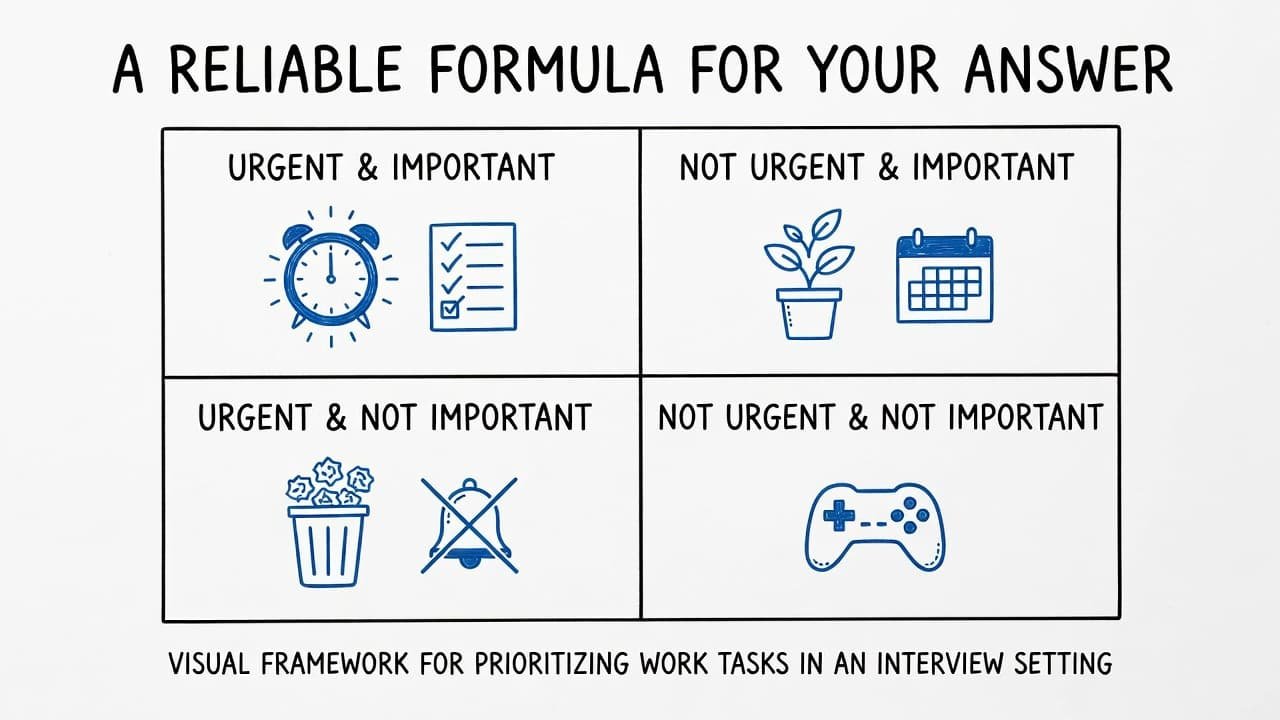
You can name a tool if it helps provide clarity. Still, the software is not the main point of your answer. Whether you rely on project management software, daily to-do lists, a CRM queue, or a shared spreadsheet, employers care far more about your underlying reasoning than the specific digital tools you use to manage your workflow.
A clean answer might sound like this: “I start with a careful task assessment, looking at impact, deadlines, and dependencies. Then, I rank my work based on what affects customers or blocks other team members. If two urgent items compete, I confirm the priority quickly instead of guessing. In my last role, using this approach helped me hit every weekly deadline while effectively handling unexpected, same-day issues.”
Sample answers for different roles
You do not need to memorize these word for word. Instead, use these real-life examples as a blueprint to help you structure your own experiences across various career stages.
Entry-level or recent graduate
I prioritize work by checking deadlines first, then looking at which tasks affect other people. During my internship, I handled support requests while helping with a weekly report. I cleared urgent issues first, blocked time for the report, and checked with my supervisor when new requests could affect the timeline. That kept response times steady, and I succeeded in meeting deadlines for every project.
Mid-career project manager
I prioritize work based on business impact, delivery dates, and team coordination. In my last project, I used our tracking board to separate critical path items from lower-risk requests. When a late change came in, I reviewed the effect with engineering and marketing before shifting anything. That helped us maintain focus, stick to our schedule, and avoid last-minute rework while meeting deadlines.
Analyst or operations professional
I start by asking which work has a fixed deadline, what carries the highest risk, and what other teams are waiting on. In operations, month-end work and ad hoc requests often collide. I protect the fixed reporting window, flag conflicts early, and give faster turnaround to requests tied to revenue or compliance. Through proactive stakeholder engagement, I communicate those trade-offs early so everyone knows what to expect.
Customer support or service role
I prioritize by urgency, customer impact, and service commitments. In a busy queue, I handle urgent tasks first, then move on to important tasks that may be less time-sensitive, grouping similar items to stay efficient. If a manager needs something that could affect response times, I raise that conflict right away. That keeps service levels stable and helps the team avoid surprises.
For panel rounds, concise stories matter even more. CareerScribeAI’s guide to tips for answering panel interview questions is useful if you need help trimming examples for multiple listeners.
Common mistakes and a quick do/don’t check
Weak answers usually fail for one reason: they stay abstract. Vague claims about organizational skills or saying “I multitask well” tell the interviewer almost nothing.
Use this quick screen before you practice aloud:
| Do | Don’t |
|---|---|
| Tie workload management to impact, deadlines, and dependencies | Say you handle everything at once |
| Mention how you align with a manager or team | Pretend you never need clarification |
| Give one short example with an outcome | List every tool you use |
| Show flexibility and adaptability when priorities change | Sound rigid or over-scripted |
Practice until the answer sounds natural. Mastering the art of re-evaluating priorities and demonstrating a calm approach to handling pressure will leave a lasting impression on any hiring manager. CareerScribeAI’s AI Resume Builder, Cover Letter Generator, and Interview Prep Tools can help you keep your examples consistent across your resume, application, and interview stories. If you’re preparing for an early screening call, this preparation guide for phone interviews is a helpful next step.
Frequently Asked Questions
Should I mention specific software tools when explaining my process?
You can mention tools like project boards or ticket queues, but they should not be the focus of your answer. Employers are interested in your underlying reasoning and logic, not the digital platform you happen to use for tracking tasks.
How do I handle a situation where everything feels urgent?
Explain how you evaluate competing tasks based on impact, risk, and team dependencies. If you are truly stuck, clearly state that you proactively communicate with managers or teammates to verify which task aligns best with current company objectives.
Can I admit that I sometimes need help prioritizing?
Yes, showing that you ask for clarification when priorities are unclear is a strength, not a weakness. It demonstrates that you value accuracy and alignment over guessing and risking a project’s timeline.
How long should my answer to this question be?
Keep your response between 60 and 90 seconds. A structured, concise answer allows you to convey your professional competence without rambling or overwhelming the interviewer with unnecessary details.
Final Thoughts
A strong answer to the question of how do you prioritize your work is ultimately a short decision story. You should show the rules you use, how you collaborate with others when priorities clash, and the specific results you protect.
When you practice, focus on clear reasoning more than perfect wording. If the interviewer can visualize how you handle pressure and make sound decisions on a crowded Monday, your answer is doing its job. Remember that mastering this skill is not just about impressing recruiters. Effective prioritization helps you manage your time efficiently, which is a key component in maintaining a healthy work-life balance and preventing burnout throughout your career.