


Hiring managers need more than proof that you care about a cause. A strong nonprofit resume shows that you understand the mission, can do the work, and have delivered results people can verify.
That matters whether you are entering the sector, moving from a corporate role, or pursuing nonprofit leadership. Your experience becomes more persuasive when it connects skills to people, programs, donors, and communities. A mission-driven resume pairs personal motivation with evidence of results, showing social impact and advancing social change.
Use each section to make that connection clear.
Key Takeaways for a Stronger Application
- Lead your nonprofit resume with relevant outcomes in a professional summary, not a broad claim that you’re “passionate” about the mission.
- Translate corporate experience into nonprofit sector language without overstating your background.
- Use action verbs to present accomplishments clearly, and include volunteer experience when it demonstrates relevant skills.
- Tailor keywords and job titles to each posting, while keeping every claim accurate.
- Choose a clean resume template that works with applicant tracking systems, so your evidence reaches a human reviewer.
What a Nonprofit Resume Must Prove
Show mission alignment through choices
Mission alignment should appear in the facts of your career, not only in your summary. Mention work with relevant communities, boards, advocacy efforts, employee resource groups, pro bono projects, or long-term service commitments.
Use these nonprofit resume examples to show sector-specific evidence. An applicant for an environmental advocacy role might emphasize stakeholder outreach, public education, grant support, or policy research.
A public health organization may value experience with patient access, health equity, community partnerships, or program evaluation. Advocacy that advanced social change can also reveal a clear connection to the mission.
Keep the connection direct. Hiring managers want to see why this role fits your record and values.
Pair integrity with measurable results
Nonprofit work often involves limited budgets, sensitive data, public trust, and diverse stakeholders. Show sound judgment through responsibilities such as managing restricted funds, safeguarding participant information, coordinating volunteers, or reporting outcomes to a board of directors.
Coordinating volunteers and stakeholders can also demonstrate leadership skills. Look for evidence throughout your work experience, including fundraising events, donor retention, grants submitted, volunteers trained, people served, response times, and program completion.
Then turn that evidence into resume accomplishments. Use action verbs to structure bullets around the scale of work, your action, and the result. Real figures make those contributions more credible.
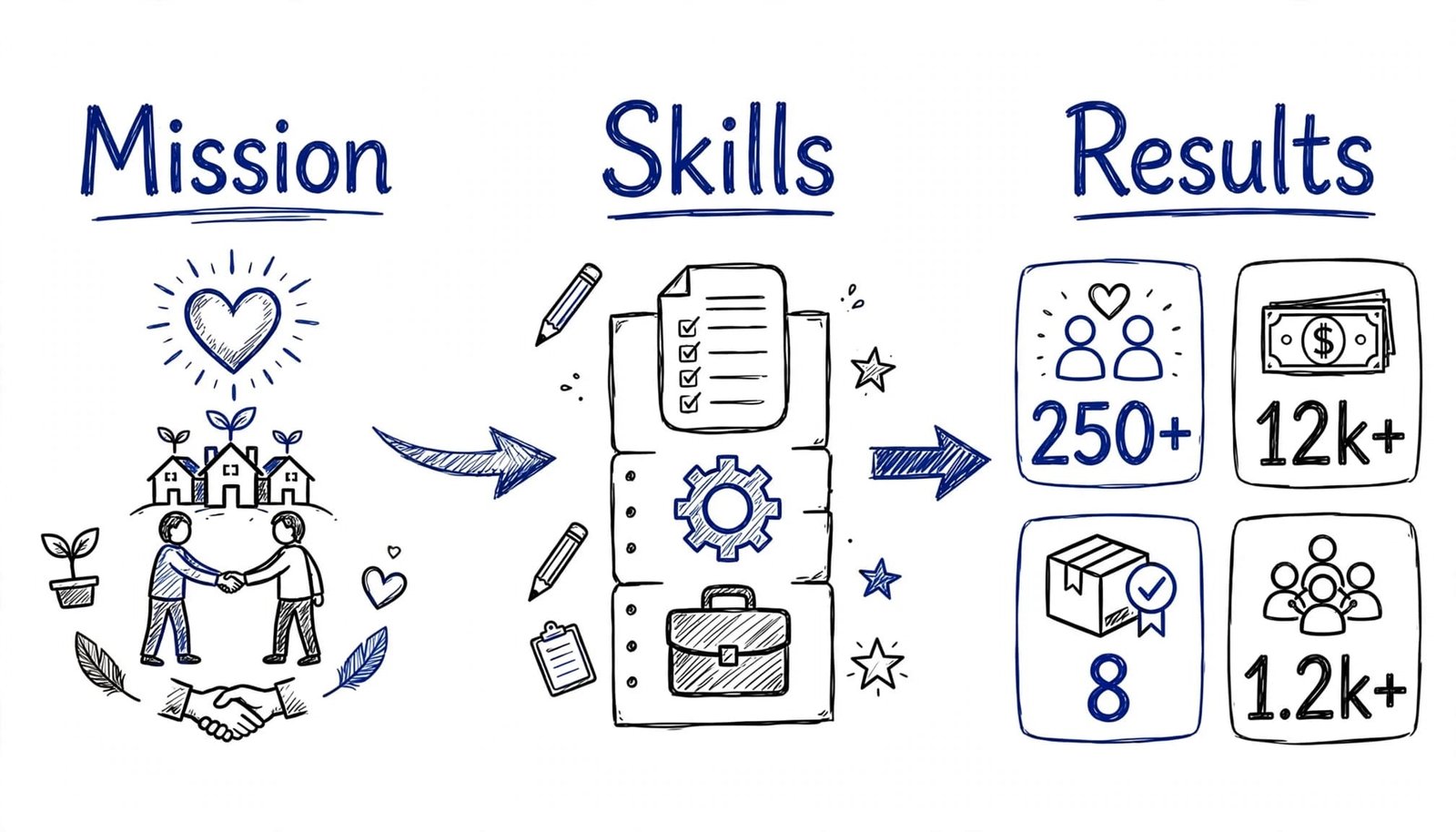
This hand-drawn black-and-blue-on-white infographic shows the transformation from mission-driven work to quantified resume accomplishments: mission or need → action → audience served → metric → result.
Mission language earns attention when the rest of the resume shows what you did, who benefited, and how you measured progress.
Adapt Corporate Experience for the Nonprofit Sector
Translate transferable skills into outcomes
A corporate background can transfer into the nonprofit sector. On a nonprofit resume, explain how experience from the for-profit sector supports mission-driven work.
Transferable skills such as project management, budgeting, data analysis, operations, marketing, client service, and people leadership all transfer when you explain them in mission-relevant terms.
A sales background can demonstrate donor relations, relationship management, and prospect research. Operations experience can show vendor oversight, budget discipline, and program delivery. Marketing work may translate to community engagement, supporter communications, and fundraising events promotion.
Bridgespan’s guidance for adapting for-profit experience offers useful examples for candidates making this transition.
Replace internal jargon with plain language
Avoid company acronyms and polished business phrases that hide your contribution. Use action verbs to state what you owned, who you worked with, and what changed.
If you’re adapting a resume template, replace phrases like “drove cross-functional alignment” with the partners involved and the work completed. Instead of “optimized the customer journey,” explain the process you improved and the result. Plain language makes your experience easier to understand.
Build Each Resume Section Around Evidence
Write a focused summary and work history
Open your nonprofit resume with a focused professional summary of two or three sentences. Name your specialty, relevant experience, and the mission you support in the nonprofit sector. Tailor the professional summary to the target role, then show nonprofit resume skills through specific evidence. Skip an objective statement and vague claims about being hardworking.
Under work experience, start each bullet with action verbs such as led, coordinated, analyzed, developed, secured, improved, or trained. Prioritize resume accomplishments that best match the role, even when they came from a corporate position. Use a clean resume template with clear headings and readable spacing.
Recent graduates can feature internships, campus leadership, research, substantial volunteer work, and their educational background. Experienced professionals should focus on the last 10 to 15 years, with older roles condensed unless they directly support the target position.
Give volunteer work professional weight
Place volunteer experience in its own section when it’s sustained, leadership-oriented, or relevant to the role. Include the organization, position, dates, and results. Use action verbs to describe committee leadership, recurring program work, or board service. Treat these contributions with the same care as paid work.
Education belongs near the top for students and early-career applicants, whose educational background may carry more weight. For leadership roles, list credentials only when they fit the posting and support nonprofit management work. An executive director target may value leadership skills alongside relevant experience. CFRE may support fundraising roles, PMP can reinforce project management, and DEI training may matter for community-facing or people leadership work. These credentials can strengthen your application, but none replaces demonstrated experience.
Make Your Nonprofit Resume ATS-Friendly
Mirror the job description honestly
A nonprofit resume should be easy for applicant tracking systems to parse. Some systems also assess language alignment with a role’s criteria. Read the job description closely and use its exact terms when they accurately describe your work.
If the posting requests grant writing, donor stewardship, Salesforce, program evaluation, or community engagement, place those terms in relevant bullets or skills sections. Pair them with action verbs that describe real accomplishments. Don’t add a keyword because it sounds useful. Unsupported claims create problems during interviews.
CareerScribeAI’s responsible AI resume optimization guidance emphasizes the same rule: use AI to organize and strengthen real evidence, never to invent experience.
Use conventional formatting and tailored versions
Choose standard headings such as a professional summary, Experience, Education, Skills, and Community Service. Applicant tracking systems read these familiar labels more reliably. Avoid text boxes, graphics, tables, unusual fonts, and critical details in headers or footers.
A targeted nonprofit resume for each application is worth the effort, especially when moving into the nonprofit sector. A resume template can provide structure, but tailor its content to each posting. CareerScribeAI’s AI resume builder and career tools can compare a resume with a specific posting, identify missing phrasing, and provide a directional 0 to 100 match score. Its Cover Letter Generator and Interview Prep Tools can then help you keep your application, tailored cover letter, and STAR stories consistent.
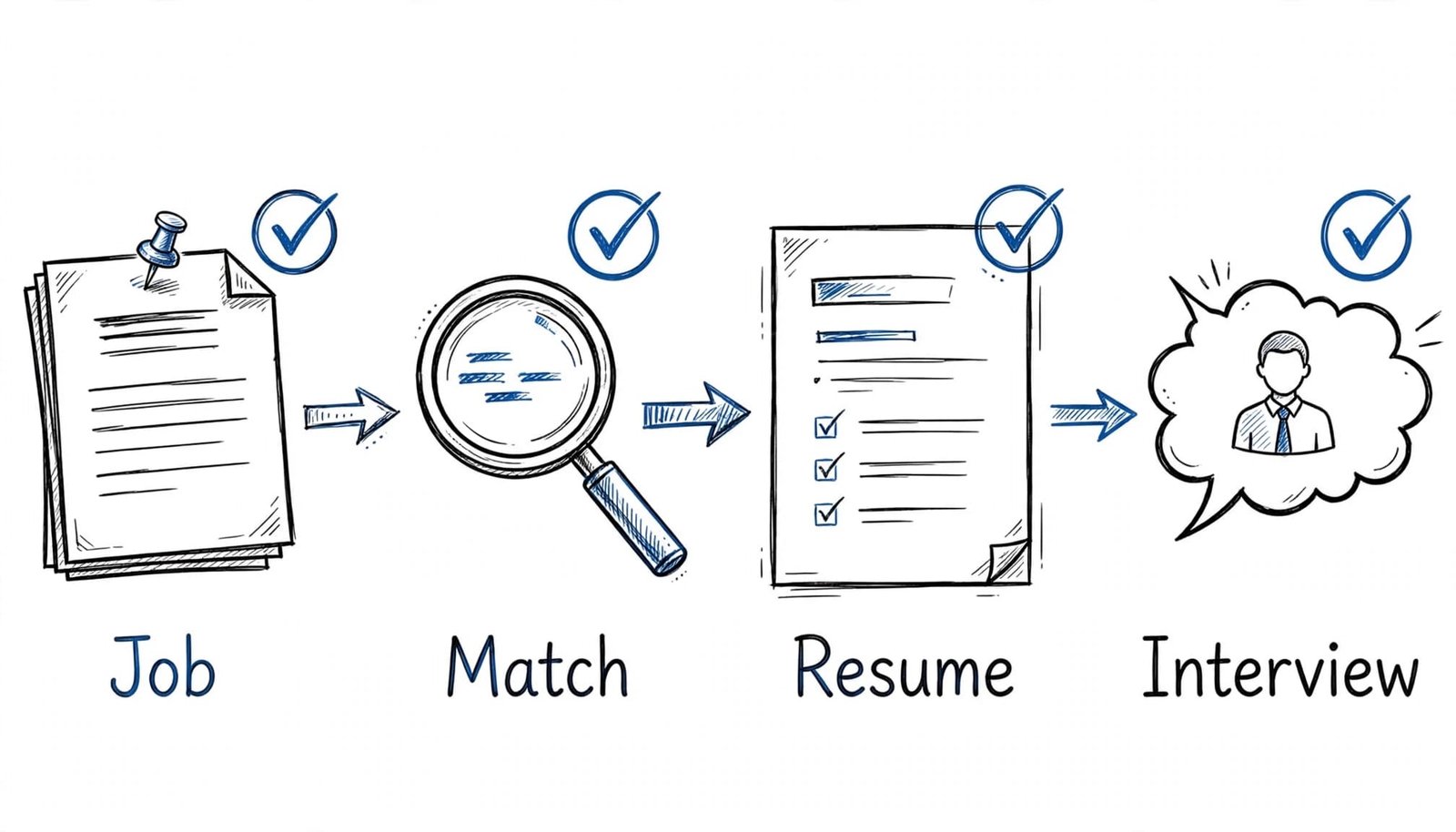
This hand-drawn black-and-blue-on-white infographic compares a posting with a tailored application: required phrase → evidence bullet → standard section → ATS-readable format.
Frequently Asked Questions
What resume length is right for a nonprofit resume?
Recent graduates should usually aim for one page. Professionals with substantial, relevant leadership or program experience may use two pages. Choose a resume length that keeps every line relevant to the role.
Should volunteer experience come before paid work?
Put it first only when it’s your strongest evidence for the position. Otherwise, list it after paid experience and give major contributions enough detail to show scope and results.
Where can I find mission-driven roles?
Search organizations directly, professional associations, and targeted job boards. Impact Opportunity’s mission-focused career board is one resource for people seeking roles with a nonprofit organization.
Final Thoughts
A persuasive nonprofit resume connects mission, capability, and results in every major section. It gives employers clear proof that you can advance the organization’s work with skill and integrity.
Review your professional summary alongside the evidence throughout the document, then tailor each detail to the role and let specific outcomes carry the story.