


Your last job title tells employers where you worked. It doesn’t show what changed because you led, but a strong executive resume makes those results clear before a hiring committee reaches page two.
For C-suite roles, use strategic thinking to choose the decisions you owned and outcomes you can defend. Shape your executive resume around the role you’re seeking, whether an executive search or job search brought it to you. Terminology varies by market, but your executive CV and cover letter should support your next step in career development.
Build an executive resume around the target role
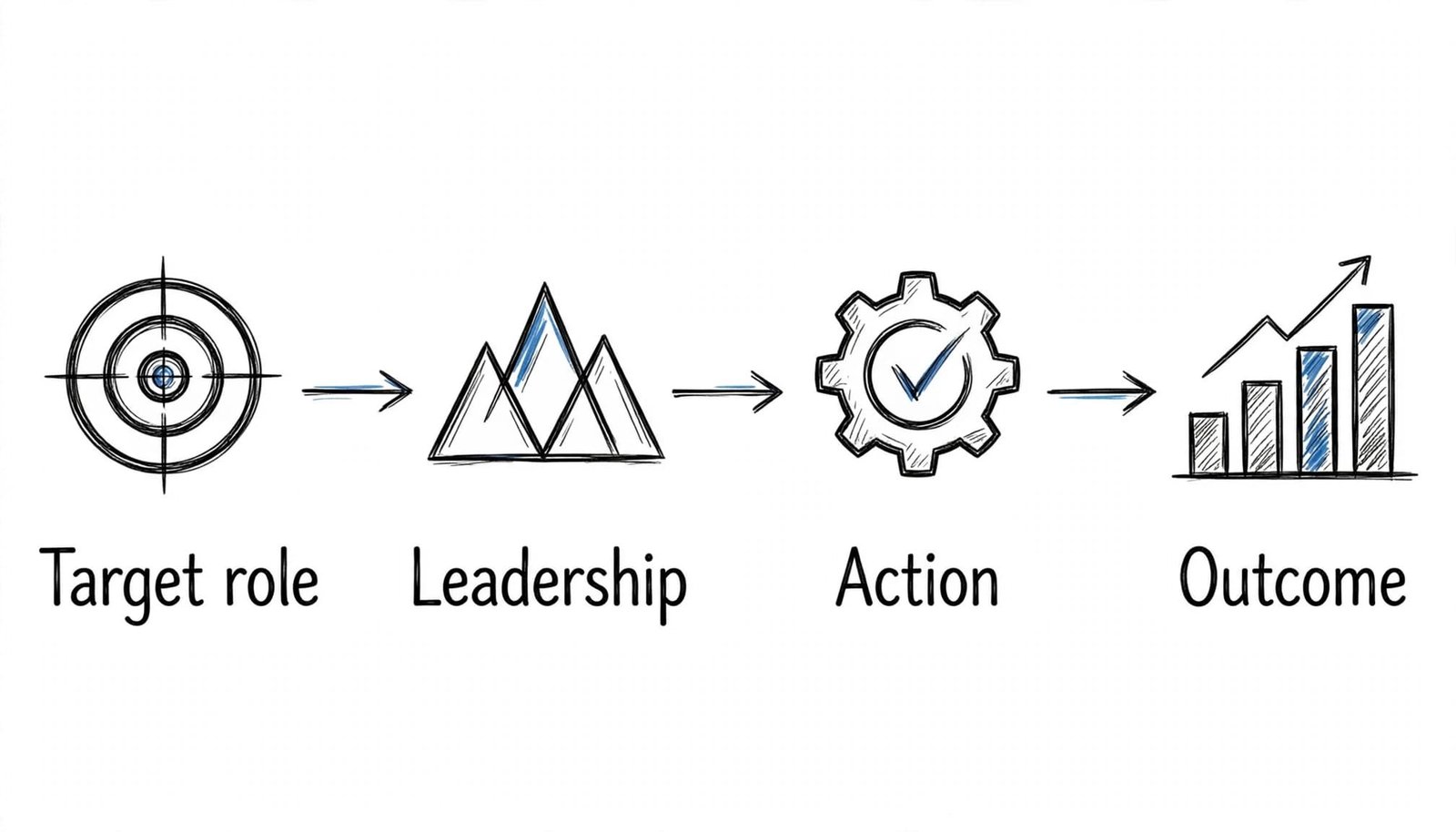
A hand-drawn black-and-blue infographic on white shows four steps: identify the mandate, select evidence, shape the summary, and choose relevant skills.
A standard resume can emphasize duties and technical skills. An executive resume needs to show organizational scope, strategic judgment, and outcomes. Read the posting first: a growth mandate calls for different evidence than a turnaround or operational overhaul. Depending on the market, the document may be called an executive CV.
Define the leadership mandate
Identify the decisions the employer needs its next leader to make. Then select career highlights from your leadership experience and professional experience that show you’ve handled comparable stakes. Budget ownership, reporting lines, geographic reach, and cross-functional authority give readers context for your results and demonstrate strategic thinking.
Don’t claim full credit for a company-wide outcome if you owned one part of it. Describe your contribution precisely. That’s more credible than a broad claim you can’t explain in an interview. Keep your cover letter aligned with the same evidence.
Make the opening earn its space
Use a short professional summary to establish your leadership focus and strongest relevant result. This supports executive branding and gives hiring managers a clear view of your fit. An executive CV can use the same concise opening structure. Follow it with a compact key skills section that separates relevant hard skills, such as P&L management, from soft skills, such as change management.
Replace an objective statement with evidence. “Seeking a challenging leadership role” tells an employer little; a summary that connects your remit to a proven business outcome gives them a reason to keep reading. If that message is hard to explain aloud, interview coaching can help sharpen its focus.
Translate leadership actions into business impact
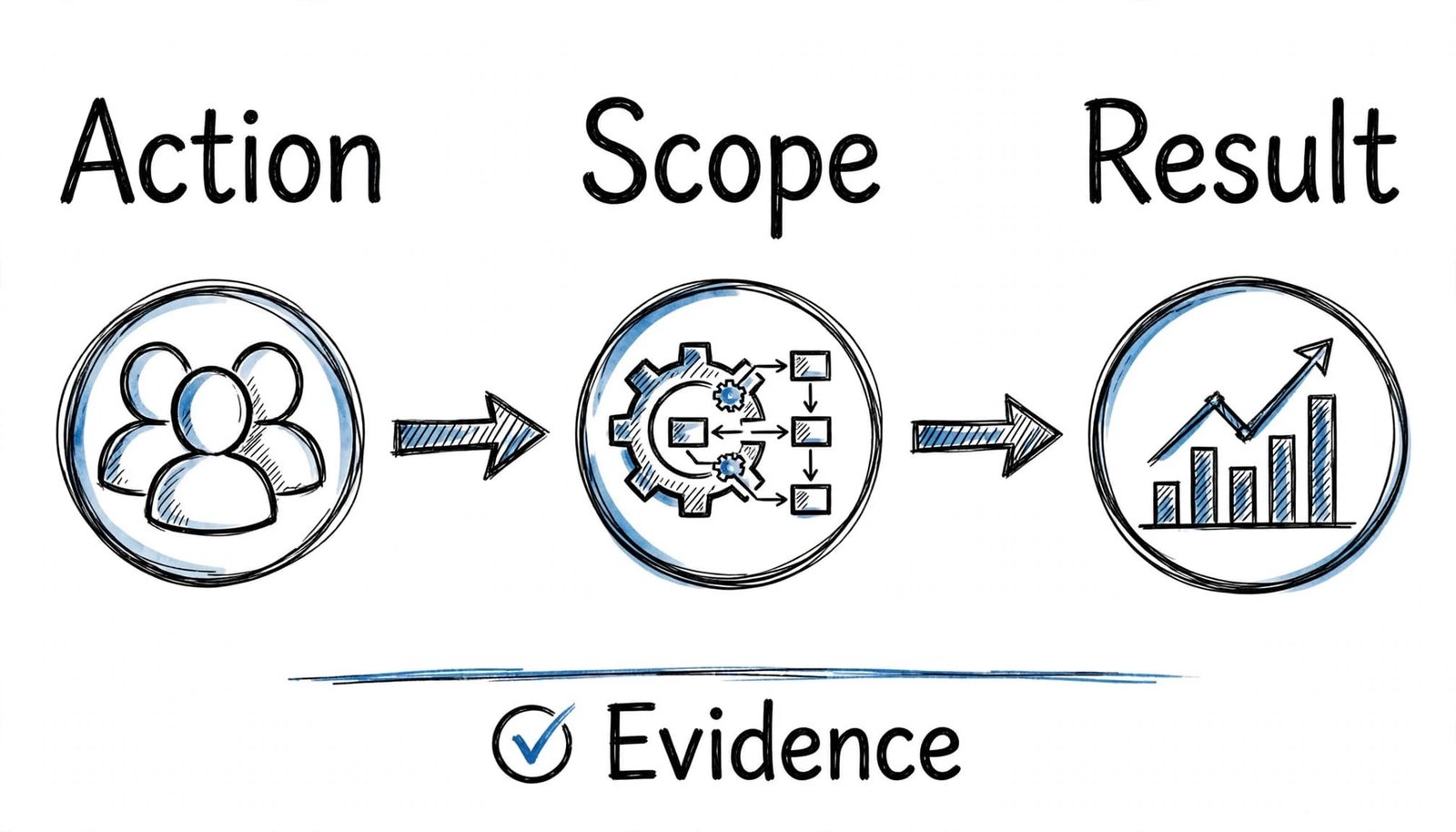
A hand-drawn black-and-blue infographic on white illustrates action + scope + result + evidence as a defensible achievement bullet.
A responsibility describes what your role required. An achievement shows what your leadership changed. For each major bullet, connect action, scope, result, and evidence.
Write bullets that can survive follow-up questions
“Responsible for sales operations” leaves the reader guessing. Use specific action verbs, but don’t mistake strong wording for evidence. A stronger version might read: “Led a cross-functional team through a CRM migration across regional sales teams, replacing duplicate pipeline reports with a shared forecasting process.” It names an action, the affected group, and an observable change without inventing a percentage.
Add revenue growth, cost reduction, time savings, or improved operational efficiency when you have records to support them. An executive resume should connect each result to a clear baseline and time period. Practice explaining those details and your contribution; interview coaching can help you prepare concise answers.
Use evidence when precise metrics are missing
Older employers may not have tracked clean before-and-after figures. In that case, show verifiable scale and outcomes: a budget you managed, markets covered, teams brought together, or a process adopted across business units. Records, performance reviews, board materials, and former colleagues can help confirm details.
An executive CV should make claims easy to defend. Rehearse how you’ll explain the baseline, time period, and your role; interview coaching can help you prepare for follow-up questions. AI can improve phrasing, but it can’t verify your history. CareerScribeAI’s evidence-based AI resume tailoring is a useful model: compare suggestions with your records and reject numbers you can’t substantiate. An executive CV is strongest when every claim can be backed up.
Give senior experience enough room, without keeping everything
Start with two pages
Two pages are a practical starting point for most leaders with more than ten years of experience, whether they’re preparing an executive resume or executive CV. A third page can make sense for a complex C-suite career if every section adds relevant evidence. Don’t shrink the font to meet an arbitrary limit.
Give recent leadership positions in your professional experience the most space. Compress early positions into brief entries when they establish useful industry experience, and remove details that no longer support your target role.
Keep personal information focused
Include your name, city and region, phone number, professional email, and a relevant LinkedIn profile. Usually, you can leave off your exact street address, birth date, graduation dates that add no value, and a photo. Check local application requirements before following a convention that may differ by country.
Your LinkedIn profile should reinforce the same scope and achievements as your executive CV. It needn’t repeat every bullet, but conflicting dates or job titles create avoidable questions.
Make the document readable by people and hiring systems
Applicant tracking systems can parse resumes into fields, while employers may also use automated tools in selection. The EEOC’s discussion of AI in employment illustrates why these tools deserve scrutiny. No formatting trick guarantees an interview.
Use a clean structure
A clean executive resume should be easy for people and software to scan. Choose standard headings such as “Professional Experience” and “Education.” For an executive CV, keep dates consistent, contact details in the document body, and the main layout simple. Tables, text boxes, and complex columns can make information harder to extract. Follow the posting’s file instructions, and use a text-based PDF or DOCX when either is accepted.
CareerScribeAI offers ATS-friendly resume templates if you’re rebuilding the layout. Check the exported executive CV yourself to confirm that names, dates, and bullets appear in the right order.
Match the role without overstating your expertise
Use the employer’s terminology where it’s accurate. For digital transformation, name the process or system you changed and what improved. For AI fluency, distinguish sponsoring adoption from building or governing a model. Include ESG work when you can explain your responsibility and its business or reporting outcome. Interview coaching can help you prepare to explain these claims clearly.
CareerScribeAI’s job-specific resume and interview tools include an AI Resume Builder, Cover Letter Generator, and Interview Prep Tools. The tools can support interview coaching as you prepare to discuss your application. Keep your cover letter aligned with your resume, and review every AI-generated claim.
Avoid the mistakes that weaken executive resumes
Generic summaries, long duty lists, and unsupported superlatives obscure strong careers. Unexplained acronyms, irrelevant early jobs, and results you can’t defend also weaken an executive CV.
Before applying, review your executive resume: can readers identify your mandate, decisions, and resulting change within the first half-page? Practise explaining each achievement clearly in conversation, as you would in interview coaching. If those answers are buried, move the best evidence up rather than adding more claims.
Key Takeaways
- Target the leadership problem named in the posting.
- Connect each major action to its scope and a defensible outcome.
- Keep the format readable, then check the exported resume and every AI suggestion.
FAQ
How is an executive resume different from a standard resume? It gives more space to leadership decisions, organizational scope, and business results than to routine responsibilities. In some markets, the term executive CV is used instead.
Should every achievement include a number? No. Use verified figures when available; otherwise, describe a concrete change and your role in it.
Can an ATS reject a resume for missing keywords? Screening practices vary by employer. Clear headings and truthful, role-relevant language help readers and systems interpret your experience, but they don’t guarantee selection.
Conclusion
An impressive title won’t answer what changed because you led. A focused executive resume, also called an executive CV, will show the mandate, the decisions you made, and the results you can support.
Credible business impact is the strongest case you can make, on the page and in the interview.