


When a hiring manager asks how you adapt to change interview questions, a weak response often sounds like a generic personality guess. In 2026, employers want concrete proof that you can remain productive when tools, teams, and priorities shift within a modern work environment.
That pressure is higher now because the professional landscape keeps moving. AI is changing daily tasks, hybrid work models are the standard, and many roles expect rapid learning. In this climate, a clear story about your resilience beats a vague claim every time.
Key Takeaways
- Employers are looking for specific examples of your experience, rather than just hearing you claim that you are flexible at work.
- Use a simple four-step story format to handle behavioral interview questions: acknowledge, assess, act, and analyze.
- Tie your answer to the reality of modern work environments, including AI integration, hybrid teams, and the essential soft skills required for continuous reskilling.
- Match your narrative to your professional level, as an intern’s story about change should sound fundamentally different from a manager’s experience.
Why employers ask about adapting to change in 2026
This question is not about whether you like change. It is about how you behave when plans shift and nobody has a perfect script.
That matters more now because many companies have moved from AI adoption to AI absorption, meaning they are redesigning workflows to navigate organizational change alongside new AI tools and agents. Recent 2026 reporting shows 69% of business leaders expect AI agents to change operations, while Gallup notes that 52% of remote-capable U.S. employees work in hybrid setups. In this dynamic work environment, LinkedIn has reported that 10 of the 15 fastest-growing skills are soft skills.
When you face standard adaptability interview questions, the interviewer is scoring four specific traits at once:
- Can you stay calm when the plan changes?
- Do you possess a growth mindset that allows you to learn fast without being defensive?
- Does your communication style allow you to coordinate effectively with other people?
- Can you demonstrate the resilience to turn a messy situation into a useful result?
For extra practice, review a few adaptability interview questions with sample answers to better prepare. The patterns remain consistent, as employers are ultimately looking for sound judgment, decisive action, and clear results.
A simple structure for your answer
A strong answer should feel organized, not rehearsed. Keep it under two minutes, and use one example that shows movement from disruption to action to demonstrate how you handle change effectively.
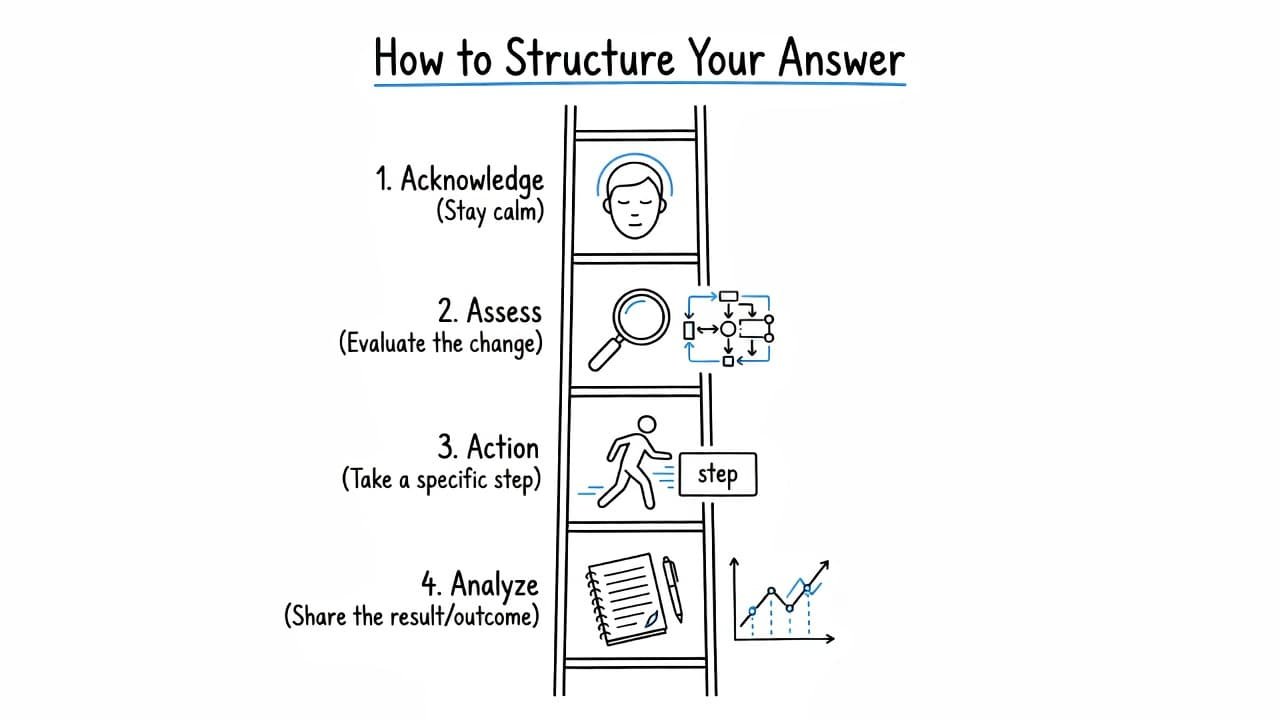
Use this four-step frame to navigate common workplace changes:
- Acknowledge the change. State what shifted, such as a new manager, tool, deadline, or unexpected obstacles that disrupted your workflow.
- Assess the impact. Show that you understood the risk, not only your personal stress, and identify where you may need to learn new skills to maintain quality.
- Take action. Explain what you did first to stabilize an unfamiliar situation, who you involved, and how you adjusted your approach.
- Analyze the result. End with the outcome and the key takeaway of what you learned.
This works well because it gives shape to a behavioral answer without sounding robotic. You can still borrow from the STAR method, but keep the situation and task short. Spend most of your time on action and result.
Pick an example that matches the role. If you are interviewing for customer support, talk about a ticketing change, policy update, or AI assistant rollout. If you are in marketing, use a campaign shift, channel change, or new reporting system. Meanwhile, if the role is hybrid or cross-functional, mention how you kept people aligned across meetings, time zones, or tools.
One mistake sinks many answers: candidates talk only about feelings. A better answer names the problem, shows a decision, and ends with evidence. For more ideas on answering questions about unexpected change at work, this guide to adaptability interview questions has useful prompt examples.
Weak vs strong answers, with examples
Most weak answers fail for the same reason. They stay general, or they turn into a complaint.
This quick comparison of candidate responses shows the difference between an average answer and a standout one:
| Type | Weak answer | Strong answer |
|---|---|---|
| Focus | “I handle change well.” | One clear example |
| Detail | Vague and broad | Concrete actions |
| Tone | Frustrated or passive | Calm and practical |
| Finish | No result | Measurable outcome or lesson |
The strongest answer sounds steady, even if the change was difficult.
Sample answer for an entry-level candidate
“I had to adapt during my internship when our team switched project tools in the middle of a product launch. I was still learning the old system, so I kept a positive attitude and spent the first day comparing workflows and writing down the steps that changed. Then I asked a senior coordinator to review my notes, and I used them to update my own job responsibilities and help two teammates catch up. We hit the launch deadline, and I learned that I adapt fastest when I document changes early instead of trying to memorize everything.”
Sample answer for an experienced candidate
“At my last company, leadership implemented an AI-assisted forecasting tool, which led to shifting priorities for the entire department. My team was initially skeptical because the new software changed how we reviewed weekly numbers. To succeed, I had to adjust your approach by testing the tool on one product line first. I flagged where the output needed human review and utilized my problem-solving skills to build a short training guide for the team. Within a month, our reporting cycle was shorter, and accuracy improved because we stopped duplicating manual checks.”
A quick prep timeline before the interview
The day before
Match one adaptability story to the job description, ensuring the example aligns with the company culture you are entering. If your resume says you improved a process, reduced errors, or learned a new system fast, be ready to explain that change out loud. CareerScribeAI’s AI Resume Builder and Cover Letter Generator can help you keep that story consistent with the materials you already submitted.
The hour before
Shrink your answer to three proof points: the change, your action, and the result. This structure helps you demonstrate how you are capable of navigating change and being flexible at work when challenges arise. Then prepare one follow-up detail, because interviewers often ask what you learned or what you would do differently. CareerScribeAI’s Interview Prep Tools can help surface likely follow-up questions from the posting itself.
If your first round is a recruiter call, these phone interview prep tips can help you refine your communication style to keep your story concise. If a later round includes multiple interviewers, review this panel interview preparation guide to ensure your communication style remains effective as the same example lands clearly with a larger group.
Frequently Asked Questions
How long should my answer to an adaptability question be?
Keep your response under two minutes to ensure you remain concise and focused. Spend the majority of your time detailing your specific actions and the resulting positive outcome rather than lingering on the frustration of the change itself.
What if I haven’t experienced a significant change in my career yet?
Even if your experience is limited, focus on a time you had to learn a new tool quickly or pivot your approach to meet a deadline. Employers are more interested in your ability to demonstrate a growth mindset and a logical problem-solving process than in the scale of the change.
Should I mention negative feelings about a workplace change?
It is best to remain professional and solution-oriented by focusing on the transition rather than the inconvenience. Highlighting how you stayed calm and productive during a difficult period is more impressive than detailing any initial resistance or frustration you may have felt.
Conclusion
A thoughtful answer to “How do you adapt to change?” proves that you possess the mindset to learn and act when professional expectations shift. In 2026, the ability to handle change matters more than ever because rapid AI integration, the evolution of the hybrid work environment, and shifting team structures continuously raise the bar for success.
Your best move is simple: pick one authentic story, organize it clearly, and highlight the positive result. Because employers want to see your actual capabilities, providing specific examples will always beat a polished but vague claim. When you demonstrate that you can effectively handle change in a dynamic work environment, you signal to hiring managers that you are ready to grow alongside the company.