


Your resume should open doors, not hand out sensitive information you do not need to share. In 2026, the old habit of listing a full home address on your resume header is mostly outdated.
Most employers want to know your general location, not your street name. If you are unsure what belongs in that contact line, the standard practice for job seekers is to include only your city and state, plus your phone number, email, and LinkedIn profile, rather than listing a full physical address prematurely.
Key Takeaways
- In 2026, most job seekers should list only their city and state on a resume, rather than including a full street address.
- You should reserve your full mailing address for official application forms, background checks, or onboarding documents, as it is not necessary on the resume itself.
- Recruiters often look for a location signal, so omitting all location information can create unnecessary friction during the review process.
- An Applicant Tracking System (ATS) reads location data most accurately when it is placed in the main contact block rather than inside a resume header, footer, or text box.
- If you are planning a move or applying for remote work, state your relocation intent clearly in one short, dedicated line.
The short answer for 2026
For most US job seekers, you should not include your full street address on your resume in 2026. When considering the best format for an address on resume, opting for a general location like Phoenix, AZ or Boston, MA is the preferred approach. Avoiding a full street address keeps your personal information secure while still providing recruiters with the necessary geographic context.
The modern standard for your contact information is to list your city and state rather than including your full street address and zip code.
That advice matches Indeed’s guidance on resume addresses. It also fits how hiring works now, because recruiters contact candidates by phone, email, LinkedIn, and video, not by postal mail.
Recent US resume data backs this up. About 94% of candidates list a general location, while only 4% include their house number and street name. At the same time, 57% of resumes still carry a physical address, which shows how slowly professional habits change.
Due to growing privacy concerns, it is wise to limit the personal details you share publicly. Oversharing sensitive information like your home address can potentially lead to identity theft or unnecessary location bias during the screening process. Unless an employer specifically asks for your full details in an application portal or during the onboarding paperwork, keeping that information off your resume is the better call.
What recruiters and ATS expect now
Recruiters and hiring managers still care about your location, though they no longer require your full street address. They primarily use this information to determine if you are within a reasonable commuting distance, located in the correct time zone, or serious about a potential relocation.
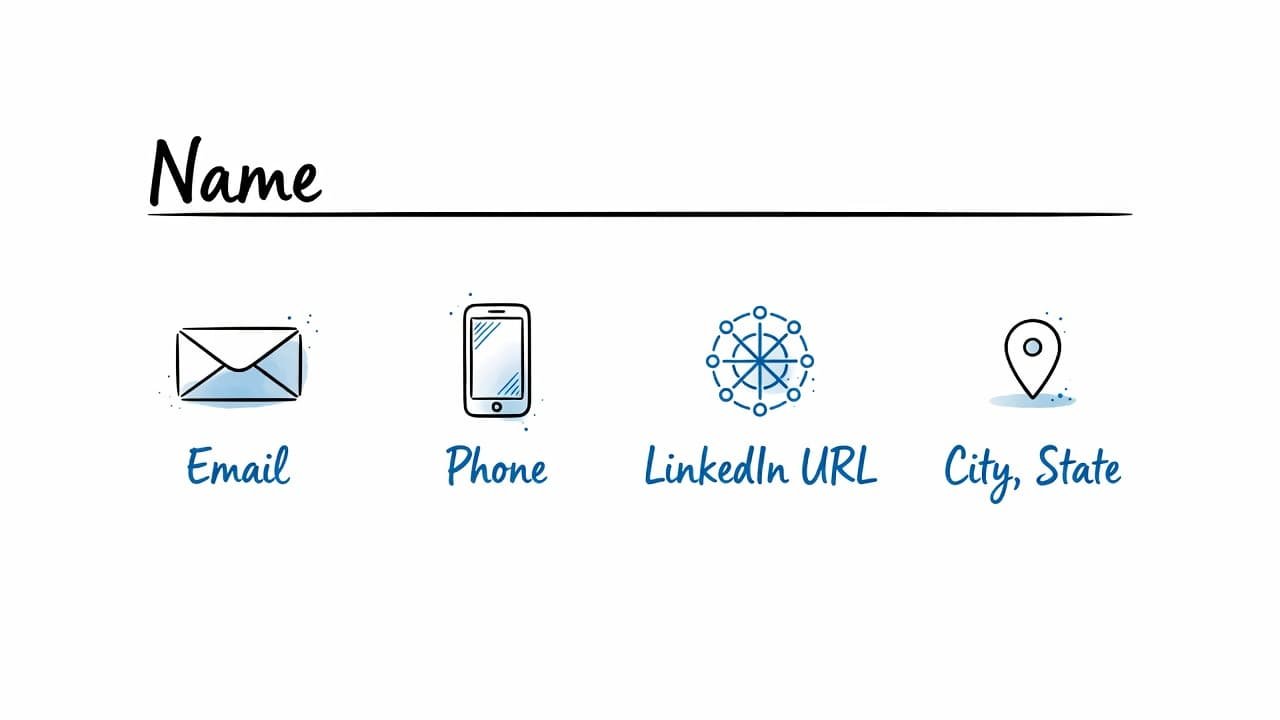
An Applicant Tracking System also reads location data most reliably when it is placed within the main contact block of your resume header. For the best results, include your City, State alongside your phone number and email address within the resume header itself. Avoid hiding these details in a page footer or a graphical text box, because the ATS often fails to parse information stored in those elements.
A clean, one-column layout helps the entire document parse better for any ATS. If you are reworking your layout as well as your contact details, these ATS-friendly resume format tips are worth using.
Your location data must also remain consistent across your job search. If your resume lists a specific city and state, ensure your LinkedIn profile reflects the same information so recruiters do not question your current status. Kael Campbell makes the same point in a recruiter-facing LinkedIn post about city and state only.
A tool can help here, as long as it stays out of the way. CareerScribeAI’s AI Resume Builder can keep the header clean, while its Cover Letter Generator is a better place to explain relocation timing. After that, Interview Prep Tools can help you answer commute, time zone, or relocation questions without sounding unprepared.
When city and state, full address, or no address makes sense
This quick chart shows the best option in common job-search situations.
| Situation | What to list | Best reason |
|---|---|---|
| Local onsite or hybrid role | City, State | Confirms you are one of the local candidates |
| Remote work | City, State or “Remote” | Clarifies time zone and market context |
| Relocating soon | “Relocating to [City, State]” | Signals intent and removes guesswork |
| Employer requires exact address | Full address | Use it only when the form asks for it |
| Safety or privacy concern | City, State only | Protects personal information |
For most people, listing just your city and state is the sweet spot. It answers the practical questions recruiters have while keeping your personal data protected. Providing a general city and state also helps you avoid location bias, as it ensures you are viewed based on your qualifications rather than a specific neighborhood.
A full street address makes sense only in narrow cases. While a physical address is rarely necessary on a resume, employers may require your specific physical address for background checks, government applications, or onboarding paperwork. That is a separate process from the initial screening.
Using no location at all can work, but it carries some risk. A recruiter hiring for an in-office role may assume you are far away if you do not clarify your current city and state. Even for remote jobs, location can affect time zone overlap, pay bands, and work authorization.
If you are short on space, do not cut skills or proof points to make room for your contact information or a full mailing address. Use that space for evidence that matches the job requirements. This guide on tailoring your resume to job description skills can help you decide what deserves the top of the page.
A simple decision framework
Use this three-step check before you send your resume to ensure your contact information does not raise any red flags for hiring managers.
First, consider the work environment. If you are applying for on-site roles, list your city and state. If you are applying for remote work, you can include your city and state to show your time zone, or simply note your availability.
Next, consider if your current location could cause confusion. If you are planning a move, use the term relocation to your advantage. Writing “Relocating to Tampa, FL” instead of your full street address clarifies your situation and prevents confusion regarding your commuting status.
Finally, check whether the employer explicitly requests additional details. If an application form asks for a full address, provide it in the portal. You do not need to force that level of detail onto the resume file itself unless the employer requires it.
A simple header that includes your phone number, email address, LinkedIn profile, and city and state might look like this:
Jordan Lee | 555-123-4567 | jordanlee@email.com | linkedin.com/in/jordanlee | Denver, CO
If you are navigating a relocation, this format works better:
Jordan Lee | 555-123-4567 | jordanlee@email.com | linkedin.com/in/jordanlee | Relocating to Chicago, IL
These examples remain effective because they are clear, current, and easy to scan. By including your phone number, email address, and LinkedIn profile alongside your city and state, you ensure your contact details are professional. This keeps your header concise and leaves more room for the part of your resume that matters most: your specific fit for the role.
Frequently Asked Questions
Is it ever necessary to include my full street address on a resume?
Generally, no. A full street address is rarely needed during the initial screening phase and is best reserved for official onboarding documents, background check forms, or secure job application portals later in the hiring process.
Will an ATS reject my resume if I omit my street address?
No, an ATS does not require your street address to parse your file. In fact, placing only your city and state in the main contact header helps the system accurately identify your location without unnecessary data.
What should I list if I am applying for a remote position?
Even for remote roles, you should still list your current city and state. This provides recruiters with essential information regarding your time zone, which helps them coordinate interviews and determine if you fall within the company’s hiring-eligible regions.
How does listing just a city and state protect my privacy?
By omitting your house number and street name, you reduce the risk of identity theft and limit the exposure of your private residence. This practice keeps your professional documents focused on your qualifications rather than your specific physical coordinates.
Conclusion
In 2026, the standard practice for most job seekers is straightforward: include your city and state on your resume rather than a full street address. Opting for this approach balances your privacy concerns with the professional context recruiters need.
Your address on a resume should be kept minimal to protect your personal information until you are further along in the hiring process. If a company requires your exact location for background checks or relocation purposes, they will ask for it during the formal application stages. Ultimately, a clean resume header that prioritizes only essential contact details is the best way to ensure readability for both hiring managers and ATS software.