


In your job search, one blank box for salary expectations can feel bigger than the whole job application. It might ask for your desired salary or salary requirements. Type too low, and you worry you’ll undercut yourself. Type too high, and you worry you’ll get screened out before a person reads your resume.
In 2026, that question is a little less murky, but it still matters. Pay transparency laws now cover more than 16 states plus Washington, D.C., so many employers post ranges up front. Still, plenty of application systems ask for your desired salary early. Here’s how to answer without boxing yourself in.
Key Takeaways
- Research your market value first using posted ranges, compensation data, location, and role fit to set a floor, target, and stretch salary—don’t guess.
- In free-text fields, provide a flexible researched range like “$88,000 to $98,000 based on role scope and total compensation”; use your target for single-number fields.
- Mirror the employer’s posted range if it aligns, stay informed and flexible for recruiter follow-ups, and always back your numbers with data to avoid underselling.
- Transparency laws make ranges more common in 2026, but applications still screen early—sound prepared without locking in to keep options open.
- A defensible range prepares you for negotiation, balancing base pay, benefits, and growth while matching your resume story.
Why employers ask for salary expectations so early
Most salary expectations applications aren’t trying to lock a final offer. They’re usually part of screening. Recruiters and hiring managers want to know whether your expected salary fits the budget before they spend time interviewing.
That matters more now because pay ranges are more visible. As Harvard’s overview of public compensation explains, transparency changes the conversation. You often walk in with more data, and employers know you have it.
Still, transparency isn’t universal. Some roles list a range. Others give a wide band. Salary history is becoming less relevant in 2026 due to privacy laws. Some applications ask for one number with no context at all. That’s why you need a target range, not a single guess.
Think of it like buying a house. You don’t walk in with one secret number and hope for the best. You set a floor, a target, and a stretch point. Salary expectations work the same way.
A simple framework helps:
- Your floor is the lowest number you’d honestly accept.
- Your target is the fair number based on your skills, market data, and industry standards.
- Your stretch is what you’d ask for if the role strongly matches your background and the total package is strong.
If the posting has a salary range, start there. If your target falls far outside it, the bigger issue may be fit, not wording.
Research your market value before you answer
Don’t type anything until you’ve checked the posting, location, level, and total compensation. A remote role in Denver may pay differently than the same title in Atlanta due to cost of living differences. A senior analyst title can mean very different scopes across companies.

Begin your market research with the posted range if one exists. Then compare it with compensation data and similar roles, factoring in market trends and salary trends that influence current pay. For a quick refresher on how to answer the question itself, Salary.com’s 2026 guidance on salary expectations is a useful benchmark.
Next, check whether you meet the core requirements or only part of them. If you’re unsure how much of the job you truly match, this guide on Must-Have vs Nice-to-Have Job Skills can help you sort the posting fast. Strong alignment supports the higher end of a range and boosts your potential for receiving a better offer. Gaps usually push you toward the middle.
This is also where CareerScribeAI can help quietly in the background. Its AI Resume Builder can help you line up your resume with the role, and the Cover Letter Generator can help you explain fit when your experience is strong but not perfect. That context matters when salary bands are wide.
If you must give a range, the low end should be a number you can live with.
How to answer salary expectations on applications
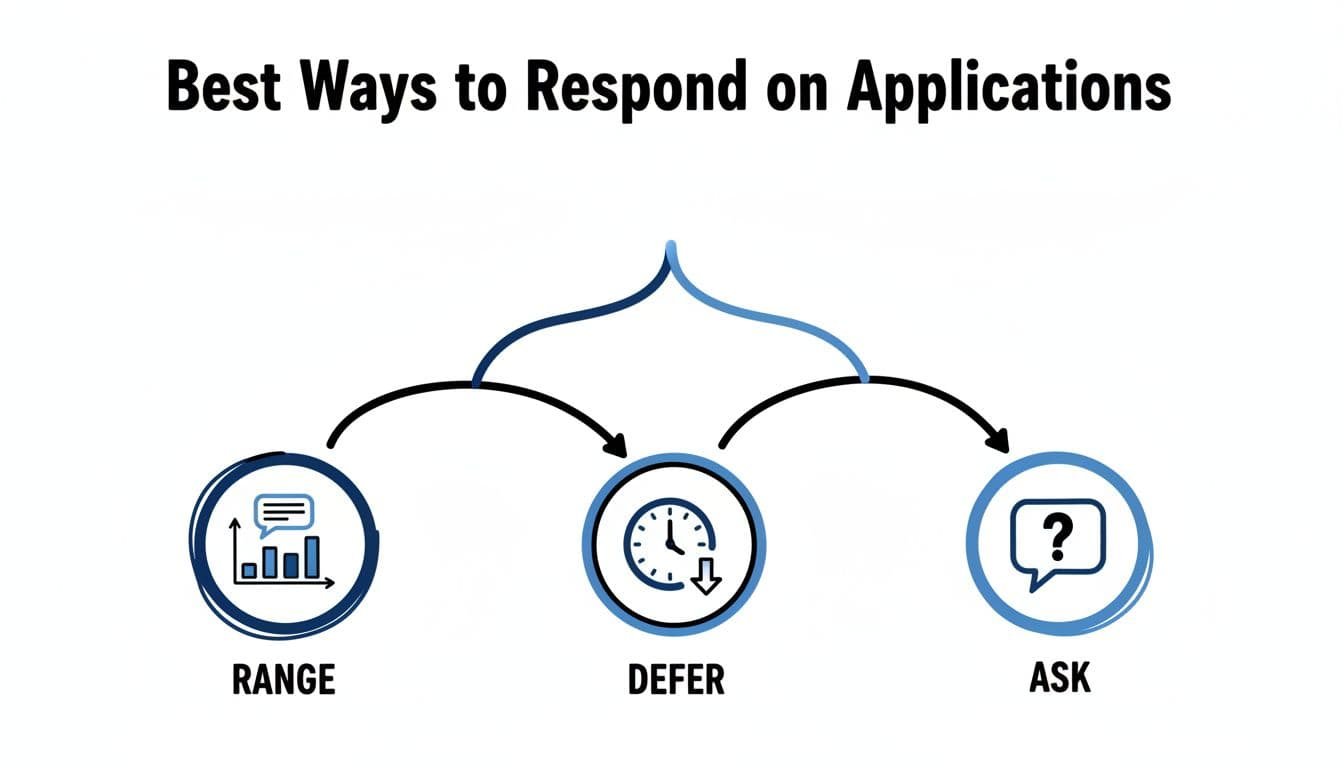
The best reply for online applications depends on the field type. Some systems allow text. Others force a number. A few let you choose from bands.
This quick guide keeps it simple:
| Application field | Best response | Why it works |
|---|---|---|
| Free-text box | Give a flexible, researched salary range | Shows preparation without sounding rigid |
| Required single number | Use your target number | Avoids anchoring yourself at your minimum |
| Dropdown salary band | Pick the closest acceptable band | Keeps you in range without oversharing |
What to write in a text field
If the employer posted a range, mirror it only if it fits your market value. Good examples:
- “Negotiable range of $88,000 to $98,000 based on the role scope, my experience, and total compensation.”
- “Open to a range of $70,000 to $78,000, depending on benefits package, bonus, and growth path.”
- “Flexible. Based on similar roles in Boston, I’m targeting the mid-$90,000s.”
If the form forces one number, don’t enter your bare minimum unless you’d happily accept it; some candidates use placeholder numbers, though it’s risky. Use a fair target. That gives you room later.
When no range is posted and the field allows text, a softer reply can help. AskCruit’s job application examples reflect a common approach: stay flexible, but show that your answer is based on research, not guesswork.
One more 2026 reality matters here. Many application workflows still combine resume parsing, knockout questions, and salary fields in one pass. So keep your resume clean and readable too. If you’re uploading to an ATS-heavy system, this 2026 Lever ATS Resume Checklist is a useful reminder that formatting mistakes can hurt before pay talks even start.
Frequently Asked Questions
What should I do if no salary range is posted?
Research market data for similar roles in the location and industry using sites like Salary.com. Set a flexible range based on your floor, target, and stretch, such as “mid-$90,000s based on Boston market rates.” This shows preparation without rigidity, keeping you in play for interviews.
Is it okay to use a single number if forced?
Yes, enter your researched target number, not your minimum, to avoid anchoring low. For example, if targeting $95,000, use that—it gives negotiation room later. Placeholder numbers are risky as they can screen you out.
How do I handle it if my target exceeds their posted range?
Reassess role fit; if your skills strongly align, apply at the high end or note flexibility on total comp. If gaps exist, target the middle. The mismatch might signal poor fit overall, so prioritize roles where your value matches.
Should I share my salary history?
Avoid it—many states ban salary history questions in 2026 due to privacy laws. Focus on forward-looking market value and your fit. If pressed, pivot to “I’m targeting a range based on current data for this role.”
What do I say in a recruiter phone screen?
Keep it short: “Based on my background, I’m targeting $95,000-$105,000, open to the full package.” Or ask for their budgeted range first to react thoughtfully. This builds rapport while staying consistent and data-driven.
What to say when a recruiter follows up
A written number isn’t the end of the conversation. It’s the opening bid in salary negotiation, or sometimes just a placeholder.
If a recruiter asks live during an initial phone screen, keep your answer short and calm. Try one of these:
- “Based on the role and my background, I’m targeting $95,000 to $105,000, though I’m open to the full compensation package.”
- “I’d like to learn a bit more about level and scope, but my current market range is around $80,000 to $90,000.”
- “If you have a budgeted range for base salary and compensation package, I’m happy to react to that first.”
That last line works well when the posting didn’t share pay. It shifts the focus to the employer’s budget without sounding evasive.
CareerScribeAI’s Interview Prep Tools can help here because the best salary answer matches the story your resume tells. If your resume positions you as mid-level, but your salary ask sounds senior-director level, the mismatch will show during negotiation.
The safest goal is simple: sound informed, flexible, and consistent. This sets you up well for the interview process and eventual job offer.
You don’t need the perfect number. You need a defensible range backed by real market data and your actual fit for the role. A strong range also prepares you to handle a future counteroffer, balancing pay with professional growth opportunities.
That one blank box feels less scary when you’ve already done the math.