


Submitting a job application from another city can make even a strong profile feel like a gamble to hiring managers. A professional relocation cover letter removes that uncertainty by addressing logistics head on.
In 2026, companies remain open to hiring out-of-town applicants, but they often face strict state regulations regarding payroll, taxes, and labor laws. Employers want clear proof that you are qualified, committed to a realistic moving timeline, and prepared to start work without unnecessary friction. Your letter should address these practical concerns early to put the recruiter at ease.
Key Takeaways
- Address logistics immediately: Include your relocation timeline and interview availability in the first or second paragraph to remove employer uncertainty regarding your transition.
- Focus on value, not geography: Devote the majority of your letter to your professional achievements and skills rather than your personal reasons for moving.
- Establish a clear timeline: Provide a specific date for when you will be in the new area to show that your move is planned, realistic, and committed.
- Maintain consistency: Ensure that the narrative in your cover letter aligns perfectly with your resume to prevent any perceived inconsistencies regarding your work history or professional goals.
Why relocation details matter more in 2026
Out-of-state job applications face more scrutiny now. Remote and hybrid hiring is still common, yet a potential employer can often only hire in certain states. That means your current address can raise questions before anyone reads your resume closely.
A good relocation cover letter lowers that resistance. It tells the hiring manager where you are headed, when you will be there, and why your move is settled enough to trust. At the same time, it keeps the focus on your relevant experience, because hiring is more selective and skills-based hiring continues to grow.
If you are moving for a job, do not write a letter that sounds like a personal announcement. Write one that sounds like a business case. Show the move, then show the match.
Your first paragraph matters most. If you need help finding the right tone, these effective cover letter opening lines can help you sound direct and specific. CareerScribeAI’s AI Resume Builder and Cover Letter Generator also help keep your resume and letter aligned, while the Interview Prep Tools can turn the same relocation story into a strong interview answer.
The best relocation letter does not sell the move. It removes doubt about the move and sells your fit.
What to include in a relocation cover letter
Hiring managers do not need your full moving story. They need the specific details that affect their hiring decisions.
A strong letter should clearly outline these four points:
- Your relocation plan and a firm relocation timeline
- A concise reason for moving to the new area
- Clear proof that your skills align with the job description
- Your available start date and interview preferences
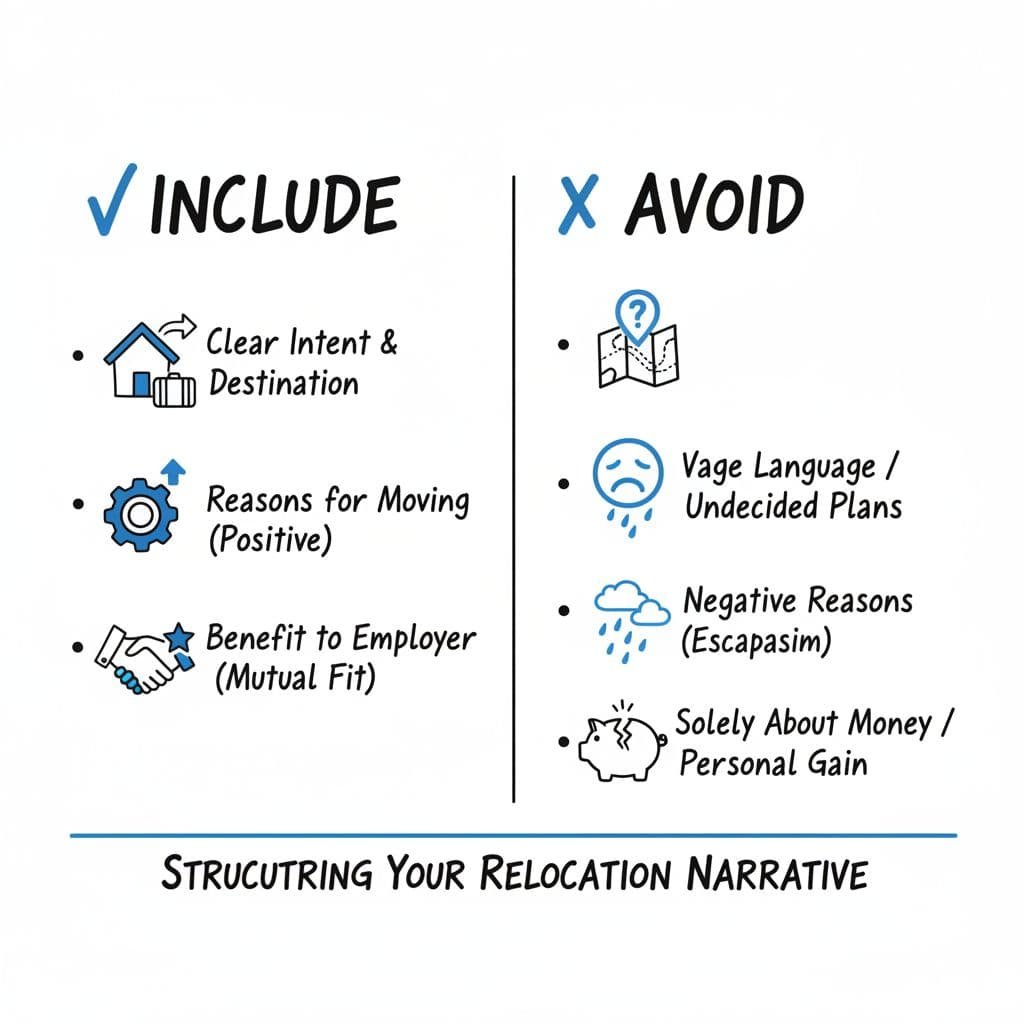
Place your relocation note in the first paragraph or early in the second. Do not hide it at the end of the document. If you are moving for family, school, a spouse’s transfer, or a planned return to your home state, state your reason for moving in one clear line, then move on. Note that the necessary level of detail may vary depending on whether you are an entry-level candidate or an executive-level hire, as higher-level roles often require more transparency regarding your transition.
Next, tie the move to the employer’s needs. Reference the job description, your potential impact on the team, and one or two results you have delivered in the past. This is where many candidates lose focus. They write too much about their desire to live in a new city and too little about why the company should hire them.
A useful rule is simple: spend more space on the value you bring to the company than on your location. For example, mention that you have a relocation plan to be in Seattle by August and can interview by video now. Then, immediately follow that with a metric, project, or result that proves you are worth the extra look.
It also helps to be clear about logistics. Can you interview remotely? Are you covering your own moving expenses? Do you already have housing secured? You do not need a long explanation, but a short line clarifying your status reduces doubt. Resume Genius’s relocation guide makes the same point, especially regarding the importance of a clear relocation timeline and interview availability.
Keep the letter tight. Three or four short paragraphs are usually enough to cover your relocation plan and your professional qualifications.
Relocation cover letter examples
This example works because it handles location details early, then focuses the majority of the space on your professional fit for the role.
Dear Hiring Manager,
I am applying for the Marketing Manager role at NorthPeak Health. I currently live in Chicago and will be relocating to Denver in July 2026, with housing already arranged. I am available for a remote interview immediately and can transition to an in-person meeting after July 15.
In my current role at a multi-location healthcare company, I lead demand generation campaigns that increased qualified leads by 28% in one year and lowered cost per acquisition by 16%. Your opening stood out because it blends patient education, growth marketing, and cross-functional work, which matches the work I do best.
I am also familiar with the Denver market and have strong personal ties to the area, which makes this a long-term move rather than a trial relocation. I would welcome the chance to discuss how I can help NorthPeak grow patient acquisition and strengthen campaign performance.
Sincerely,
Maya Chen
Notice what the example avoids. It does not apologize for being out of state. It does not ramble about lifestyle reasons. It provides a clear move date, a defined interview plan, and relevant proof in fewer than 170 words. This structure is effective for relocation, and it also works well if you are seeking an internal transfer within your current company.
If you want to adapt this structure to another role, using a professional cover letter template can help you tailor this framework to a specific job posting while keeping your tone grounded and readable.
Common mistakes in out-of-state job applications
The biggest mistake is vagueness. If you are a long-distance candidate and your letter says you are open to relocating but provides no timeline, the employer has to guess. Guessing creates friction, and friction gets applications rejected.

Another common mistake is leading with personal motives. Employers do not need a paragraph about the weather, the cost of living, or your desire for a fresh start following a cross-country move. A short location note is enough. After that, focus on proving that you can solve the company’s problems. If you are returning to the workforce after a career break, explain how that time away prepared you for this new chapter rather than focusing solely on the logistics of the move.
Watch for these issues before you send your letter:
- A move plan with no clear start date
- No mention of interview availability
- Too much personal detail
- A generic letter that could be sent anywhere
- A resume and cover letter that tell different stories
- Ambiguity regarding visa status or work authorization for an international relocation
The final point matters more than many applicants realize. If your resume highlights remote-only work but your letter says you are ready to relocate, the application feels inconsistent. Your resume and cover letter must align to demonstrate a genuine commitment to the role, which provides the employer with the confidence that you are prepared to make the transition successfully.
Frequently Asked Questions
Should I mention my reason for relocating in the cover letter?
Yes, but keep it brief. A single, clear sentence explaining that you are moving for family, school, or a career opportunity is sufficient; you do not need to provide an exhaustive personal story.
How should I handle interview scheduling as an out-of-state candidate?
Clearly state your availability for remote interviews immediately and mention when you will be available for in-person meetings. This shows that you are prepared for the logistics of the hiring process and are ready to accommodate the company’s timeline.
Is it necessary to mention that I am paying for my own move?
While not strictly required, clarifying your moving status can be helpful if you want to eliminate any concerns about relocation stipends. A short, professional note stating you have secured housing or are managing your own transition can further reduce employer hesitation.
Conclusion
A well-crafted relocation cover letter is essential because it replaces uncertainty with clarity. State the move, provide a clear timeline, and spend the majority of your letter proving that you are the right fit for the role.
In 2026, employers care less about your current ZIP code than your professional qualifications and your ability to deliver strategic value. When your letter makes this obvious, moving for a job stops looking like a risk and starts looking like a calculated move. By highlighting your local market knowledge or your unique institutional knowledge, you can demonstrate that your transition is actually a professional gain for the company.