


Recruiters can scan an HR resume in seconds. If your bullets read like a job description, your best work stays hidden.
In 2026, strong human resources resume bullets need to show what changed for people and for the business. That means clear proof in retention, talent acquisition, engagement, compliance, and manager support. These impact-driven bullets also strengthen your resume summary and resume objective while writing for both the ATS and the person reading after it, ideally in a reverse-chronological format to align with modern standards.
The shift starts when you stop listing duties and start showing outcomes.
Key Takeaways
- Strong human resources resume bullets shift from listing duties to proving people impact and business results, like higher retention, faster hiring, or fewer escalations.
- Build bullets with four parts: action verb + action + people metric + outcome, quantifying scale (e.g., employee count, sites) and change (e.g., 14% retention lift).
- Use HR-specific metrics from retention, engagement, talent acquisition, compliance, and more to make abstract work visible and credible.
- Tailor bullets to job postings with keywords, keep ATS-friendly formatting, and mirror impacts in your resume summary and objective.
- Rewrite weak ‘before’ bullets into ‘after’ impact statements to show real proof that gets recruiters’ attention.
What strong HR resume bullets look like in 2026
A weak HR bullet says what you handled. A strong one shows who you helped, how much changed, and why it mattered.
Hiring teams want evidence of scope. That includes employee count, site count, case volume, hiring volume in talent acquisition or full-cycle recruiting, or manager population. They also want proof that your work improved something real, such as lower turnover, faster hiring, better performance management, fewer escalations, or better audit results.
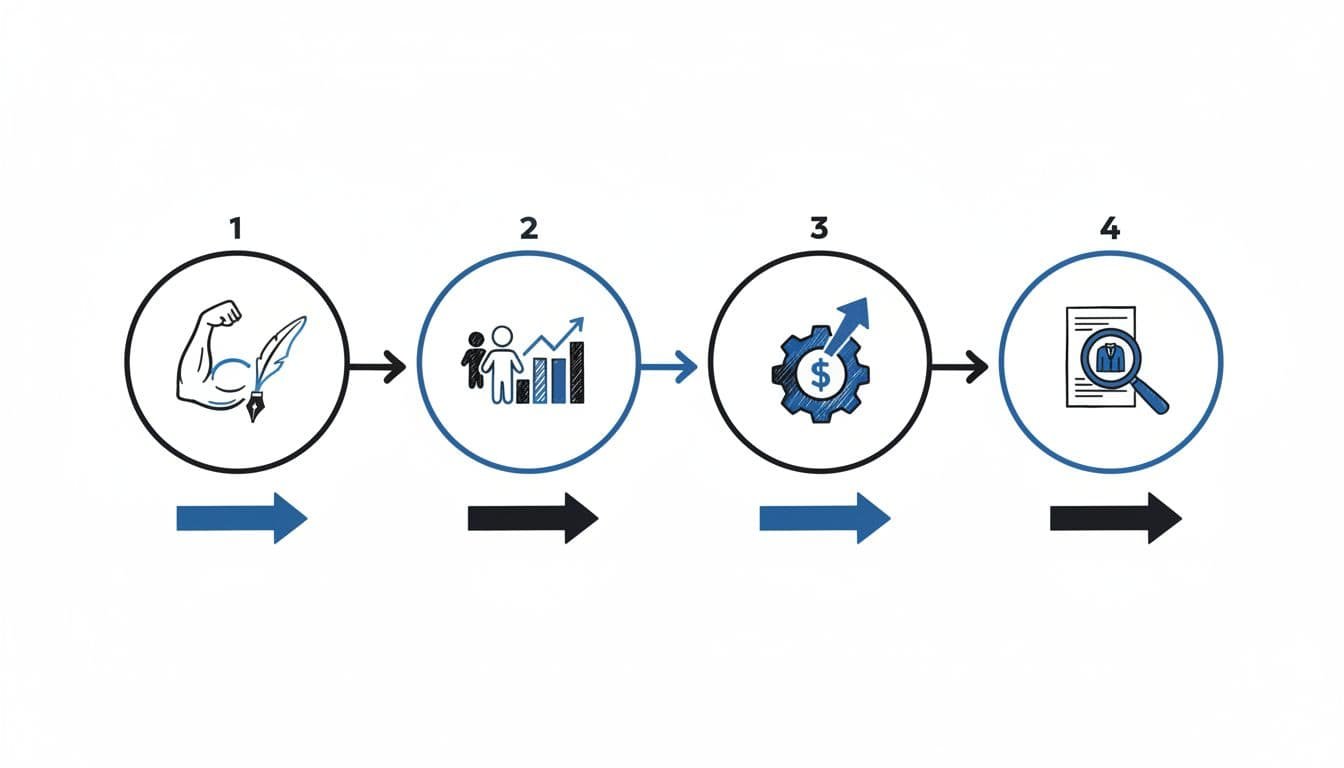
A good bullet usually has four parts: action verbs, the action you took, a people metric, and the business result. For example, “Redesigned onboarding programs for 180 new hires, lifting 90-day retention by 14% and cutting early attrition costs.” That line says more than “Managed onboarding.”
The best HR bullet shows people impact and business value in one sentence.
A clean format still matters. Use standard section titles, simple bullets, and plain text that an applicant tracking systems can read. This ATS-friendly resume guide explains why overly designed layouts still fail. For phrasing ideas, this HR manager resume example shows how scale and outcomes can work together.
Tailoring matters as much as numbers. If the posting stresses employee relations, policy compliance, HRIS management, and manager coaching, your bullets should use those exact ideas in context. You don’t need to repeat every keyword. You do need to show direct fit. That’s what helps your resume clear the first screen and hold attention afterward.
The HR metrics that make people impact visible
Many job seekers think HR work is hard to measure. It isn’t. People work creates numbers all the time, even when the outcome feels human first.
Track what changed in retention, engagement, talent acquisition, compliance, learning, workforce planning, and process time. If you don’t have exact numbers, use a careful range, a timeframe, or the size of the group you supported. Indeed’s guide to quantifying resume accomplishments gives useful ways to frame results without guessing.
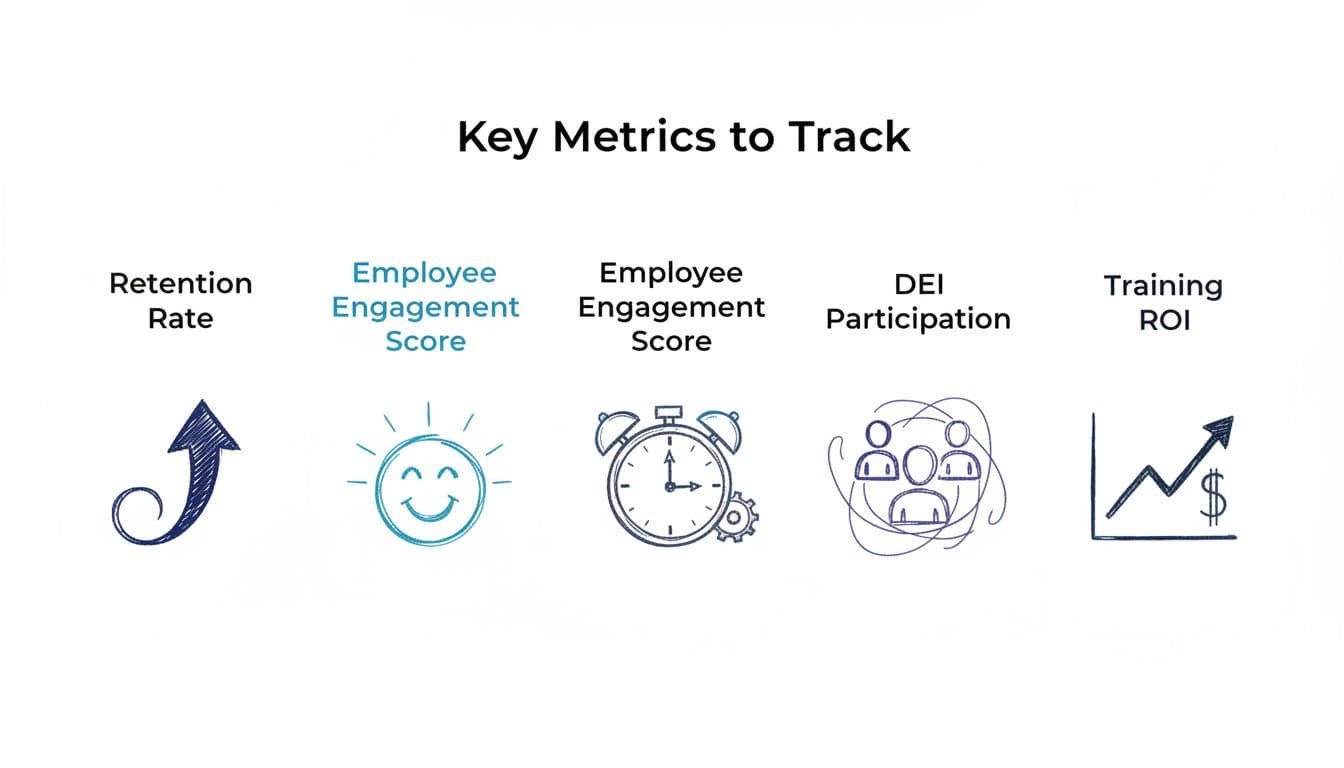
This quick map helps you spot the HR metrics and measurable results hiding in your work:
| HR area | What to quantify | What it shows |
|---|---|---|
| Retention | turnover, 90-day retention, first-year attrition | stability and cost control through employee retention strategies |
| Engagement | survey scores, participation, response rates | employee experience |
| Talent acquisition | time-to-hire, fill rate, offer acceptance | hiring efficiency |
| Compliance | audit results, labor laws adherence, completion rates, error reduction | risk control |
| Training | completion, test scores, behavior change | capability growth |
| Payroll administration | processing accuracy, on-time payments, error reduction | financial compliance and employee satisfaction |
| Benefits administration | enrollment rates, claims processing time, satisfaction scores | employee well-being and retention |
| Employee relations | case volume, resolution time, escalation rate | manager support and trust |
| DEI support | participation, diverse slate rate, referral growth | talent access and fairness |
| Process improvement | hours saved, cycle time, error rate | operational value |
The takeaway is simple. Your bullet gets stronger when the reader can picture the scale, the change, and the result. “Supported HR operations” is fog. “Supported 6 sites and cut onboarding delays by 35%” is proof.
Before-and-after HR resume bullets that show real results
The easiest way to improve human resources resume bullets is to rewrite task language into impact language. The “before” version describes activity. The better version shows evidence.
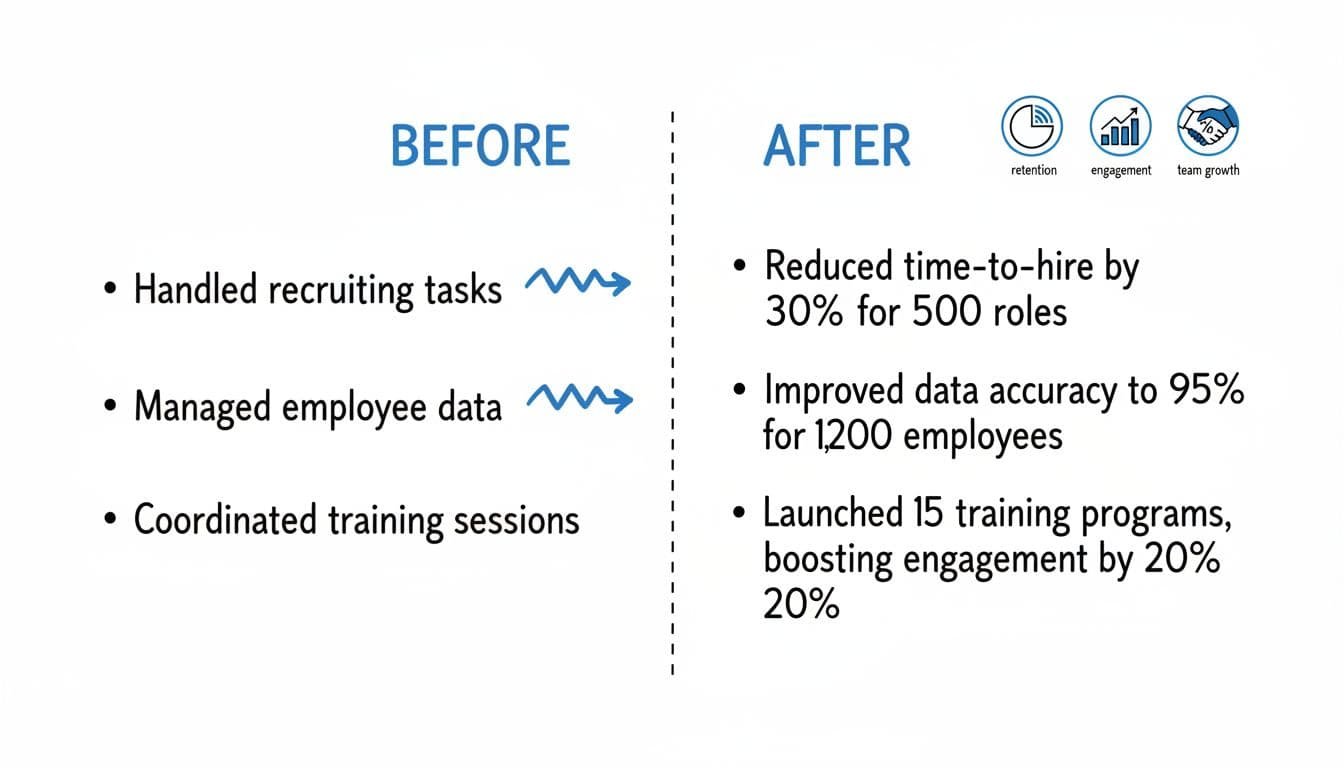
- Before: Managed employee onboarding.
After: Redesigned onboarding for 220 hires, raising 90-day retention from 82% to 91% and reducing manager follow-up time by 6 hours per week. - Before: Helped with recruiting.
After: Revamped talent acquisition for hourly roles, cutting time-to-hire from 41 to 29 days by revising interview flow and training 18 managers on structured hiring. - Before: Worked on employee engagement.
After: Launched quarterly pulse surveys and action plans that lifted engagement scores by 11 points across a 300-employee division. - Before: Handled compliance tasks.
After: Improved I-9 and policy audit completion to 99.6% across 6 locations, eliminating repeat findings during internal review. - Before: Supported employee relations.
After: Resolved 92 conflict resolution cases in employee relations within service targets, lowering escalations by 27% through better manager coaching and documentation. - Before: Assisted with DEI programs.
After: Partnered with talent teams to increase referrals from underrepresented groups by 22% year over year while keeping offer acceptance above 90%. - Before: Coordinated training.
After: Led organizational development to rebuild manager training on leave, performance management conversations, and documentation; completion reached 97% and policy-related cases fell 14%. - Before: Updated HR processes.
After: Automated onboarding steps in the HRIS, saving 8 hours weekly and raising pre-day-one completion rates to 96%.
To ensure consistency, mirror these impact bullets in your resume summary and resume objective, reinforcing the same results in your resume summary and resume objective.
If you’re stuck, start with rough notes, then tighten them. CareerScribeAI can help turn those notes into ATS-friendly bullets through its AI Resume Builder. Its Cover Letter Generator and Interview Prep Tools also help keep your story consistent after the resume is done. An HR generalist can use these to showcase strategic HR initiatives and transferable skills, while proving readiness for SHRM-CP certification or PHR certification level roles. For more models, review a few resume bullet point examples for 2026 and compare them against your own experience.
Frequently Asked Questions
How do I structure a strong HR resume bullet?
A strong bullet uses an action verb, describes the action taken, includes a people metric (like employee count or case volume), and ends with a business result (such as reduced turnover or saved time). For example, ‘Redesigned onboarding for 180 hires, boosting 90-day retention by 14%.’ This format proves impact in one clear line that works for ATS and human readers.
What HR metrics should I quantify in my resume bullets?
Focus on measurable changes in retention (turnover rates), talent acquisition (time-to-hire), engagement (survey scores), compliance (audit results), and areas like training completion or employee relations escalations. Use exact numbers, ranges, or group sizes if precise data is unavailable. This turns ‘handled tasks’ into proof like ‘cut time-to-hire from 41 to 29 days.’
Why is tailoring HR bullets to the job important?
Tailoring matches the job posting’s keywords (e.g., employee relations, HRIS) to show direct fit, helping clear ATS screens and grab recruiter attention. You don’t need to repeat every term, but weave in context-specific impacts. This makes your experience relevant and memorable beyond generic duties.
How can I improve weak ‘before’ bullets into impact-driven ones?
Start with your duty (e.g., ‘Managed onboarding’) and add scale, action, and results (e.g., ‘Redesigned for 220 hires, raising retention to 91%’). Draw from HR metrics tables for ideas and use tools like AI builders for polishing. Consistent impacts across bullets, summary, and objective build a trusted narrative.
Do HR roles really need numbers on resumes?
Yes—HR work generates metrics in retention, hiring efficiency, compliance, and engagement that prove business value. Numbers like ‘lifted scores by 11 points’ or ‘saved 8 hours weekly’ make your people impact concrete and differentiate you from duty-focused resumes.
Conclusion
Your resume doesn’t need more HR duties. It needs proof that your work improved hiring, retention, compliance, employee relations, engagement, or manager outcomes.
When your human resources resume bullets show action, scale, and a result, they define your career goals while making your experience easier to trust. Paired with a strong resume objective, that’s what gets your HR resume read, remembered, and moved forward.