


A weak answer when asked to describe your management style can sink your candidacy fast. If your approach sounds like a hollow label with no concrete examples behind it, the person across the table will quickly move on.
In 2026, employers want more than a generic personality summary. They want to hear how you lead people, navigate the nuances of hybrid work, provide actionable feedback, and maintain high standards without smothering your team. Demonstrating this balance is exactly what a hiring manager is looking for during a job interview.
Key Takeaways
- Avoid generic labels like “hands-on” or “people person”; instead, describe your leadership style through specific, actionable habits.
- Structure your response as a mini-story using the Situation, Action, and Result (STAR) framework to provide clear proof of your effectiveness.
- Adapt your answer to the specific company culture by researching their values regarding collaboration, autonomy, and speed.
- Balance your need for results with team support by demonstrating how you set clear expectations while providing enough space for your reports to succeed.
What interviewers want to hear
This interview question is really about how you work with your direct reports under real conditions. The interviewer wants to know how you set direction, approach decision making, and respond when someone struggles.
Because many teams now split time across office, home, and async channels, your answer should show clarity and flexibility. A strong manager today knows when to coach, when to step in, and when to let people run.
Research matters here. If the company talks about collaboration, speed, or ownership on its site, reflect that language in your answer. The common management interview questions guide from University of Phoenix also stresses the importance of aligning your response with the company culture before you walk into the room.
A good management style interview answer should do three things at once. It should sound self-aware, fit the role, and include proof.
If your answer could describe almost anyone, it’s too vague.
So skip broad claims like “I’m a people person” or “I’m hands-on.” Those phrases don’t tell an employer what working for you would feel like for your team members on a busy Tuesday.
Build a management style interview answer that sounds real
The best responses are short and concrete. Aim for about 45 to 60 seconds, and treat it like a mini story instead of a slogan.
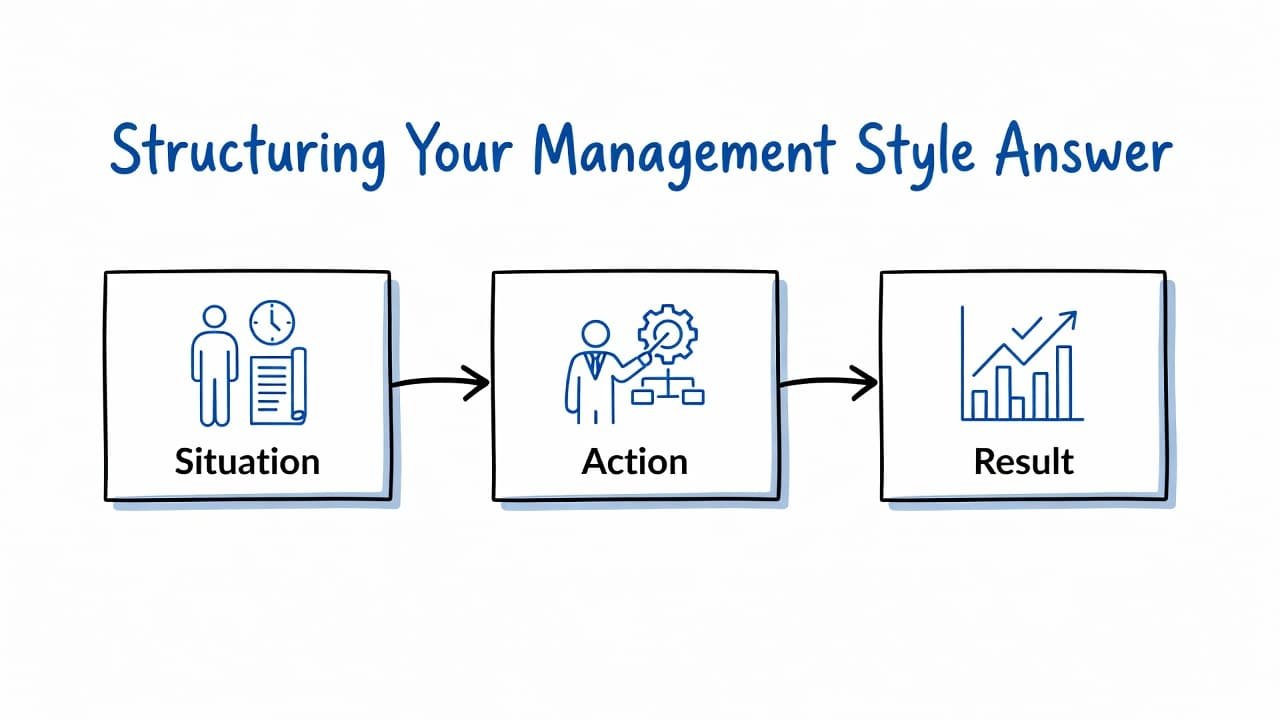
A simple structure that works
Use this three-step approach:
- State your core style in plain language.
- Explain how that style shows up in your daily management habits.
- Give an example with a clear result.
For example, you might say, “My management approach is clear, coaching-focused, and rooted in accountability. I set high expectations early, then grant my team members the autonomy they need to excel while remaining available for support. In my last role, this method helped a new hire ramp up in six weeks and hit their quota in their second month.”
That answer works because it has a point of view and results-oriented proof. It also shows balance. Most employers do not want a manager who controls every detail, and they do not want one who is invisible either.
One of the smartest job interview tips is to match your story across every part of your application. If your resume says you led a team through change, your interview answer should sound like the same person. That is where CareerScribeAI can help. Its AI Resume Builder, Cover Letter Generator, and Interview Prep Tools can keep your leadership examples consistent and role-specific.
Sample answers you can adapt
Your answer should shift with your experience level. A first-time manager should not sound like a director of 50 people, and an experienced leader should not sound generic.
If you’re moving into your first people-management role
You can lean on team leadership, mentoring, or project ownership:
“My leadership style is supportive but clear. I believe in establishing clear goals early, checking for blockers, and giving people enough trust to do strong work. In my current role, I often lead cross-functional projects, and I have learned that people do better when expectations are specific and feedback is timely.”
This works because it doesn’t pretend. It shows readiness without overstating your title.
If you already manage a team
Now you can add scale, judgment, and results:
“My style is collaborative and accountable. I involve my team members in planning, but I make decisions quickly when priorities change. I hold regular one-on-ones, rely on strong communication skills, and track progress with simple metrics. In my last role, that approach helped reduce missed deadlines and improved retention on a seven-person team.”
Practice this answer alongside related manager interview questions with example answers. That helps because this interview question often leads to follow-ups regarding how you apply your management skills to handle conflict, feedback, motivation, and poor performance.
Common mistakes and better phrasing
Most weak answers fail for the same reasons. They are too abstract, too rigid, or too self-focused.
This quick comparison shows the difference:
| Weak response | Stronger response |
|---|---|
| “I’m hands-on.” | “I stay close to priorities, but I don’t hover over daily tasks.” |
| “My style depends on the situation.” | “I use a flexible management approach based on experience, deadlines, and risk.” |
| “I like everyone to be happy.” | “I build trust through direct feedback, clear goals, and recognition.” |
Another mistake is naming a style without providing context. Terms like democratic management or laissez-faire management can work, but only if you explain what those words look like in practice. If you cannot describe how your chosen style benefits the group, the interviewer may worry that you lack the nuance required for effective leadership.
The ability to successfully practice adapting to the team is a sign of a high-performing leader. Remember that these traits are often closely evaluated during future performance reviews, so be honest about how you support your direct reports. Also, do not make yourself the hero of every sentence. Strong leadership style interview answers show how your approach helps the team perform, grow, and solve problems. That shift matters because employers hire managers to build results through others.
Frequently Asked Questions
Should I label my management style with a specific term like “authoritative” or “democratic”?
It is generally better to describe your habits rather than using academic labels, which can be interpreted differently by different people. If you choose to use a term, immediately follow it with a concrete example of what that style looks like in your day-to-day work.
How long should my answer be?
Aim for a concise response between 45 to 60 seconds. This duration allows you enough time to define your approach and provide a single, impactful example without losing the interviewer’s attention.
What if I don’t have a lot of management experience yet?
Focus on your experience with mentoring, leading cross-functional projects, or taking ownership of specific tasks. Highlight your readiness to support others and your commitment to clear communication and goal setting, which are the foundations of effective leadership.
Final thoughts
A strong management style interview answer sounds less like a slogan and more like a short case study. It defines your approach, details your daily habits, and backs them with concrete evidence. To stand out during your job interview, do not just describe your philosophy; make sure to give an example of how you apply these management skills in real-world scenarios.
When you practice, focus on being clear rather than trying to sound impressive. The best response is one that feels true to your experience as an effective leader and remains easy for the hiring manager to picture. Ultimately, your goal is to demonstrate how your approach fosters a productive, collaborative team environment.