

The final round feels close to the finish line, but reaching this final stage is often the toughest part of the process. By this point, your technical skills are already on the table, and the hiring manager now wants proof that you will make good decisions, work well with others, and solve the problems that matter most to the team. If you are looking for effective final round interview tips to help you stand out, you are in the right place.
That shift matters even more in 2026. Final interviews are more structured, more focused on judgment, and more likely to test how you use AI, communicate in hybrid settings, and handle pressure with clarity.
The good news is that you do not need a massive study plan. You need a short, targeted strategy that addresses exactly what the last meeting is designed to evaluate.
Key Takeaways
- Shift your focus to risk management: In the final round, interviewers are no longer testing your basic skills; they are evaluating your judgment, decision-making, and ability to mitigate risk for the team.
- Prepare targeted ‘proof stories’: Use the STAR method to craft five concise, results-oriented stories that highlight your leadership, problem-solving, and adaptability to specific business needs.
- Simplify your preparation: Focus your effort on a four-step plan: rebuilding the hiring scorecard, curating your proof stories, aligning your application materials, and rehearsing your closing summary.
- Demonstrate modern fluency: Show that you can navigate current work environments by discussing how you responsibly utilize AI tools and effectively communicate in hybrid settings.
What the final round means in 2026
Reaching the final stage of the hiring process is a significant achievement that confirms you are a top contender. At this point, early interviews have already screened for basic qualifications, so the last round is designed to check for risk.
Hiring teams want to know whether you can step into the role, represent the team well, and think clearly when work gets messy. That is why final interview questions often sound broader and sharper than earlier inquiries. When a hiring manager asks the tough “why you?” questions, they are essentially looking for ways to assess risk before extending an offer.
Current 2026 hiring patterns point to four themes: more structured interviews, more direct inquiries regarding your value proposition, increased attention to AI use, and stronger checks on communication, culture fit, and strategic thinking. In other words, they are not only grading your experience. They are grading your judgment, your ability to thrive within the company culture, and your long-term potential.
Most final round interview tips that work in 2026 share one goal: reduce doubt. Your job is not to sound brilliant for 45 minutes. Your job is to make it easy for the hiring team to picture you doing the work.
Start by reading the job description one more time. Then, look for the top three business needs behind it. If the role asks for cross-functional work, expect questions about influence. If it mentions process change, expect questions about tradeoffs and resistance. Indeed’s interview preparation guide is a useful refresher on matching your background to the job description before you walk in.
You should also expect hybrid norms. Some final rounds are on-site, some are video, and many combine both. If several people join at once, review these panel interview preparation strategies so your eye contact, pacing, and examples stay sharp. By preparing in this way, you improve your own candidate experience and show the hiring team that you are a natural fit for their unique company culture.
A simple prep plan for the last interview
Effective interview preparation is short and focused. Use one session for research, one for stories, one for questions, and one for a mock run to ensure you are ready for the final interview questions.
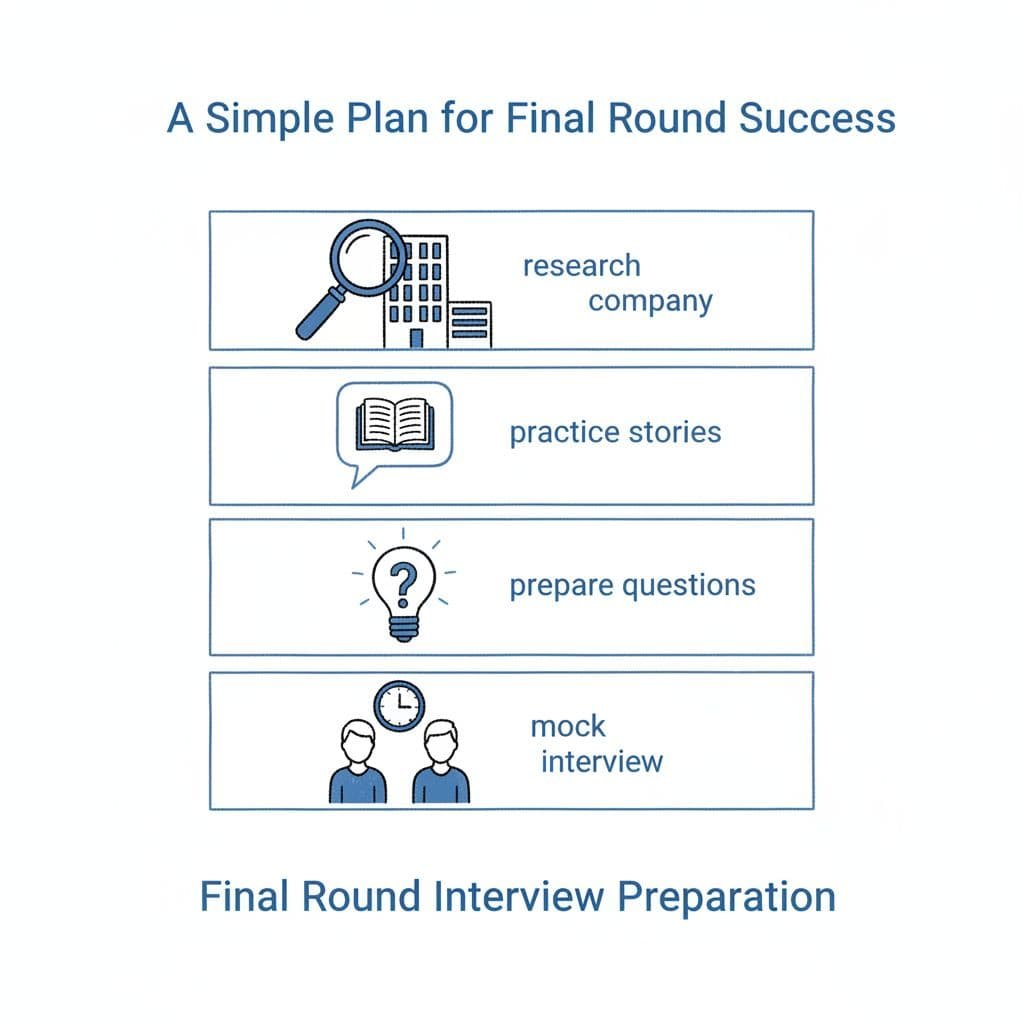
- Rebuild the company’s scorecard. Write down what they must believe before they hire you. Most final rounds come down to four checks: can you do the work, can you foster team cohesion, can you think at the right level, and do you exhibit the professionalism required when priorities shift.
- Prepare five proof stories. Choose examples that highlight your key accomplishments and technical skills. Focus on areas like leadership, conflict, problem-solving, failure, speed, and change. Keep each story under two minutes. State the situation, explain your action, and end with a clear result. Numbers help because they make your impact easier to picture.
- Align your application materials. Your resume, cover letter, and interview stories should point in the same direction, ensuring consistency across your experience and the specific job description. CareerScribeAI helps here because its AI Resume Builder, Cover Letter Generator, and interview prep tools can pull themes from the job post to keep your message clear. If you want ongoing support, you can compare CareerScribeAI premium features, which include the interview prep assistant and other job search tools.
- Rehearse the final ten minutes. Most candidates spend all their time on answers, but the closing matters just as much. Practice your reasoning for choosing this role, your questions to ask, and a short wrap-up that ties your strengths to the team’s needs. Performing a mock interview is a great way to perform a final sanity check on your delivery.
Keep each answer short, concrete, and current. Strong finalists do not sound memorized; they sound clear.
Before the meeting, test your audio, camera, and internet if any part is virtual. Then print the job description, your resume, and five bullets that capture your value. That one-page sheet is your guardrail when nerves rise.
How to answer final interview questions with confidence

By the last round, final interview questions become more pointed. You may encounter behavioral questions like “Why should we hire you?” or situational questions such as “Tell me about a tough judgment call.” Often, you will face senior management who are looking for emotional intelligence, active listening, and genuine enthusiasm.
A clean way to answer is to use the STAR method (Situation, Task, Action, Result). Start with the company need, describe the specific task, explain the action you took, and provide the result. Using the STAR method ensures your final interview questions are answered with structure and clarity. For extra practice, Coursera’s final interview questions list provides strong prompts to rehearse.
Turn pressure questions into proof
When answering tough final interview questions about mistakes or weaknesses, avoid giving a polished non-answer. Instead, name a real issue, explain how you improved, and demonstrate your current judgment. Since these rounds act as risk checks, honesty remains more important than perfection.
If asked about AI, be practical. Detail where you use it, where you avoid it, and how you verify the quality of your output. Employers in 2026 want professionals who use AI tools effectively while maintaining accountability for the final work product. Remember to use professional body language and active listening to build rapport with your interviewers.
Navigating salary and expectations
If the discussion turns to compensation, be prepared to discuss your salary expectations. Research the market rate for the role beforehand so you feel confident when you negotiate salary. While it is important to be firm, keep the conversation focused on value and your long-term interest in the company.
End with stronger questions
Your closing inquiries should sound like a future team member rather than someone collecting trivia. Excellent questions to ask include, “What does success look like in the first 90 days?” or “How does the team approach career development?” These questions show you are thinking about the company’s long-term health.
Finish with a short summary to prove your competence and secure the job offer. Thank them, restate your fit, and mention one specific business need you are excited to address. Doing so creates a calm, prepared impression that helps you stand out.
Frequently Asked Questions
How is the final round different from early-stage interviews?
While early interviews focus on your technical qualifications, the final round assesses your judgment and cultural fit. Hiring managers are looking for evidence that you can handle pressure and align with the team’s long-term business goals.
Should I prepare different stories for the final interview?
Yes, you should choose examples that demonstrate strategic thinking and leadership rather than just technical task completion. Focus on stories that showcase your ability to handle conflict, trade-offs, and complex decision-making processes.
How can I make a strong impression in the final minutes?
Use the closing to tie your background directly to the company’s current business needs. A strong closing should include insightful questions about the team’s future and a brief, confident statement that reinforces why you are a great fit.
How do I address AI use if asked?
Be honest and practical about your workflow. Explain which tools you use to improve productivity, where you draw the line for quality assurance, and how you maintain accountability for your final work.
Final thoughts
The last interview usually goes to the candidate who makes the hiring decision easy, not the one who makes the loudest impression. Clear stories, direct answers, and a calm closing style beat over-prepared speeches every time.
If you walk in with a tight strategy, your final round interview tips will help you stand out for the right reasons. You are no longer trying to impress everyone; instead, you are showing them in plain terms why you are the best candidate to receive a job offer.