

Few questions during a job interview look easier than “What motivates you?” and still cause so much rambling.
A hiring manager asks this to see what drives your work, how much self-awareness you possess, and whether your personal style fits the specific role. In 2026, when many interviews are shorter, recorded, or panel-based, a vague answer loses force fast.
A strong reply is honest, job-related, and brief. Start by understanding exactly what the interviewer is listening for.
Key Takeaways
- Focus on professional drivers: Identify a single, genuine motivator—such as solving complex problems or improving systems—rather than listing several superficial factors like salary.
- Align with the role: Tailor your motivation to match the specific needs of the job description, ensuring your internal drive aligns with the company culture and expected work style.
- Use the evidence-based approach: Structure your response by stating your core driver, connecting it to the position’s requirements, and providing one concise, STAR-method story as proof.
- Keep it brief and authentic: Aim for a 45-to-60-second response that sounds like a natural professional description rather than a memorized script.
What employers are listening for
When an interviewer asks, “what motivates you,” they are using this behavioral interview question to gauge your professional fit. It is less about your personality and more about identifying what keeps you engaged when work becomes busy, repetitive, or challenging. Employers are specifically looking for signs that you have the internal drive to stay on task without needing constant supervision.
To provide a compelling answer, you should distinguish between your intrinsic motivation, which stems from personal satisfaction or the work itself, and extrinsic motivation, which relies on outside factors. While everyone appreciates external rewards like a competitive salary, an answer focused solely on money can appear shallow. Instead, hiring managers want to see that your drivers align with their company culture. Good motivations include solving complex problems, helping customers, learning quickly, improving systems, or contributing to team success.
Weak answers usually miss one of three things: honesty, relevance, or evidence. Listing five different motivations can sound unfocused, and a long, scripted speech often sounds memorized. A strong answer should sound like a coworker describing how you operate on a high-performing day.
| Weak answer | Strong answer |
|---|---|
| “I like being successful.” | “I’m motivated by clear targets and improving results.” |
| “I work hard for a paycheck.” | “I’m motivated by seeing customers get a faster, better outcome.” |
| “A lot of things motivate me.” | “I’m most motivated when I can solve a messy problem and see the fix work.” |
The advice in Indeed’s interview guide remains highly relevant: name a genuine driver, connect it directly to the role, and back it up with a concise example.
A simple framework for answering “What motivates you”
Most compelling answers follow a consistent structure. They start by identifying a core driver, then demonstrate alignment with the job requirements, and finally provide specific examples to prove their point.
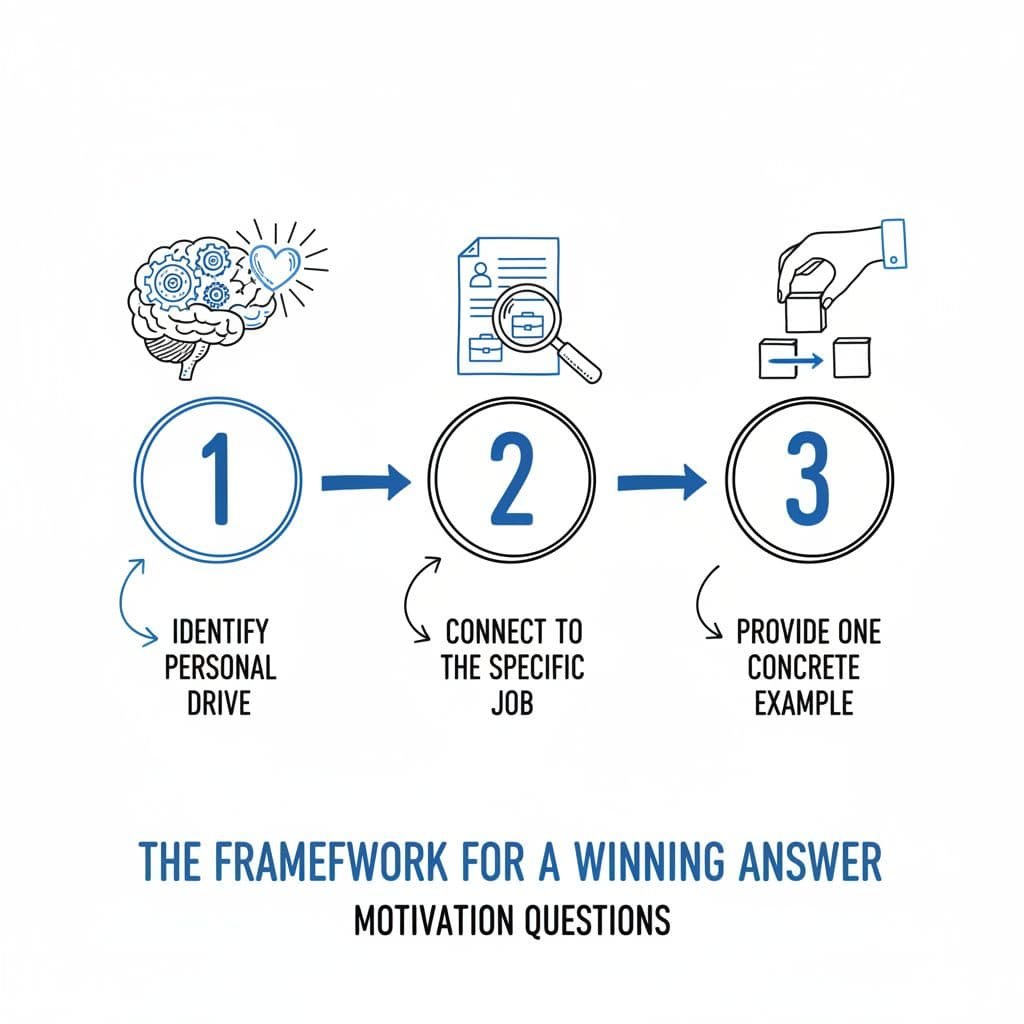
- Pick one driver. Choose one of your genuine professional motivations that fits your actual work style. Learning works if the role changes fast. Helping others is effective if service matters. Solving problems works well in almost any field, and autonomy is a great choice for remote or independent roles.
- Connect it to the role. Show that your motivation creates direct alignment with the needs of the employer. If the job description emphasizes accuracy, speed, or client care, use that language naturally to explain why you are a good fit.
- Add one short story. Use the STAR method to keep your example concise. Briefly describe the situation, the task you faced, the action you took, and the positive result.
The best answer identifies a clear driver, creates a link to the position, and supports the narrative with a brief, evidence-based story.
Here is a clean model for answering what motivates you: “I am motivated by improving how work gets done. In my last role, I noticed our team was answering the same client question repeatedly, so I built a simple FAQ sheet. That project cut down on repetitive emails and gave the team more time for higher-value work.”
If you are worried about sounding robotic, aim to keep your answer between 45 and 60 seconds. CareerScribeAI’s Interview Prep Tools can help you rehearse that length, while its story bank makes it easier to pull a real example instead of inventing one on the spot.
Sample answers and example answers to help you prepare
Strong interview motivation examples change with your career stage. The pattern stays the same, but the proof should match your level. Providing specific examples is the best way to show an interviewer that you are a candidate who understands the needs of the role.
Entry-level or recent graduate
I am motivated by learning fast and seeing steady progress. Demonstrating a growth mindset is key here. During my internship, I asked to take on a reporting task that was new to me, then built a template that cut prep time each week. I liked seeing my work become more accurate and useful.
Mid-career professional
I am motivated by solving problems that affect customers and teammates. When aligning my work with my career goals and personal values, I prioritize efficiency. In my last job, I spotted a delay in our order process and worked with operations to fix the handoff. Response times improved, and the team had fewer follow-up issues.
Career changer
I am motivated by doing work where I can see a clear result for people. That is one reason I moved from retail into HR support, as I wanted to find more purpose in my daily tasks. I rely on my background in creativity to diagnose complex issues. In my previous role, I handled a high volume of customer issues, and I did my best work when I could listen, diagnose the problem, and move it toward a clear outcome.
For more phrasing ideas, these sample motivation answers show how the same core method can fit different jobs. Still, do not borrow a script word for word. Interviewers can hear it when an answer does not belong to you.
Practice tips for 2026 interview preparation
Your answer should match the role you want now, not the role you wanted two years ago. That is why it helps to review the job post before every job interview and circle the themes that repeat. Look for clues about the expected work ethic and the potential the company sees in the right candidate. Whether the role demands a drive for technical mastery or a history of overcoming obstacles, your selected motivator should mirror those needs.

A smart prep routine is simple:
- Read the posting and pick one motivator that matches the work.
- Write a 60-second answer, then cut ten percent.
- Practice out loud until it sounds calm, not polished.
- Record yourself once, because filler words show up fast on playback.
CareerScribeAI can help here in a practical way. The AI Resume Builder and Cover Letter Generator can help you align your application materials with the job post, which makes it easier to keep the same themes in your interview answer. Ensure your response reflects both your personal mission and professional ambition, as these qualities help you stand out. Your motivation answer should also line up with your opening pitch, so it helps to review how to answer “tell me about yourself”. If you are meeting several interviewers, these panel interview tips are useful because concise, evidence-based answers are easier for a group to follow.
One last rule matters: do not choose a motivation that clashes with the job. If you say you are driven by autonomy, but the role depends on close teamwork, the mismatch is obvious. Similarly, if the position requires high levels of collaboration, emphasizing a desire for complete autonomy may signal to the hiring manager that you are not a good fit for their culture.
Frequently Asked Questions
Is it okay to mention money as a motivator?
While everyone works for a salary, framing your entire answer around money can make you appear uninvested in the actual work. It is more effective to focus on internal drivers like personal growth, problem-solving, or team impact that will sustain your performance over time.
Should I mention more than one motivation?
It is best to pick one core driver that strongly aligns with the specific role you are applying for. Listing too many motivations can make your answer sound unfocused and prevents you from providing the depth needed to prove your point effectively.
How do I know if my chosen motivation fits the role?
Carefully review the job description for recurring themes like collaboration, technical mastery, or speed. If your chosen motivator—such as working with total autonomy—conflicts with these key requirements, it may signal to the employer that you are not a good cultural or operational fit.
Conclusion
The best answer to what motivates you is usually shorter than people expect. Name one true driver, connect it to the role, and give one quick example that proves it.
This approach works because it sounds clear under pressure. By highlighting your professional motivations and showing a genuine sense of purpose, you help interviewers understand exactly what drives your performance. When your answer feels real and easy to picture, employers do not have to guess how you will show up at work.