

Most interviews feel unpredictable because you prepare from memory, not from evidence. The listing is that evidence. It tells you what the team needs, what problems they’re trying to fix, what will get measured after you’re hired, and even hints at the team environment and cultural fit.
With a simple reading method, you can forecast predictable interview questions before the recruiter ever schedules a call. You’ll also sound sharper because your answers match the role’s language, priorities, and constraints.
The goal isn’t to “game” the process. It’s to walk in prepared for the most likely topics, including common opening prompts like “tell me about yourself” where you can highlight your greatest strength, with examples ready to go.
Why job descriptions create predictable interview questions
A job description is a wish list, but it’s also a risk list. Every requirement hints at something the employer worries about. If they ask for “stakeholder management” requiring strong communication skills, they’re worried projects will stall. If they ask for “attention to detail,” they’re worried mistakes will ship. Interviewers turn those worries into questions.
Here’s why predictable interview questions show up across industries:
Responsibilities become “prove you can do it” questions. If the posting says “own monthly reporting,” expect: “Walk me through how you build a monthly report. What do you track and why?”
Requirements become “do you really have it” questions. Recruiters use these role requirements to evaluate past performance and soft skills. If it says “SQL required,” expect: “How have you used SQL in your last role?” plus a follow-up prompt.
Nice-to-haves become “are you worth extra” questions. These often show up late in the process, when the team compares finalists.
Company values become behavioral interview questions. These help assess cultural fit during the hiring process. When you see “bias for action” or “customer obsession,” expect competency-based interview prompts that test how you act under pressure.
To sharpen your read, it helps to know how to break down a posting into signals (must-haves, patterns, and hidden expectations). This guide to analyzing a job description lays out a structured approach you can mirror with your own notes.
One more advantage: postings are often written with the same internal scorecard interviewers use. Your job is to reverse-engineer that scorecard, then practice answers that match it.
A quick method to extract questions from any job description
Treat the posting like a map. You don’t need to highlight every line. You need to identify the few lines that will drive the interview.
Start with a clean copy of the posting. Then run this five-pass scan:
- Circle the “own” verbs (own, drive, lead, manage, design, build). Each verb predicts a “tell me about a time” prompt.
- Underline tools and methods (Excel, Python, GA4, ticketing systems, Agile). These predict questions on your technical competencies and workflows.
- Mark constraints (deadlines, ambiguity, cross-functional, limited resources). These predict situational questions testing time management, problem-solving skills, and soft skills like communication.
- Spot metrics (KPIs, conversion, SLAs, quality). These predict “how do you measure success?” questions.
- Extract repeated themes. If a skill appears twice, it’s not decoration, it’s a priority.
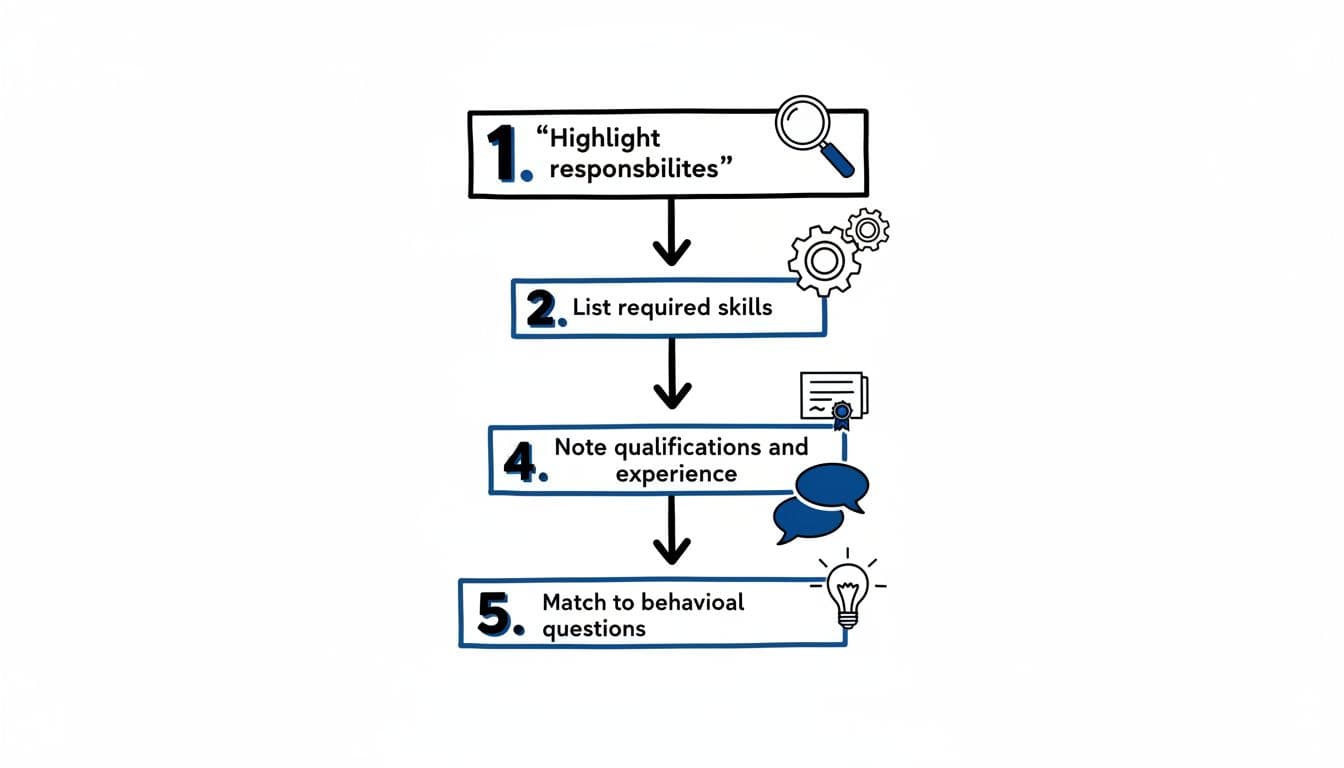
Once you’ve marked the posting, convert highlights into question prompts. A simple rewrite works:
- “Coordinate cross-functional launches” becomes “Tell me about a cross-functional launch you coordinated. What went wrong, and what did you do?”
- “Improve processes” becomes “Describe a process you improved. How did you choose what to fix first?”
Practice answering these prompts aloud while focusing on your body language to convey confidence.
If you can’t point to a single line in the posting that your story answers, it’s probably not a story you should lead with.
Next, align your documents to the same signals. For additional context on motivation, check the company website. In practice, this is where a tool can save time. CareerScribeAI.com can help you mirror posting language in a natural way: the AI Resume Builder can align bullets to the posting’s keywords, the Cover Letter Generator can connect your “why me” to their top needs, and the Interview Prep Tools can generate practice questions from the same posting you’re studying, including tips on soft skills and communication skills.
Also keep formatting simple. Even great content can get lost if an ATS can’t parse it. A clean, one-column format helps, and this Lever ATS resume format guide explains why simple structure often beats fancy design.
For another perspective on using postings to forecast interviews, this article on predicting interview questions from the job description offers extra examples you can compare against your own list.
Map JD lines to question types, then build answers with STAR
After you extract themes, sort them into three buckets. This keeps prep focused and prevents over-practicing random questions.
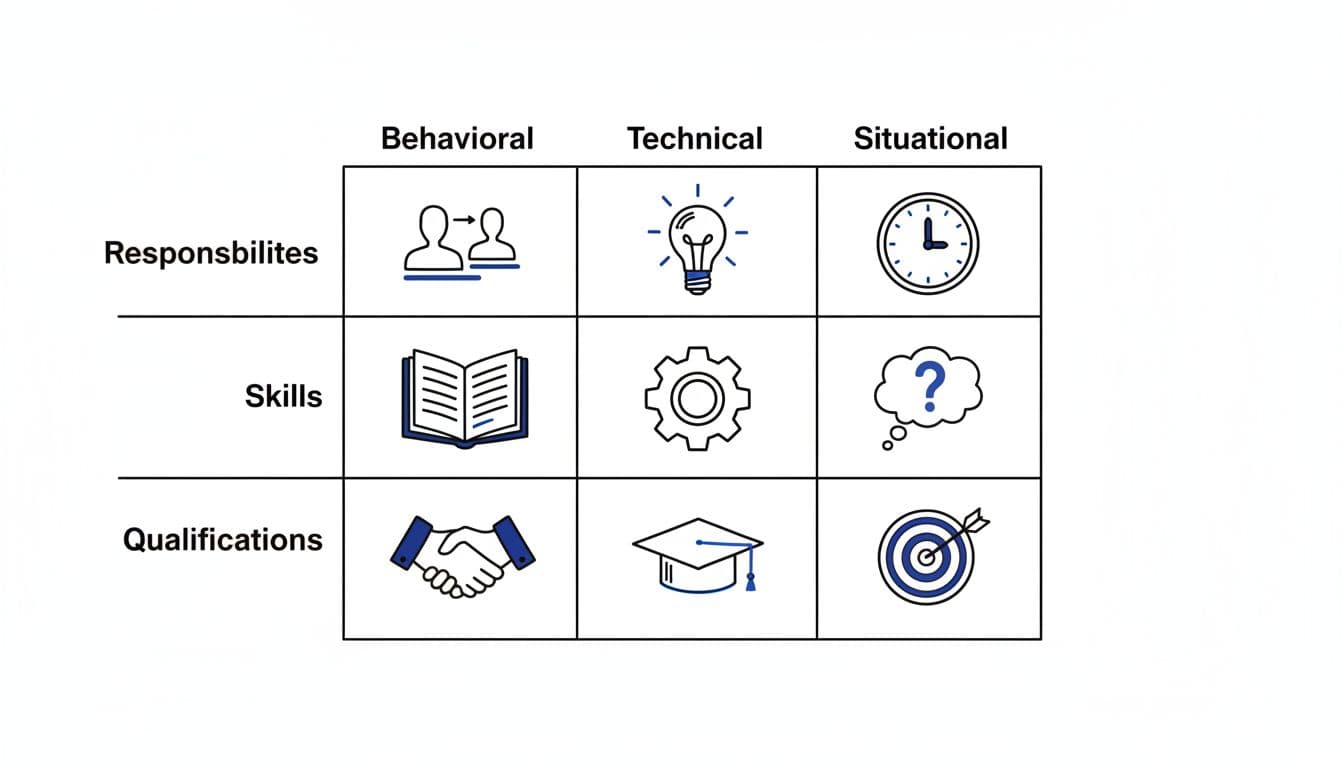
Use this quick mapping to turn job description text into predictable interview questions for a focused practice plan:
| JD signal you see | What interviewers test | A question you can expect |
|---|---|---|
| “Lead,” “partner,” “influence” | Behavioral interview questions, leadership skills, collaboration (conflict resolution) | “Tell me about a time you influenced without authority.” |
| “Build,” “analyze,” “optimize” | Technical, problem-solving | “How do you approach analysis when results conflict?” |
| “Ambiguous,” “fast-changing,” “prioritize” | Situational interview questions, judgment | “How do you decide what to do first with limited info?” |
| Tool list (SQL, Figma, Jira) | Technical, workflow | “How have you used X in real projects?” |
| KPIs and targets | Execution, measurement | “What metrics did you own, and how did you improve them? Tell me about a professional accomplishment.” |
Now write answers in a way that hiring teams can score. The safest structure for behavioral interview questions is the STAR method (Situation, Task, Action, Result). Keep it tight:
- Situation and Task: 1 to 2 sentences.
- Action: the longest part, focus on decisions and tradeoffs.
- Result: numbers if you have them, learning if you don’t.
Competency-based interview panels often probe the same story from different angles. Prepare one follow-up line for each STAR method story: what you’d do differently next time.
Finally, build a short “question bank” that matches the role. Aim for 10 to 14 prompts total, including themes like “where do you see yourself in five years”. If you have more, you’ll practice less well.
A strong way to pressure-test your list is to compare it to role-specific question patterns. OneTen’s guide on anticipating role-specific interview questions is useful for checking whether you’ve covered both role tasks and core behaviors.
Final takeaway checklist (use this the night before)
- Top 5 responsibilities translated into “walk me through” questions (e.g., management style, unpopular management decision, delegating tasks)
- Top 5 skills/tools matched to real examples you’ve done (e.g., customer service questions, professional development)
- 3 constraints you’re ready to handle (time, ambiguity, stakeholders; e.g., handling pressure, adaptability)
- 6 STAR stories that cover the role profile’s repeated themes
- 1 metrics story explaining how you measure success
- 2 smart questions you’ll ask that mirror the JD priorities (e.g., greatest weakness)
When your prep starts from the posting, the interview stops feeling like a pop quiz. It becomes an open-book test, and you brought the book.