


You can have a strong resume and still get rejected in minutes. Often, it’s not because you’re unqualified. It’s because you tripped an Applicant Tracking System (ATS) knockout questions rule inside the application form.
In 2026, many employers screen faster than ever. The knockout questions are the first gate, and some answers can end your candidacy instantly.
This guide explains what these questions look like now, why they exist, and how to answer them clearly, honestly, and in a way that keeps your job application in the running.
ATS knockout questions in 2026: what they’re really checking
Knockout questions are the non-negotiable requirements. Employers add them to hiring software to filter for legal, logistical, and budget fit before time is spent reading resumes. Some are true “auto-reject” fields. Others flag you for review, which still slows you down.
A good way to think about them: a bouncer at the door isn’t judging your personality. They’re checking age and dress code. Screener questions do the same job for hiring before the recruiter spends time on you.
In 2026, these questions show up in a few common forms:
- Yes/No gates (work authorization, certification or license, shift availability).
- Multiple-choice ranges (salary expectations, years of experience).
- Short text boxes (explain a gap, clarify relocation, confirm start date).
The tricky part is that the ATS often uses automated screening and pre-screening filters to compare your answers to the job post and sometimes to your resume. If your application says one thing and your resume suggests another, you can get filtered out or routed to a lower-priority queue. Clean formatting helps here because it reduces parsing errors that make your experience look “missing” to the system. If you’re seeing scrambled fields after upload, use a plain layout like the Lever ATS one-column resume template to keep your info readable.
For a hiring-side view of how these screeners get used, this explanation of how knockout questions work in modern screening is a useful reference.
Treat every knockout question like a required field on a passport form. One wrong mark can end the process, even if everything else is right.
Common ATS knockout questions (with answers that pass screening)
The questions below cause a large share of instant rejections because they’re easy to misunderstand, rush through, or answer emotionally. Along with years of experience as a common screening factor, these test must-have requirements. Keep your tone neutral, keep it consistent with your resume, and don’t add extra details unless asked.
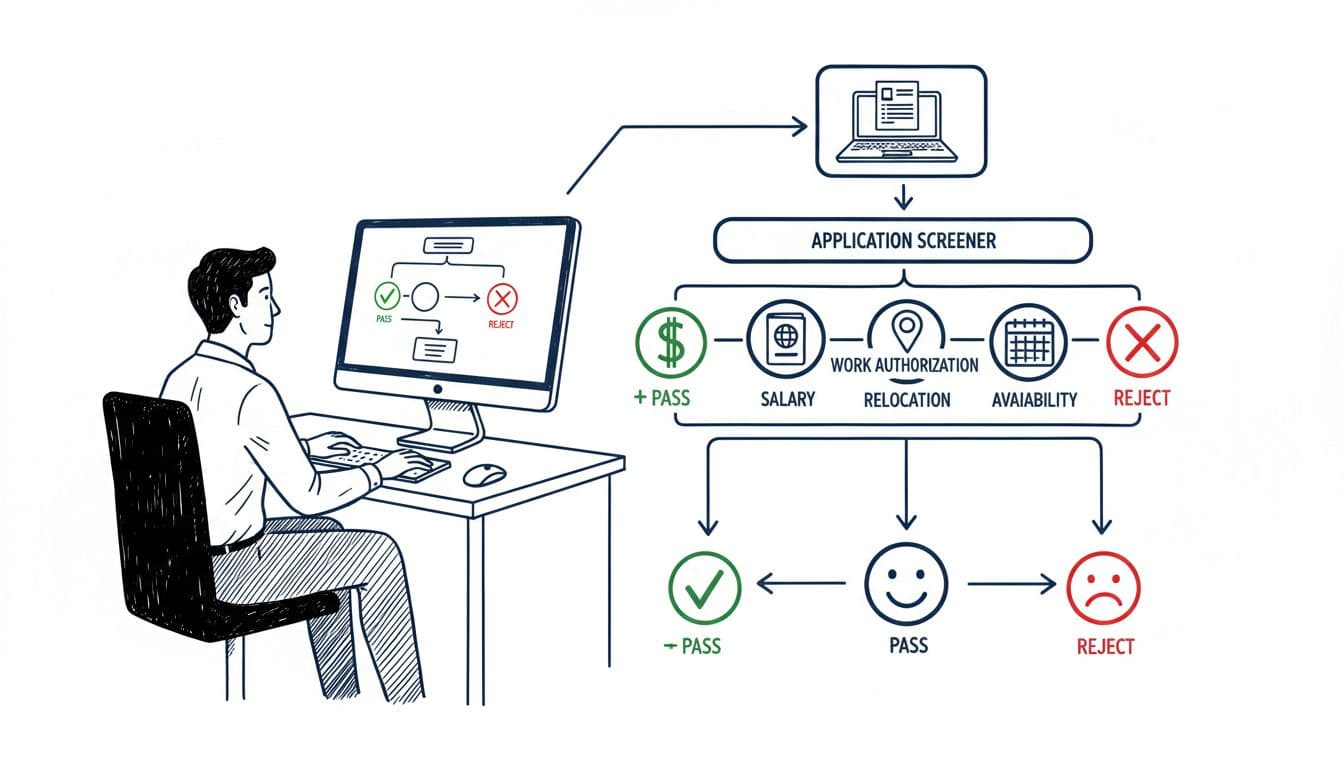
Here’s a quick map of what each category is really testing, plus common traps.
| Knockout question type | What it’s really asking | Safe answer pattern | Automated rejection mistakes |
|---|---|---|---|
| Work authorization / sponsorship | Can we legally hire you now with a valid work permit, and will it change later? | Direct “Yes/No”, then match the exact follow-up field | Choosing “No” by mistake, contradicting your status later |
| Salary expectations | Are you in range, and are you flexible? | Use the posted range, or a researched range with flexibility | Writing a single high number, adding ultimatums |
| Relocation / location | Will you show up where work happens, on their timeline? | “Yes, by X date” or “No, seeking remote only” | Saying “Yes” with conditions that conflict with the role |
| Availability / start date | Can you start when they need you? | Give a date and keep it consistent everywhere | “Immediately” when you can’t, vague answers like “ASAP” |
Work authorization (and sponsorship)
Keep this one plain. Avoid explanations unless the form asks for details.
- If you’re authorized and don’t need sponsorship: “Yes, I’m authorized to work in the United States and don’t require sponsorship now or in the future.”
- If you’re authorized now but may need sponsorship later: Answer truthfully based on the exact question. If it asks “now or in the future,” don’t guess. Say “Yes, authorized now; sponsorship required in the future” only if the form provides that option.
- If you need sponsorship now: Don’t try to hide it in a text box. Put the correct answer, then focus your search on employers who sponsor.
Salary expectations (range without boxing yourself in)
Salary expectations often appear in the job description and help identify qualified candidates. If the job post lists pay, anchor to it. If it doesn’t, use a range you can defend. Recent guidance like how to answer salary expectations in 2026 can help you shape a range that stays realistic.
Sample answers that usually work well:
- When a range is posted: “I’m targeting roles in the posted range of $X to $Y, depending on total compensation and scope.”
- When no range is posted: “Based on the role and my experience, I’m targeting $X to $Y. I’m open to discussing total compensation.”
If the form forces one number, choose a number inside your true range, not the top.
Relocation and location questions
These are often strict filters because they tie to office policy, taxes, and time zones.
- If you can relocate: “Yes, I can relocate to [City] by [Month Year].”
- If you’re already local: “Yes, I’m currently located in [City, State].”
- If you can’t relocate: “No, I’m not able to relocate. I’m seeking remote roles.”
Don’t write, “Yes, but only if…” unless they give a field for conditions. That “but” is where applications go to die.
Availability and start date
Hiring teams use this to match start dates to business needs.
- If you need notice: “Available to start on April 15, 2026 (two-week notice).”
- If you’re truly available now: “Available to start immediately.”
- If you have constraints (classes, planned travel): “Available May 20, 2026 due to prior commitment.”
Consistency matters. If your resume shows you’re employed, “immediately” can look suspicious.
A repeatable way to answer knockout questions without tripping filters
A good answer is short, truthful, and matched to the job’s constraints. The process below keeps you from rushing and clicking yourself out of the running during candidate screening, improving candidate experience by avoiding frustration in the screening process.
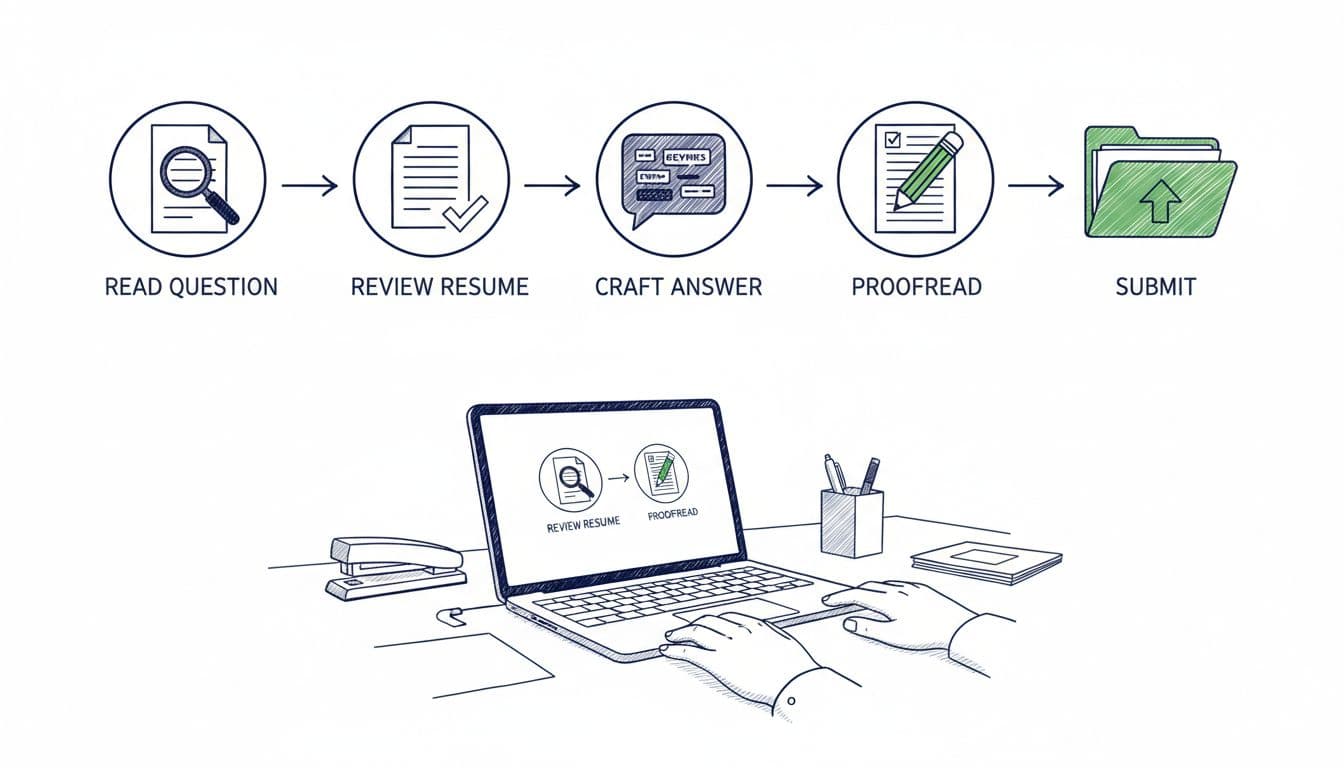
First, read the exact wording twice, especially “now,” “in the future,” “required,” and “must.” Many people answer the question they expect, not the one on screen.
Next, cross-check your resume for alignment, particularly software skills. If the form asks for “years with Python” and your resume buries Python in a project, the ATS may not connect the dots. Tools like CareerScribeAI’s AI Resume Builder help you line up your resume language with the job requirements so the experience is easy to detect.
Then, write the simplest answer that is still complete. When a text box exists, one to two sentences is enough. Save longer context for an interview.
After that, proof your application like it’s a legal document, since recruiting automation can be unforgiving of errors. Watch for dropdown defaults, reversed Yes/No toggles, and unfinished fields. One common fail is selecting “No” to relocation when you meant “No” to travel.
Finally, keep your story consistent across documents, so the hiring manager reviewing your online application sees full alignment. If you’re clarifying constraints (start date, relocation timing, schedule), CareerScribeAI’s Cover Letter Generator can help you state those limits cleanly without sounding defensive. Once you land an interview, use Interview Prep Tools to practice your spoken version of the same answers so nothing changes under pressure.
A quick formatting note: if your resume paste looks jumbled, fix that before you apply again. The Recruitee ATS resume format for 2026 includes a fast copy-paste test that can reveal hidden parsing issues.
Fast mistakes that trigger auto-rejection
Small errors cause big outcomes:
- Picking an answer that conflicts with a hard requirement (shift, license, location).
- Entering a salary number far above any reasonable band for the level.
- Adding “will explain in interview” in a required field.
- Leaving required questions blank, or typing “N/A” when a real answer exists.
- Changing your story between the application, resume, and cover letter.
- Errors that filter applicants out of the pool prematurely.
Conclusion
ATS knockout questions are less about impressing someone and more about clearing basic constraints to manage the applicant pool. They often verify legal status and education requirements. In 2026, the winners aren’t the most talkative applicants, they’re the most consistent ones.
Answer directly, match the job’s must-haves, and keep your resume and application telling the same story. When in doubt, slow down and treat each field like it can decide your outcome, because it often can.