


A large option grant can sound generous while leaving you with nothing you can spend. Startup equity offers uncertain upside, so your salary should cover your budget without relying on a future payout.
Before accepting, understand what your equity compensation includes, what ownership costs, and what happens when you leave. Start by separating an option grant from shares you already own.
Key Takeaways
- Stock options give you the right to buy shares at a set strike price. Restricted stock is issued upfront but can be forfeited until it vests, while RSUs promise shares without a purchase price.
- Vesting determines how much equity you keep. Check the vesting schedule and post-departure exercise window, since exercising vested options requires cash and the shares may remain unsellable.
- Evaluate your fully diluted ownership percentage, possible dilution, and investor claims rather than relying on the company’s headline valuation to estimate proceeds.
- Compare exercise costs and taxes with salary you would give up. Treat equity as potential upside, and ask for the grant terms in writing before accepting.
Understand the startup equity in your offer
Stock options and restricted stock
Stock options give you the right to buy shares at a fixed price, called the strike price. You don’t own shares until you exercise and pay that price.
Restricted stock means shares are issued upfront, but you can forfeit them until they vest.
A 409A valuation estimates a private company’s common stock fair market value and helps set option strike prices. Companies typically refresh the 409A valuation annually and after material events, such as funding. It isn’t the company’s headline fundraising figure.
RSUs and share classes
Restricted stock units (RSUs) promise shares without a purchase price, although taxes apply. They’re more common at later-stage and public companies. Private-company awards may require both service and a liquidity event before settlement.
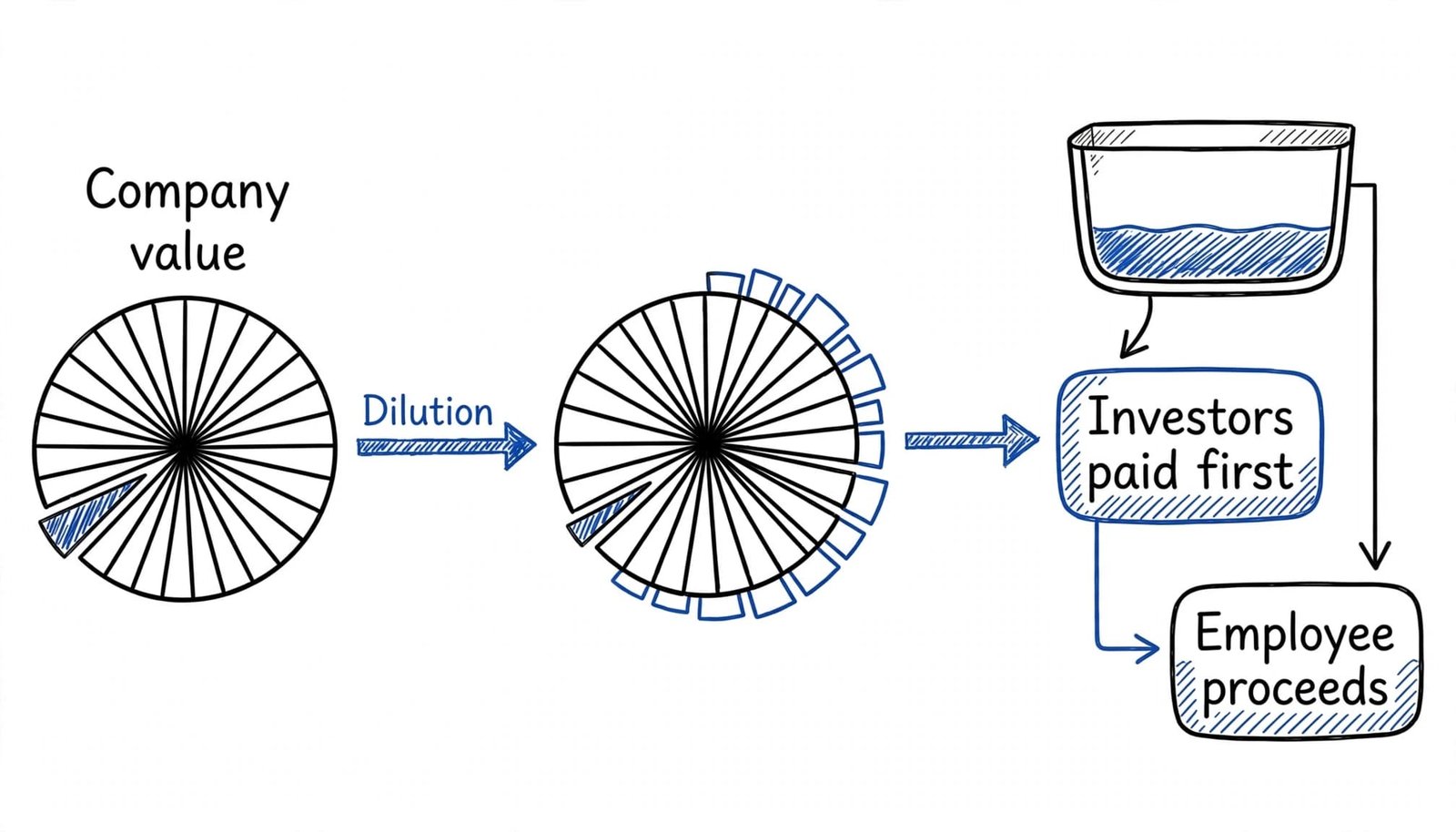
Employees generally receive common stock, which provides basic ownership rights. Investors may hold preferred stock with a liquidation preference, which can give them priority over common shareholders in a sale.
Vesting determines what you keep
Vesting means earning equity over time. A typical vesting schedule for stock options lasts four years, with a one-year vesting cliff. Nothing vests before your first anniversary, then 25% vests. The rest commonly vests monthly.
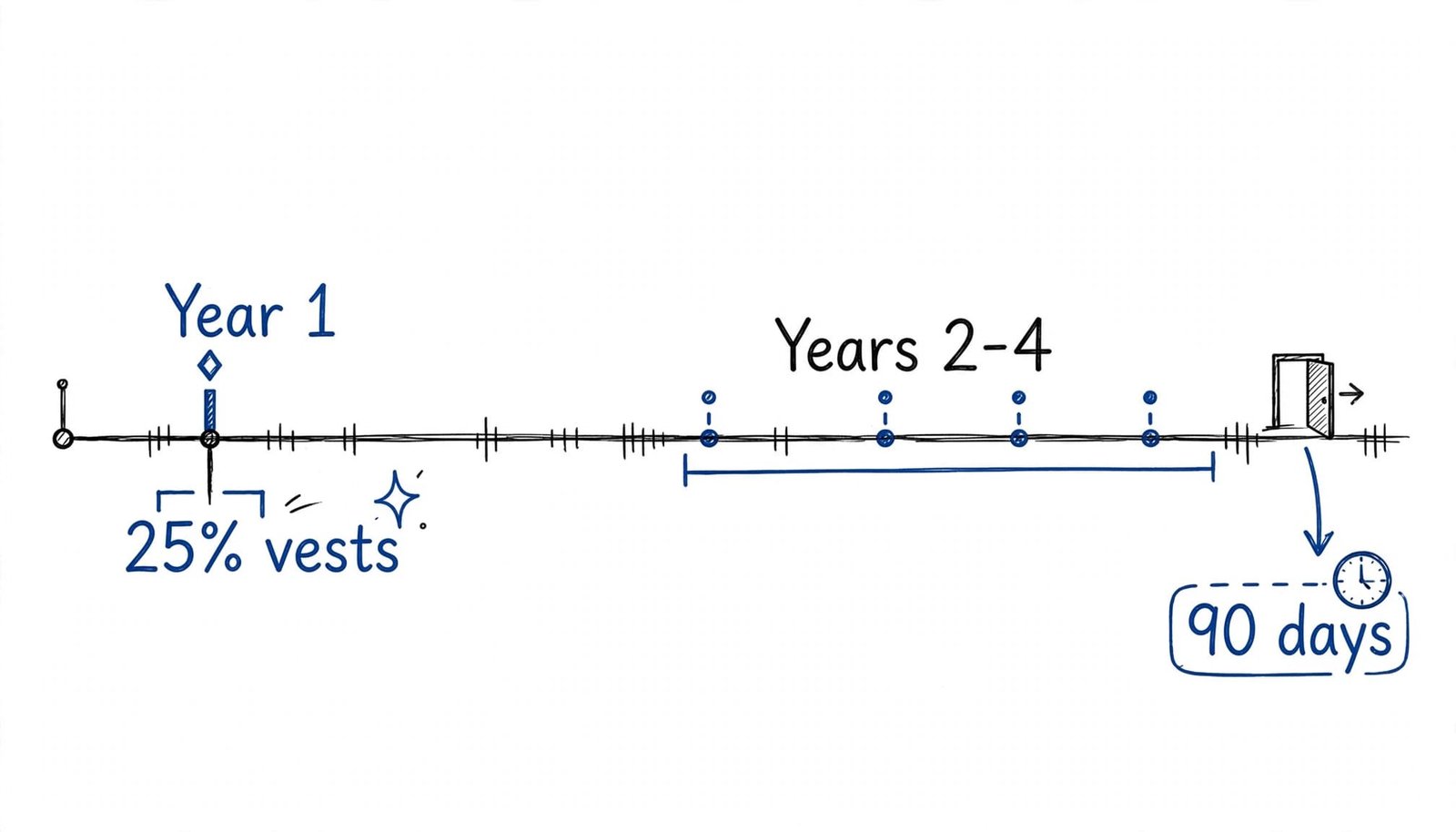
If you leave after two years, you typically keep half the grant as vested options. Unvested options usually disappear.
Many plans give you about 90 days after leaving to exercise vested options. This period is called the exercise window. Longer windows exist, but don’t assume yours includes one. Exercising options requires upfront cash, and the shares may remain unsellable for years.
Calculate ownership, not headline valuation
Translate an option count into potential proceeds
For illustration, 10,000 stock options divided by 1 million fully diluted shares equal 1% ownership. A fully diluted cap table includes outstanding shares and potential shares from options and other convertible securities, accounting for dilution.
At a $1 strike price, exercising all 10,000 options costs $10,000. If common shareholders eventually receive $10 per share, your proceeds after exercise costs would be $90,000 before tax.
That estimate assumes full vesting, exercise of all options, and a payout to common shareholders. A company’s headline valuation, including its 409A valuation, doesn’t determine employee proceeds. Preferred stock can carry liquidation preferences, giving investors priority over common shareholders. Those preferred stock claims can reduce the amount left for employees.
Account for dilution and investor claims
Dilution occurs when new shares reduce your ownership percentage. A round that dilutes existing holders by 20% reduces 1% ownership to 0.8%. Early funding rounds commonly reduce founders’ ownership by roughly 15% to 25%.
HubSpot cites Carta’s 13% to 20% employee equity allocation range. Haven describes typical option pools of 10% to 15%, often required by investors before funding. These are company-wide reserves, not individual grant benchmarks.
Founder stakes aren’t employee benchmarks either: Carta’s founder ownership report found 45.9% of two-founder teams split equally in 2024, versus 31.5% in 2015.
A liquidity event is an opportunity to sell shares, such as an acquisition, IPO, or approved secondary transaction. Until then, paper value may produce no cash.
Taxes can make exercising expensive
These are U.S. federal tax rules; Canadian and other tax systems differ.
Exercise costs and option taxes
For NSOs, the spread between the strike price and fair market value generally counts as ordinary income when you exercise.
ISOs can trigger alternative minimum tax. For ISOs, favorable capital-gains treatment generally requires holding shares more than one year after exercise and two years after grant.
Product Lessons recounts a $100,000 exercise cost plus a $200,000 tax bill. Haven reports average exercise-and-tax costs of roughly $543,000. Neither figure predicts your taxes. Your grant size, spread, and tax situation determine your cost.
The 83(b) election deadline and QSBS rules
An 83(b) election taxes eligible restricted stock at transfer rather than as it vests. File an 83(b) election using IRS Form 15620 within 30 days of share transfer, typically the grant date for restricted stock or early exercise for options. Ordinary option grants and RSUs don’t qualify.
Qualified small business stock (QSBS) can provide federal gains exclusions for eligible C-corporation shares. For older qualifying stock, QSBS generally has a $10 million exclusion limit and a $50 million gross-asset ceiling.
Under updated Section 1202 rules, QSBS issued after July 4, 2025, uses $15 million and $75 million thresholds. Qualifying holdings receive 50%, 75%, or 100% exclusions after three, four, or five years. Limits can also depend on tax basis.
Negotiate equity alongside salary
A $20,000 annual salary reduction costs $80,000 over four years before raises. Compare that certain sacrifice with uncertain proceeds from stock options.
Before signing:
- Request the grant’s fully diluted ownership percentage, strike price, vesting terms, and post-departure exercise window in writing.
- Model exercise costs and taxes before committing cash. Early exercise can reduce the taxable spread, but puts money at risk sooner.
- Negotiate salary and equity compensation, weighing grant size against its terms. You can also ask for a longer post-departure period or acceleration provisions that vest shares after defined events.
Vague equity promises deserve attention, especially alongside phrases such as “startup pace” or “wear many hats.”
Strong alternatives also improve your negotiating position. At CareerScribeAI.com, our role-specific resume examples support applications using our AI Resume Builder. Our Cover Letter Generator grounds claims in your resume, and our Interview Prep Tools help you practice role-specific questions.
Frequently Asked Questions
What’s the difference between stock options and restricted stock?
Stock options give you the right to buy shares at a fixed strike price, and you don’t own the shares until you exercise. Restricted stock is issued upfront, but you can forfeit it until it vests.
What happens to my options if I leave the company?
You typically keep vested options, while unvested options usually disappear. Many plans give you about 90 days to exercise vested options after leaving, so check your plan’s exercise window.
How can I estimate what my equity might be worth?
Divide your option count by the company’s fully diluted share count to estimate your ownership percentage, then account for dilution and any preferred stock liquidation preferences. The company’s headline valuation doesn’t determine what employees receive, and you may not be able to sell shares until a liquidity event.
What costs should I consider before exercising options?
You’ll need cash to pay the strike price, and taxes may add to the cost. NSOs generally create ordinary income tax on the spread at exercise, while ISOs can trigger alternative minimum tax.
Accept based on terms you can afford
Evaluate startup equity through ownership percentage, exercise costs, taxes, and realistic opportunities to sell. A large grant can still yield nothing.
Keep affordable cash compensation at the center of your decision. Treat equity as potential upside, and avoid spending money you can’t afford to lose.