


In a job interview, answer this interview question with a realistic 30-60-90-day plan: learn the role, apply your skills, then demonstrate measurable progress. Connect the employer’s priorities with your qualifications without promising results you can’t control.
Interviewers want clear priorities, not a rigid schedule. Start with what you know about the position, then explain how you’d confirm expectations after joining.
Why employers ask about your first 90 days
Employers use this question to assess how quickly you’ll adjust to a new position and how well you understand the role. Manpower’s interview guidance frames their concerns around three questions: Do you understand the job? Can you perform it? Will you perform it?
Your response should therefore show enthusiasm, relevant qualifications, and a credible approach to learning the company’s processes.
Prepare your answer in six steps

Indeed’s preparation process gives you a useful sequence:
- Research the position and company, including the posting, products, customers, and stated priorities.
- Consider realistic goals that match the responsibilities and onboarding requirements.
- Outline qualifications that show how your experience fits the position and supports those goals.
- Select a genuine example of learning quickly or improving relevant work.
- Practice aloud before the job interview so your answer sounds confident and conversational.
- Prepare a follow-up question for the hiring manager about the employer’s priorities, expectations, or onboarding.
Our Interview Prep Tools suggest questions based on your resume and the posting. Use them to rehearse, then edit each answer around your actual experience.
Keep your interview claims consistent with your application. Our AI Resume Builder and Cover Letter Generator can help express the same relevant qualifications across your materials.
Build a realistic 30-60-90-day framework
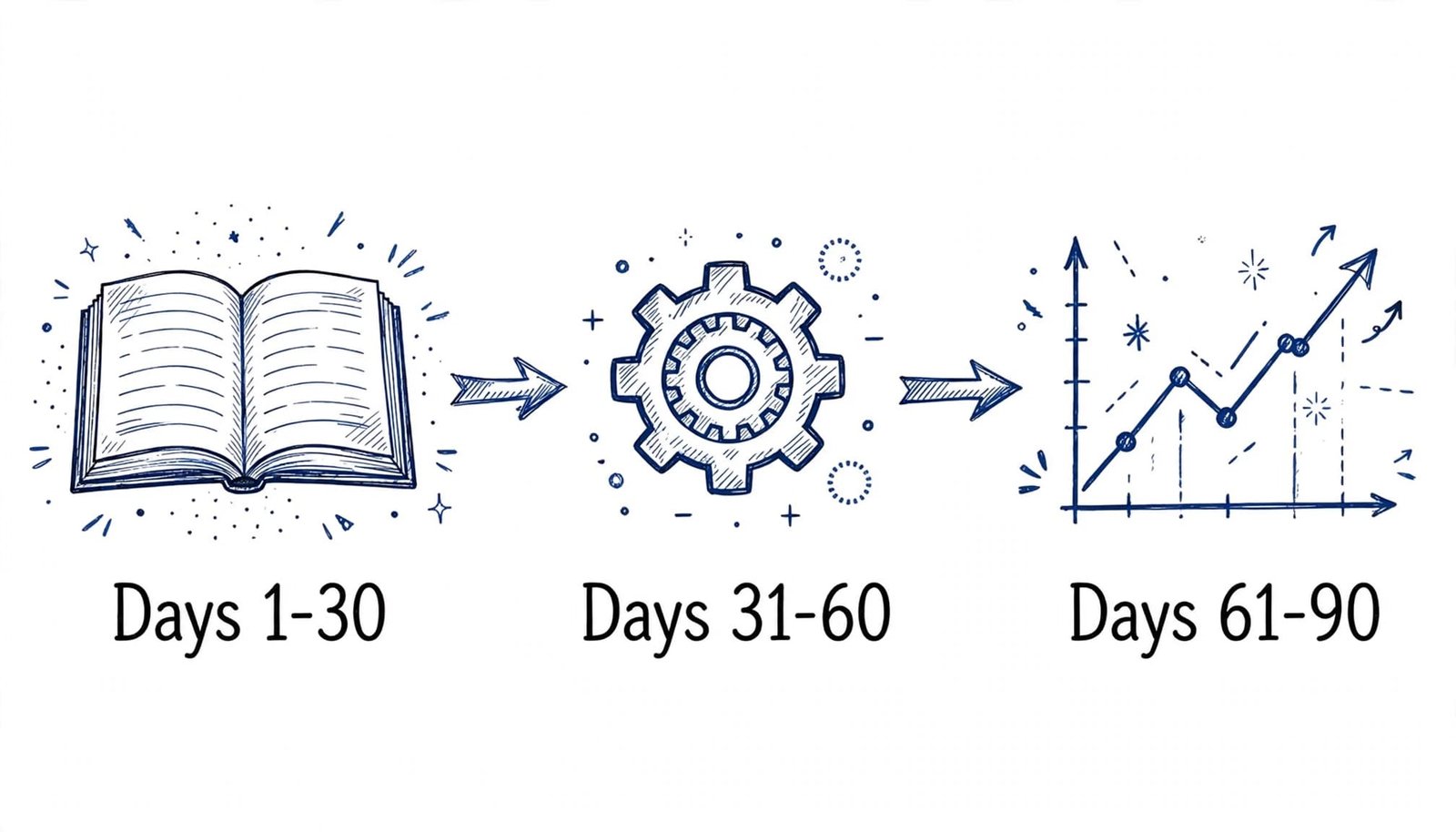
Give each month a clear purpose
Use this 30-60-90-day plan to connect learning with contribution and set realistic goals.
| Period | Focus | Evidence of progress |
|---|---|---|
| Days 1-30 | Complete initial onboarding, meet your manager and coworkers, review processes. | Agreed priorities and completed onboarding tasks. |
| Days 31-60 | Build role knowledge, deepen industry knowledge, begin assigned work. | Completed work reviewed against team standards. |
| Days 61-90 | Apply what you’ve learned, strengthen relationships, own appropriate responsibilities. | Agreed deliverables and a progress review. |
The stages overlap. You can contribute during the first 30 days while training, and relationship-building continues beyond that period.
Choose measures without inventing targets
Match the measure to the work. Sales candidates might discuss qualified pipeline; customer service candidates might track resolution time. Software candidates could discuss completing a reviewed change.
Indeed’s sample answers include an entry-level goal of 1,000 new social media followers monthly after 90 days. A management example describes reducing customer wait times by 15% over three months through simpler paperwork.
These are illustrations, not universal benchmarks. Establish the baseline before proposing a numerical improvement.
A credible answer names what you’ll measure while leaving the target open until you understand the starting point.
Sample interview answers by experience level
These example answers are templates to adapt to your experience.
Entry-level candidate
“In my first month, I’d complete onboarding, meet the team, and learn your processes. During month two, I’d take on assigned tasks and request feedback. By day 90, I’d aim to handle routine responsibilities independently and review my progress with my supervisor.”
Experienced individual contributor
“I’d first align with my supervisor on priorities and success measures, then meet colleagues to understand how my work supports theirs. During month two, I’d own an agreed deliverable. By day 90, I’d aim to complete it, assess the results, and recommend improvements based on what I’ve learned.”
Management candidate
“My first month would focus on understanding team expectations, performance measures, and stakeholder needs. Next, I’d agree on priorities with the team and test a manageable improvement. By day 90, I’d review its results with my manager and propose the next priorities.”
Add more depth for a leadership interview
Writing for Harvard Business School Alumni, Matt Spielman describes research suggesting that early tenure strongly influences performance, longevity, and contribution.
His five-step approach starts by clarifying the work’s what, why, and how with your supervisor. Next, identify stakeholders and conduct 30-45-minute interviews. Synthesize recurring themes into an action plan with about four goals, then share and execute it.
The ACHIEVE model calls for goals that are Action-Oriented, Consequential, Hard not Herculean, Integrated, Explicit, Visualized, and Endpoint-focused. Break the work into three 30-day segments, quantify each segment’s output, and schedule supervisor check-ins.
In the interview, summarize this approach rather than reciting every detail.
Avoid promises that weaken your answer
Don’t propose major changes before understanding existing decisions. Also avoid spending all three months observing without identifying useful contributions.
A generic answer such as “I’ll work hard and learn everything” gives the interviewer little evidence. Name relevant responsibilities instead. Keep your plan adaptable because access, training, and business priorities affect the pace.
Frequently asked questions
What should I ask after answering?
Ask, “What type of training can I expect to receive in my first three months?” You could also ask, “How can I be successful in my first three months in this role?”
Should I prepare a plan if nobody asks?
Yes. Manpower recommends preparing one anyway because it demonstrates seriousness and preparation. It also helps you discuss priorities when the interviewer asks broader questions about your contribution.
Key takeaways
A strong answer connects learning to useful work. Show that you understand the position, support your confidence with real qualifications, and choose measures that fit the role.
Make your plan credible
Your first-90-days interview answer should show prepared judgment. Explain how you’ll learn, contribute, and review progress.
Rehearse the structure rather than memorizing every sentence. Adapt your plan to the hiring manager’s expectations and the company’s actual priorities in your new role.