

Hiring teams still skim. ATS still filters. And in 2026, your top section has one job: make the hiring manager want the next 10 seconds.
That is why the resume objective vs resume summary choice matters more than ever. Both sit at the top. Both can work. But they send different signals, and the wrong one can make you look unfocused or overqualified.
This guide explains when to use each, how to decide fast, and includes 12 plug-in examples you can copy and tailor.
What changed in 2026 (and why your top section must earn its space)
Recruiters read your resume like a movie trailer, not a novel. They want the plot and proof quickly. Meanwhile, applicant tracking systems keep getting better at matching titles, skills, and keywords, especially for large employers.
So, your objective, resume summary, or professional summary needs to do three things:
First, match the job title you want, not the one you used to have. If you are applying for “Customer Success Manager,” that phrase belongs near the top (if it fits).
Next, prove fit with a small set of role-specific skills. Keep it tight. Think 2 to 5 lines, depending on your experience.
Finally, make it easy to scan. Dense paragraphs get skipped. Vague claims get ignored.
If you tailor each application, this section becomes much easier to write. Tools like CareerScribeAI’s AI Resume Builder can help you compare your draft to a job description, then adjust keywords and focus for ATS optimization without turning your resume into a word salad.
Resume objective: best opening statement when your story needs context
A resume objective is a short “here’s where I’m going” opening statement about your career goals. In 2026, a resume objective works best when your next step is not obvious from your work history.
Use a resume objective when:
You are writing an entry-level resume and your experience is limited. For entry-level roles, your value is in skills, training, internships, and projects.
You are making a career transition and need to connect the dots. This is common for a career changer resume where titles do not match the target role, and you can highlight your transferable skills.
You are returning to work after a gap, or relocating, or switching from contract to full-time. The resume objective can remove guesswork.
A resume objective should not read like a wish. Skip lines like “seeking a challenging role.” Instead, anchor it to the role and show what you bring right now.
A good resume objective is usually 2 to 3 sentences. It names the target role, then highlights 2 to 3 relevant strengths, and ends with the type of impact you plan to deliver toward your career goals.
Resume summary statement: best when you have proof and focus
A professional summary, also known as a resume summary, is a compact highlight reel. It answers: “Why should we interview you?” before the hiring manager scrolls.
Use a professional summary when:
You have 3+ years of relevant experience and can point to quantifiable achievements from your relevant experience. This serves as a value proposition.
Your career path is consistent, even if you changed employers. The resume summary ties your wins together.
You are applying to roles where outcomes matter fast (sales, operations, engineering, leadership).
In 2026, professional summaries also help with applicant tracking systems because they can include job-specific keywords in a natural way. Still, resist the urge to stack buzzwords. A reader should hear a clear voice, not a list.
After you write your resume summary, make sure your cover letter supports the same theme. CareerScribeAI’s Cover Letter Generator can help you keep the message consistent across both documents, especially when you are applying to similar roles at different companies. This boosts your interview callbacks.
Quick comparison: resume objective vs resume summary (2026)
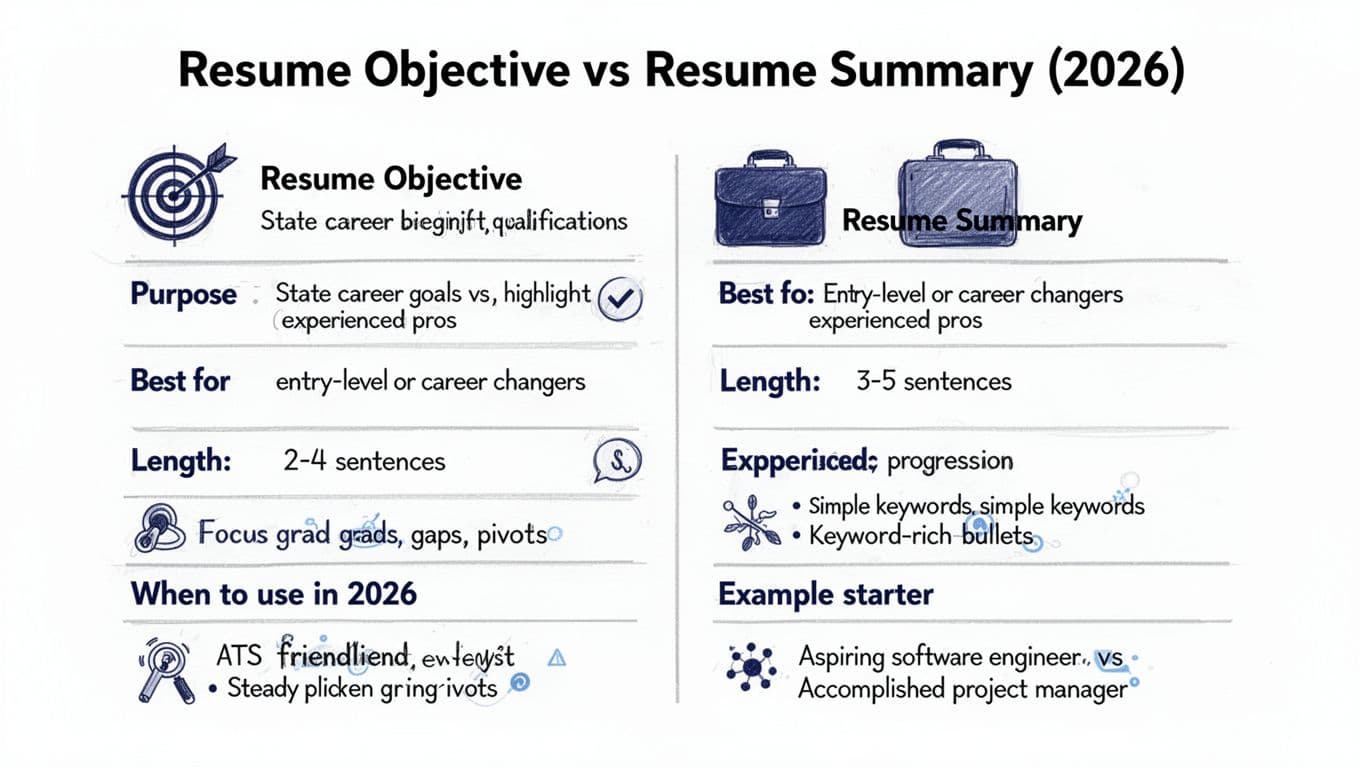
Here is the simple way to think about it: an objective explains direction, a summary proves momentum.
| Feature | Resume Objective | Resume Summary |
|---|---|---|
| Main purpose | Clarify the role you want and why you fit | Show your strongest, most relevant wins |
| Best for | Entry-level, career change, return-to-work | Experienced candidates (advanced career stage) with relevant experience and results |
| Typical length | 2 to 3 sentences | 3 to 5 lines (often 2 to 4 sentences) |
| Focus | Future contribution | Past performance plus current fit |
| ATS impact | Helpful for matching target title | Strong for keywords plus credibility |
| Biggest risk | Sounding vague or needy | Sounding inflated or too broad |
A step-by-step decision process (pick in 2 minutes)
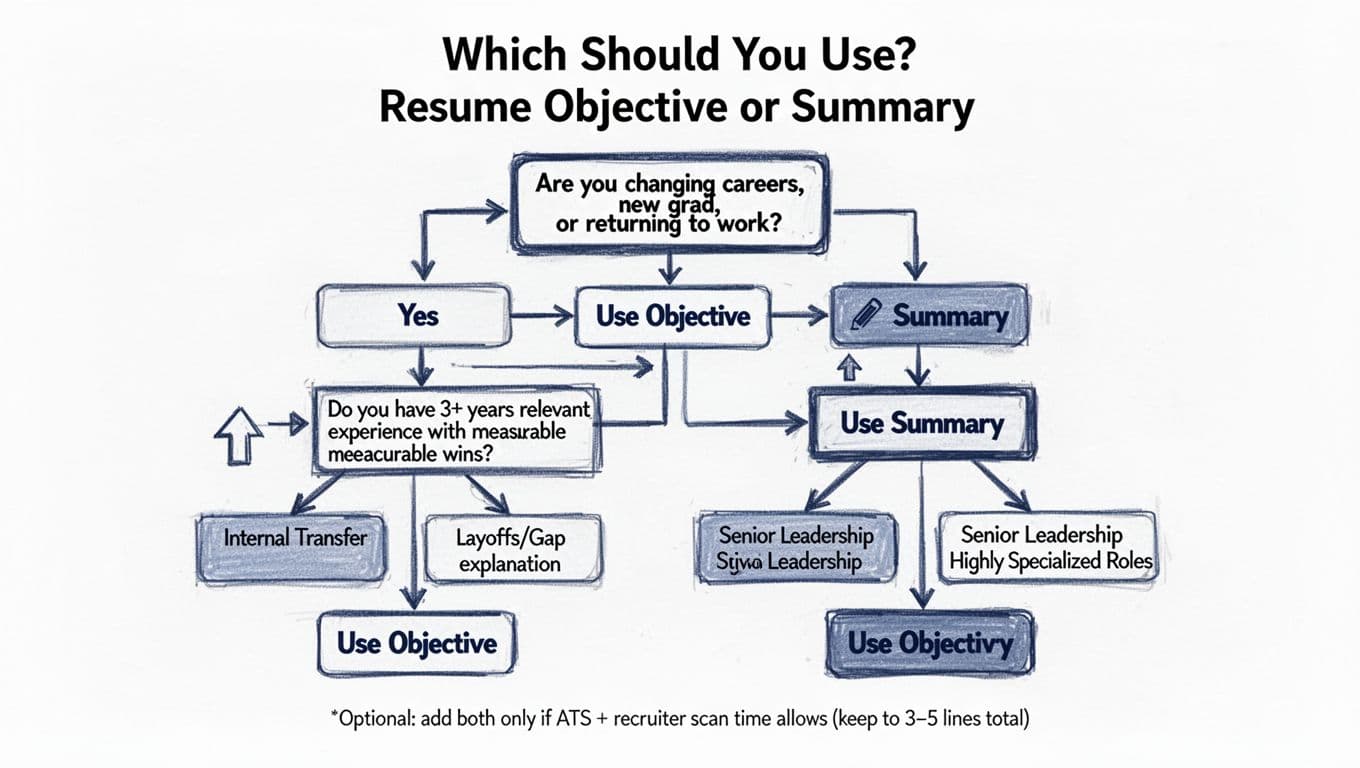
- Check your relevance. If your last 2 roles match the target role and show relevant experience, start with a professional summary.
- Look for a “why this move” gap. If a reader would ask why you are switching fields or lack years of experience in the field, use a resume objective.
- Count measurable wins. If you can name 2 to 3 metrics (revenue, cost, time, quality), you are summary-ready.
- Handle special cases. Internal transfers, layoffs, and return-to-work plans often benefit from a short resume objective.
- Keep it short for scan time. Recruiters have limited scan time, so stay within 3 to 5 lines total.
- Only combine them when it truly helps. In rare cases, you can use a custom statement with a 1-line objective plus a 2 to 3-line summary, but only if it stays tight and still reads clean.
Once you choose, turn those themes into interview stories. CareerScribeAI’s Interview Prep Tools can help you practice answers that match your summary or objective, so your first interview sounds like your resume.
12 plug-in examples you can copy and customize
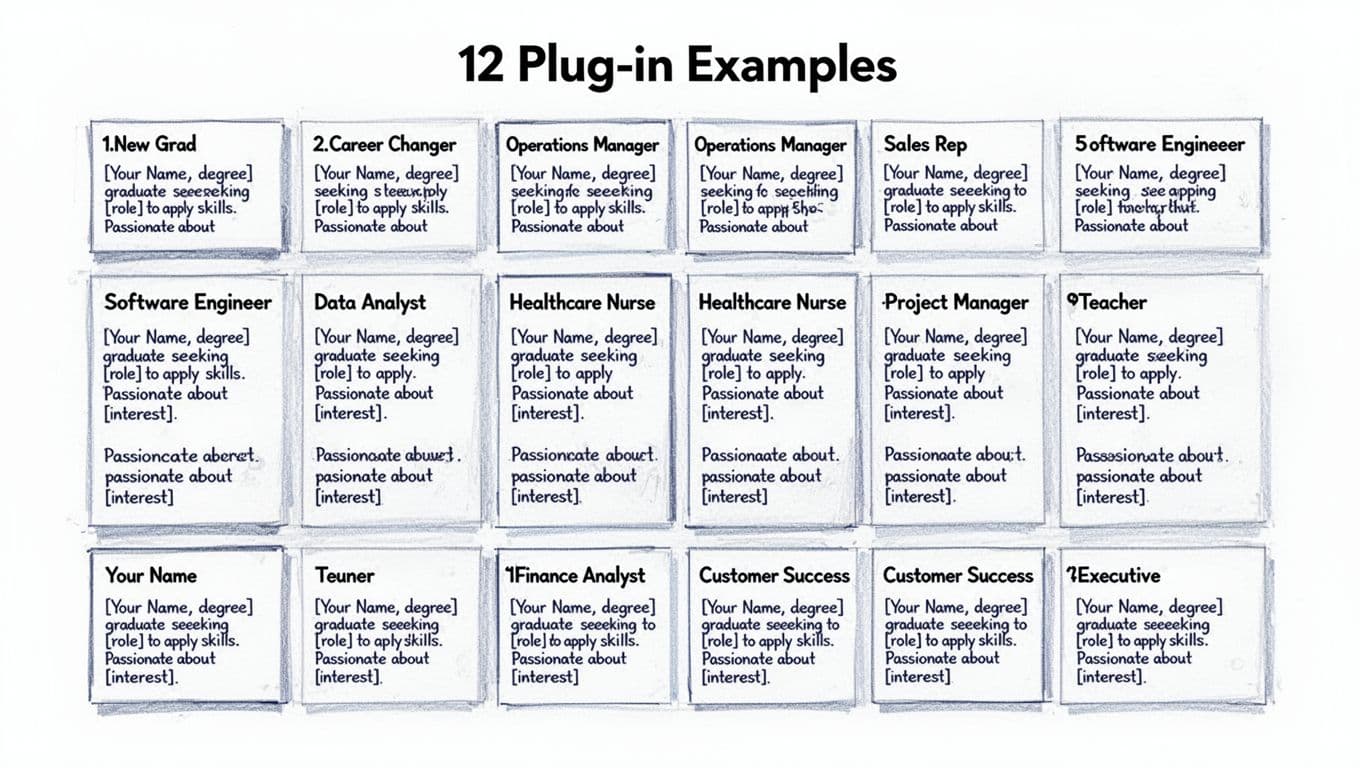
Use action verbs and results-driven phrasing when customizing these templates; fill brackets with your years of experience, technical skills, and soft skills.
- New Grad (Resume Objective): Recent [Degree] graduate seeking a [Target Role] position. Bringing [technical skills], [soft skills], and hands-on work from [internship/project]. Ready to contribute to [team goal] at [Company].
- Career Changer (Resume Objective): Transitioning from [current field] to [target field] as a [Target Role]. Known for [transferable strength] and [transferable strength], shown through [project/cert]. Eager to apply them to [business outcome].
- Operations Manager (Resume Summary): Operations leader with [X years of experience] improving cost, quality, and delivery. Reduced [metric] by [number] and improved [process] across [sites/teams]. Strong in [soft skills], SOPs, vendor management, and cross-team execution.
- Sales Rep (Resume Summary): Quota-carrying sales professional with [X years of experience] in [B2B/B2C] and consistent attainment. Closed $[amount] in [period] and grew pipeline by [percent] through [channel]. Known for clean follow-up and deal control.
- Software Engineer (Resume Summary): Software engineer with [X years of experience] building [systems/products] in [stack]. Shipped [feature] that improved [metric] by [number], and reduced [issue] through [approach]. Comfortable with [technical skills], code reviews, testing, and performance tuning.
- Data Analyst (Resume Summary): Data analyst with [X years of experience] turning messy data into clear decisions. Built dashboards in [tool] and improved reporting accuracy by [percent]. Skilled in SQL, data modeling, and stakeholder communication.
- Healthcare Nurse (Professional Summary): Registered Nurse with [X years of experience] in [unit/specialty] and a calm, patient-first approach. Experienced with triage, care plans, and EMR documentation. Recognized for [quality/safety] and teamwork under pressure.
- Project Manager (Resume Summary): Project manager with [X] years delivering [type] projects on time and on budget. Led cross-functional teams of [size] and managed $[budget] portfolios. Strong in risk control, stakeholder updates, and scope clarity.
- Teacher (Resume Objective): Licensed teacher seeking a [grade/subject] role at [School/District]. Bringing strengths in classroom culture, lesson planning, and data-informed instruction. Committed to helping students improve [goal].
- Finance Analyst (Professional Summary): Finance analyst with [X] years in FP&A and variance analysis for [industry]. Improved forecast accuracy by [percent] and built models for [use case]. Strong in Excel, [BI tool], and clear executive reporting.
- Customer Success (Resume Summary): Customer Success professional with [X] years managing renewals and adoption for [SMB/enterprise] accounts. Improved retention by [percent] and grew expansion revenue by $[amount]. Strong in QBRs, onboarding, and risk management.
- Executive (Executive Summary): Executive leader with [X] years scaling teams and owning P&L outcomes in [industry]. Delivered [result] by driving [strategy], and built leaders across [functions]. Known for clear priorities, accountability, and durable growth.
Conclusion: pick the one that makes your fit obvious
The resume objective vs professional summary decision is simple once you choose a goal. Use an objective when your next step needs context. Use a summary when your results already tell the story.
Keep it short, align it to the posting, and make every line earn its spot to build a strong professional brand. A well-crafted opening statement leads to more interview callbacks from the hiring manager. If you’re applying to several roles, CareerScribeAI can help you tailor faster while keeping your message consistent from resume to interview.