
Hiring managers still skim. ATS still screens. And in 2026, your resume often gets read on a phone, next to 40 other tabs, while someone’s between meetings. That means your resume bullet points, central to smart resume formatting, can’t behave like mini paragraphs.
The 12-word rule is a simple constraint that forces clarity. Think of it like writing a headline, not an essay. While a professional summary hooks the reader, the bullets in your work experience section seal the deal. You’re not trying to tell your whole story in one line, you’re trying to win the next 10 seconds of attention.
Below is how to use the rule, when to break it, and how to keep bullets specific without sounding robotic. This rule is essential for creating a one-page resume that stands out.
What the 12-word rule means (and when it’s okay to break it)
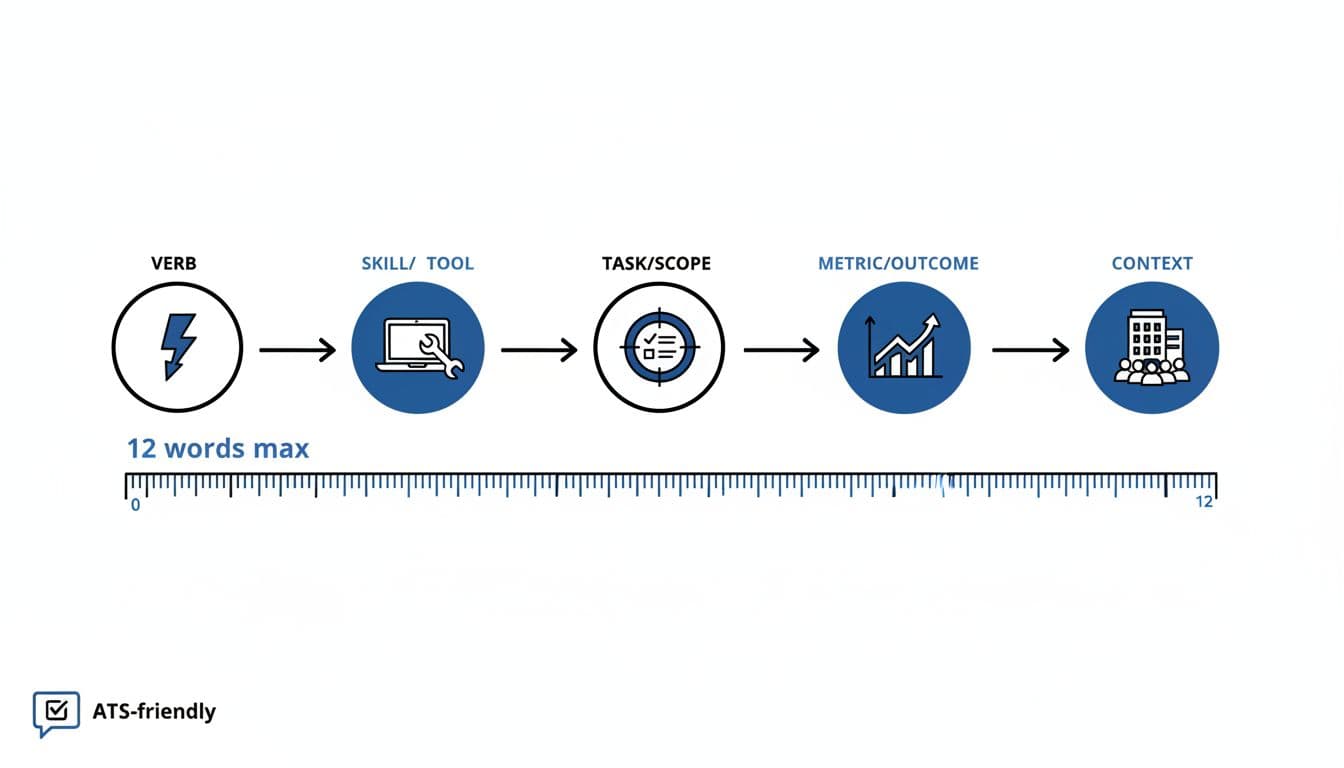
The 12-word rule means each bullet should be 12 words or fewer, while still naming the action, what you used, and the result. Using the 12-word limit is a key step toward an ATS-friendly resume that satisfies applicant tracking systems. It’s not magic; it’s a guardrail. It stops filler like “responsible for” and pushes you toward proof.
A strong 12-word bullet usually follows a tight flow: powerful action verb → Skill/Tool → Task/Scope → Metric/Outcome → Context. You won’t fit every element every time, but you should feel what’s missing.
Why it works in 2026:
- Whether you use a reverse-chronological format, a functional resume, or a combined resume, clarity is king. People read resumes like a list of receipts: what happened, how big, and why it mattered.
- Most resume templates benefit from this constraint. Suggest a single-column layout to ensure the 12 words don’t wrap awkwardly.
- ATS is better than it used to be, but it still rewards clear matches between your bullet text and job requirements. For practical ATS formatting guidance, see Jobscan’s ATS-friendly resume advice for 2026.
Rare exceptions (use them on purpose)
Break the rule when a longer line prevents misunderstanding, such as:
- Compliance or patient safety: regulated steps, required protocols, audit outcomes.
- Highly technical work: a critical dependency or constraint (security, uptime, data integrity).
- One-time, high-stakes achievements: mergers, incident response, litigation support.
Even then, treat 16 to 18 words as a hard ceiling, and keep it to one idea.
Outcome-led bullet point formula for the work experience section (from long to 12 words)
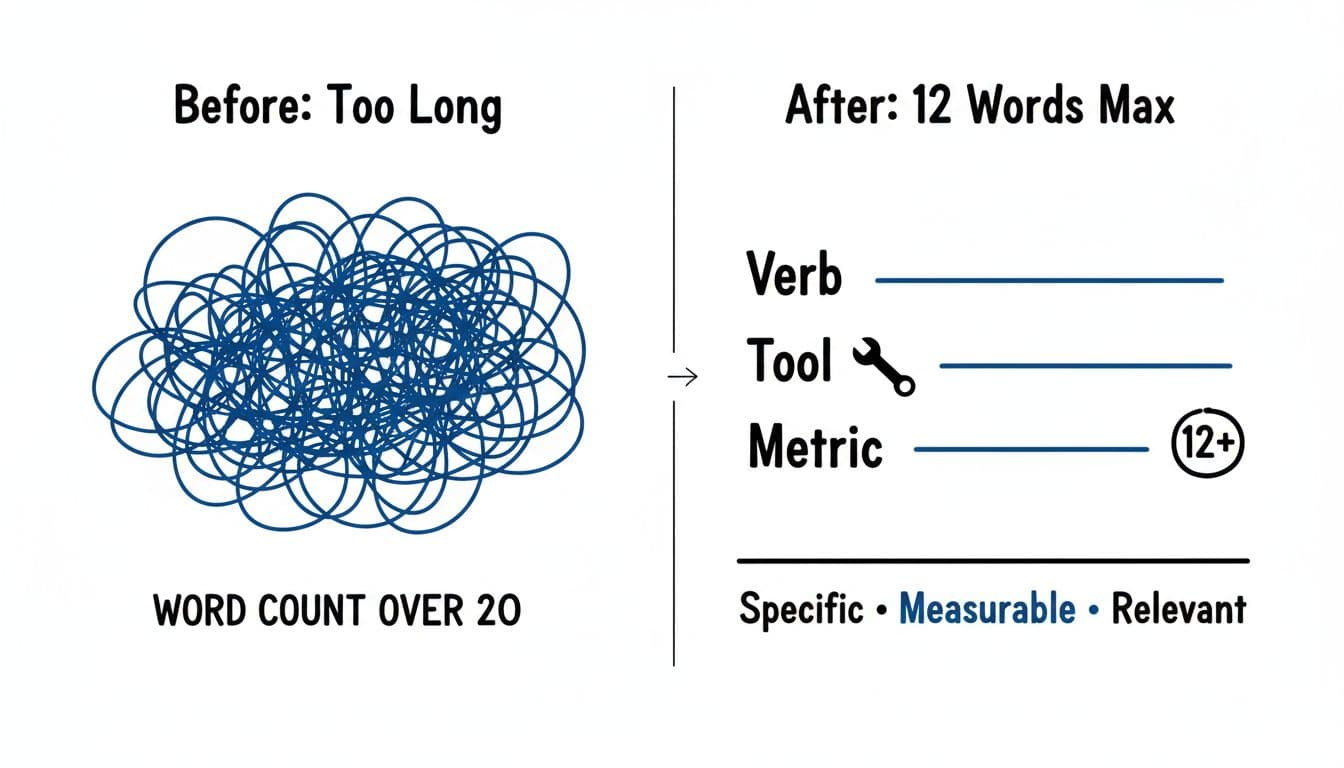
Most bullets in the work experience section start long because you’re trying to be “complete.” The fix is to rewrite like an editor.
- Circle the quantifiable achievements first. What changed because you did the work (time, cost, quality, risk)?
- Pick one strong verb. One bullet, one action (reduced, built, shipped, resolved).
- Name the tool or skill that proves fit and highlights transferable skills. Software, method, framework, equipment, language.
- Cut setup phrases. Remove “responsible for,” “worked on,” “helped with,” “in order to.”
- Trim context to the minimum. Keep only what stops confusion (team size, system, audience).
- Count words to meet reverse-chronological format standards and tighten. Swap long phrases for precise ones (use “led” not “was leading”).
Here’s a practical rewrite:
Long: “Responsible for managing weekly reporting and creating dashboards for leadership to track performance across regions.”
Tight: “Built weekly leadership dashboards, improving regional visibility across 6 markets.”
If you want help tightening without losing meaning, CareerScribeAI’s AI Resume Builder can take a job description, flag must-have keywords, then suggest shorter bullets that match the job description and include metrics that matter. It’s also useful for catching vague verbs you stopped noticing.
Before/after bullet examples across industries (12 words max)
These resume bullet points for the work experience section showcase quantifiable achievements hiring managers look for first. The “after” lines stay under 12 words, keep one idea, and show proof. Even a skills-based resume requires these tight lines.
| Industry | Before (too broad) | After (12 words or fewer) |
|---|---|---|
| Operations | Handled order fulfillment processes and supported warehouse improvements as needed. | Reduced order-processing time 18% by automating pick-pack workflow in SAP. |
| Sales | Responsible for selling products and maintaining relationships with clients. | Closed $1.2M pipeline, 28% win rate, using MEDDIC and HubSpot. |
| Marketing | Worked on email campaigns and improved engagement across segments. | Improved email CTR 22% by testing subject lines and segmentation. |
| Software/IT | Helped improve application performance and worked with the team on fixes. | Cut API latency 35% by caching responses in Redis. |
| Finance | Assisted with invoice reconciliation and month-end close tasks. | Reconciled 400+ invoices monthly, cutting close time by 2 days. |
| Healthcare | Supported patient intake and helped reduce delays in clinic flow. | Reduced patient wait times 14% by re-routing triage staffing. |
| Customer Support | Helped customers with issues and updated support documentation. | Raised CSAT from 4.2 to 4.6 by fixing macros. |
For more examples, resume templates, and layout ideas, check Careerflow’s resume bullet point guide.
Bullet templates that stay clear without sounding generic (plus ATS tips)
A template helps you write faster, but the details make it believable. Use these fill-in patterns as resume templates for resume formatting, then swap in real tools, numbers, and outcomes.
- Improved [metric] by [number] by [action] using [tool].
- Reduced [cost/time/errors] by [number] through [method/process].
- Built [deliverable] for [audience] to [outcome], measured by [metric].
- Resolved [issue] in [time], preventing [risk/impact] for [scope].
- Shipped [feature/project] used by [users/teams], increasing [metric] [number].
ATS keyword placement (without stuffing)
Applicant tracking systems don’t need repetition, they need clarity. Stick to a single-column layout for better scanning, and ensure keywords appear naturally, much like they would in a professional summary. Put the keyword where a human expects it:
- Place the skill/tool near the verb (“Built dashboards in Power BI,” not buried at the end).
- Tailor keywords to the specific job description’s exact phrasing once when it’s natural (for example, “customer retention”).
- Avoid “keyword stacks” like “SQL, Excel, Tableau, Python, Jira” in one bullet unless the role demands it.
- Save the final document in PDF file format to preserve formatting.
If you want bullets that match the posting without copying it, tools like Teal’s guidance can help with tailoring, see Teal’s resume writing playbook.
CareerScribeAI can also help here: use its job description analyzer to spot repeated requirements, then tighten your bullets around those terms, one clean mention at a time.
Metrics in 2026: what to measure, and how to estimate ethically
Metrics turn “I did tasks” into quantifiable achievements like “I drove outcomes.” Good numbers are often closer than you think.
Core metrics for 2026:
- Speed: cycle time, close time, response time, time-to-resolution.
- Quality: error rate, defect rate, rework, audit findings.
- Money: revenue, margin, cost avoided, budget variance.
- Volume: tickets handled, invoices processed, campaigns shipped, patients seen.
- Customer impact: CSAT, NPS, retention, adoption, churn.
How to estimate without exaggerating:
- Use before/after snapshots from reports you already had.
- Convert time saved into hours per week (then stop, don’t invent dollar values).
- Use ranges when exact numbers aren’t available (“reduced handle time about 10 to 15 percent”).
- Tie estimates to a method (“based on 8 weeks of QA logs”).
These numbers also help highlight transferable skills for career pivots.
When you turn these core bullets into a cover letter story or professional summary, CareerScribeAI’s Cover Letter Generator can expand one tight bullet into a short narrative with context and stakes, without turning your resume into a paragraph block.
Tight bullet checklist and FAQ
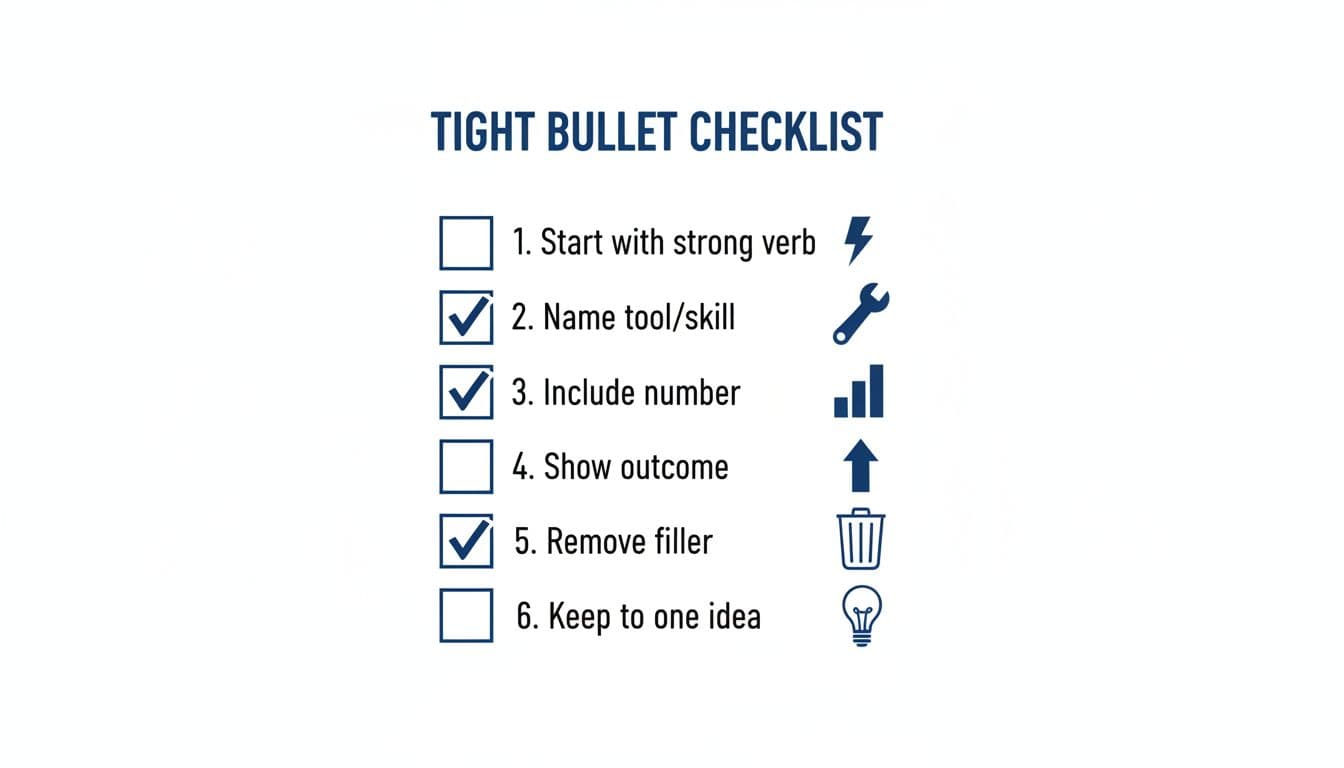
Use this quick checklist before you submit to ensure every bullet matches the job description:
- Start with action verbs
- Name the tool or skill
- Include metrics when honest and relevant
- Show the outcome, not just the task
- Remove filler words and soft starters
- Keep it to one idea per bullet to maintain white space within the work experience section
FAQ: Does every bullet need to be 12 words?
No. Use it as your default, then break it only when clarity demands it. Most resumes get better when 70–90% of bullets follow the rule.
FAQ: What if I can’t quantify my work?
Use counts, time, or scope: “Handled 30 tickets/day,” “Supported 12 clinics,” “Trained 6 new hires.” If you still can’t, name the outcome plainly (“reduced escalations,” “improved accuracy”).
FAQ: Can I include two metrics in one bullet?
Yes, if it stays readable and under 12 words. One metric is usually stronger than two weak ones.
FAQ: How do I turn bullets into interview answers?
Pick one bullet, add the problem and constraint, then explain your action and result using the STAR method. CareerScribeAI’s Interview Prep Tools can convert bullet points into STAR method answers so you don’t freeze when asked for examples.
FAQ: How do I format my resume for a one-page resume?
Use professional fonts like Arial or Calibri, a readable font size (10-12pt), and consistent line spacing (1.0-1.15) to keep everything clean and concise. Tight bullets make this easier by maximizing white space in the work experience section.
Conclusion
The 12-word rule keeps resume bullet points, the heartbeat of a modern resume, sharp, readable, and harder to ignore. Start with the outcome, name the tool, add an honest metric, then cut until every word earns its spot. If you want a faster edit loop, run your bullets through CareerScribeAI, then reuse your best lines in your cover letter and interview prep. For an ATS-friendly resume, save it in PDF file format. Tightening these lines helps you achieve your career goals by making a better impression on hiring managers. Your resume doesn’t need more words, it needs better ones.