

Career switching can feel like trying to convince a stranger you’re right for a job you’ve never had, especially when changing industries and shifting your career path. The truth is, hiring teams don’t need you to have the exact title; they need proof you can do the work.
A strong career change resume in 2026 does that with one move: it translates your past results into the language of the new role, perfect for career switching. That’s what the “Bridge Bullets” method is for. It turns your experience into role-matched bullets for your career change resume that make sense to both ATS scans and humans.
What a career change resume must do in 2026 (and what to drop)
In 2026, many companies still use applicant tracking systems to filter resumes before a hiring manager sees them. That changes what “good” looks like. Your resume can’t just be well written; it must be easy to scan and packed with relevant signals.
For career switchers, your resume has three jobs:
1) Match the new role’s keywords without sounding fake.
If the job description says “stakeholder management” and you write “people skills,” you’re forcing the reader to guess. Don’t. Use the job’s terms when they honestly fit your work.
2) Prove skills with outcomes, not traits.
“Hard-working” isn’t a skill. “Reduced support tickets 18% by rewriting help docs” is.
3) Show skills validation.
When your title doesn’t match, proof matters more, especially for soft skills: a certificate, a portfolio project, a tool you used, a process you improved, or results you measured.
For ATS basics and formatting guardrails, keep a reference open like Jobscan’s guide on ATS-friendly resume best practices in 2026. Then focus your energy where it pays off most: bullets that bridge your old work to the new job.
The Bridge Bullets method that makes your experience “count” again
Bridge Bullets are normal resume bullets with one difference: every line is written to connect your past work to the target role.
Use this simple formula (then repeat it across your experience in a combination resume format):
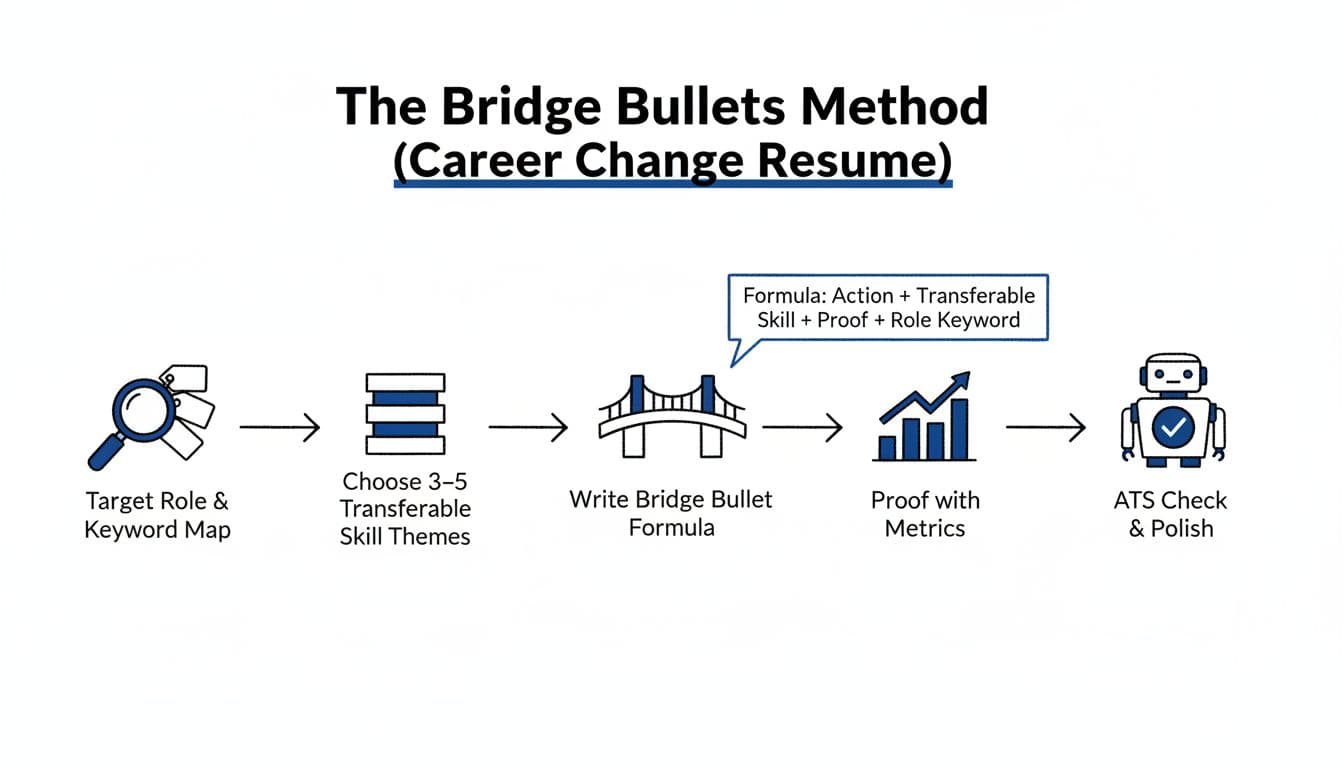
Bridge Bullet formula: Action + Transferable Skill + Proof + Role Keyword
In this formula, Transferable Skill highlights your transferable skills that apply to the new role, linking your background through those transferable skills to key requirements.
Here’s the 5-step flow to build them fast:
- Target role and keyword map: Pull 10 to 15 words from the job post (industry tools, deliverables, stakeholders, outcomes).
- Pick 3 to 5 transferable skill themes: Example themes: analysis, operations, customer insights, reporting, cross-team work.
- Write the bridge bullet: Start with what you did, then attach the theme, then connect to the target keyword.
- Prove it with metrics: Dollars, time, volume, accuracy, cycle time, adoption rate, satisfaction score.
- ATS check and polish: Clean formatting of bullet points, consistent tense, no keyword stuffing, no buzzwords.
If you want help generating variants of a bridge bullet (or checking how closely your resume matches a posting), CareerScribeAI’s resume builder and ATS match tools can speed up creating a tailored resume, while keeping your voice and facts intact.
Mini worksheet: turn a job posting into 6 bridge bullets in 20 minutes
Start with a real job description. For this example, imagine you’re moving into Customer Insights Analyst. The job description includes keywords like: stakeholder management, SQL, dashboards, customer insights, process improvement.
Next, choose your top transferable skills. If you’re unsure what counts, use a current list like transferable skills employers look for in 2026, then narrow to the transferable skills that match the posting.
Now fill in this mini worksheet. Don’t aim for perfect sentences yet, aim for raw material:
Job keyword (from posting)Your transferable proof (from work experience)Metric or scopeBridge bullet draft (1 sentence)stakeholder managementLed weekly updates with ops, sales, support6 teamsPresented weekly performance updates to 6 cross-functional teams, aligning priorities and resolving blockers (stakeholder management).SQLBuilt data pulls (or learned via relevant coursework or online certificate program + project)3 dashboardsBuilt and maintained 3 KPI dashboards using SQL-based extracts, improving decision speed for managers.customer insightsCollected feedback, analyzed trends400 responsesAnalyzed 400 customer feedback entries to identify top drivers of churn, turning findings into actions for retention.process improvementReduced rework, tightened steps22% lessImproved an intake workflow, cutting rework 22% and creating clearer handoffs across teams (process improvement, drawn from work experience).
Quick rules while you draft:
- Use the posting’s language for technical skills and deliverables (dashboards, reports, audits, tickets, forecasts).
- Keep each bullet to one main idea.
- When you don’t have a metric, use credible scope (volume, frequency, team size, regions supported).
If you also need your career change story to sound confident (not apologetic), a cover letter can carry the “why.” CareerScribeAI’s cover letter generator is useful here because it can mirror the same keywords you used in your bridge bullets.
Before and after bridge bullets (matched to target keywords)
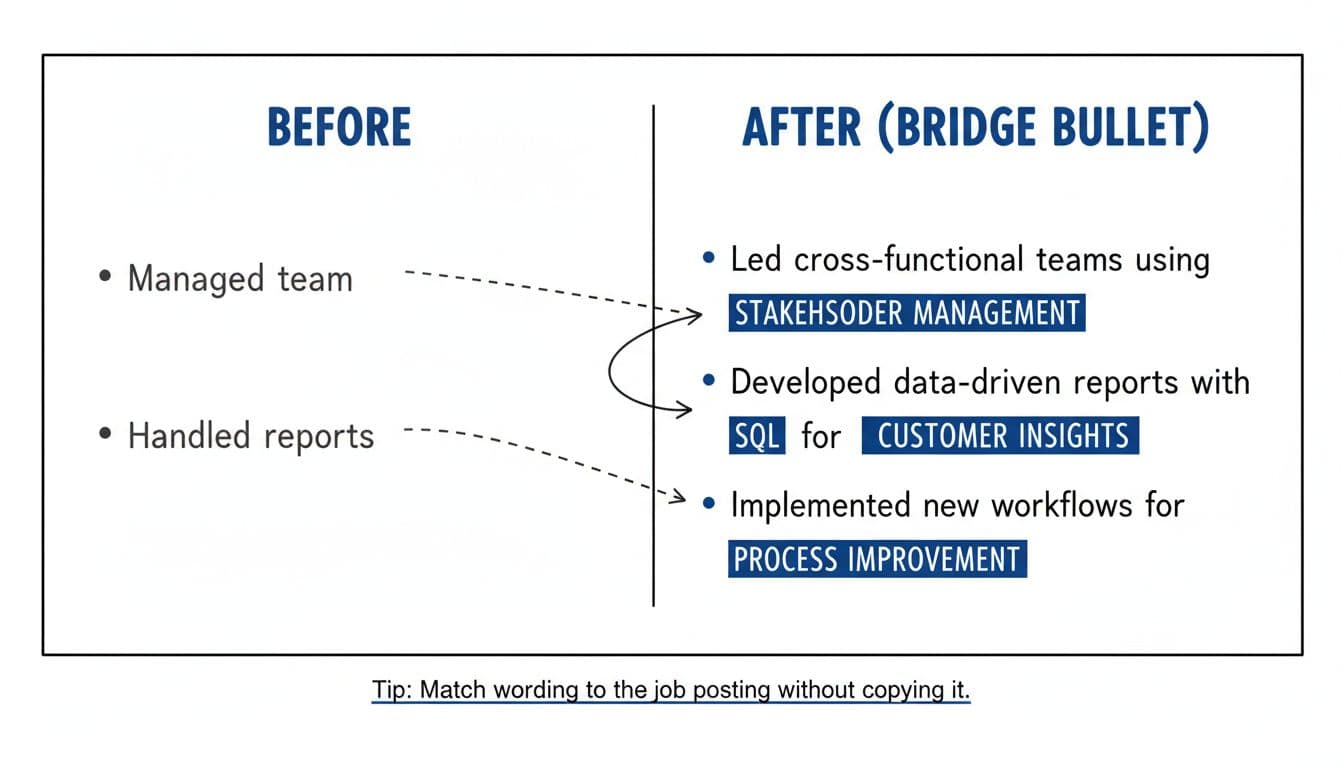
Below are three rewrites drawn from work experience and relevant work experience, aimed at a Customer Insights Analyst posting that mentions stakeholder management, SQL, process improvement, and customer insights. Start with a resume template to structure your professional experience effectively.
Example 1 (Retail supervisor to analyst)
From work experience in retail supervision:
Before: Managed a team and handled daily reports.
After (Bridge Bullet): Led daily KPI reporting for a 12-person team, flagging trends and recommending staffing changes that improved on-time task completion 15% (customer insights, process improvement, problem solving).
Example 2 (Teacher to analyst)
From relevant work experience in education:
Before: Created lesson plans and tracked student progress.
After (Bridge Bullet): Built a simple performance tracker to monitor weekly progress for 120 students, summarizing results for leadership and adjusting interventions based on trends (dashboards, stakeholder management).
Example 3 (Admin coordinator to analyst)
From professional experience in administration:
Before: Worked with different departments and maintained spreadsheets.
After (Bridge Bullet): Partnered with sales and operations to define reporting needs, then maintained KPI trackers that reduced follow-up requests 30% and improved data consistency (stakeholder management, process improvement).
To keep those bullets readable by ATS in your tailored resume, watch for common traps. A quick refresher like Careerflow’s list of ATS resume mistakes to avoid in 2026 helps you catch issues before you hit submit.
Final ATS-ready checklist for career changers
- Use a clean resume format, standard headings, and simple bullet points.
- Put a resume objective at the top that mirrors the target role’s wording and supports your career change.
- Add a skills summary section with the posting’s tools, including technical skills (only what you can defend).
- Include a second skills summary focused on leadership skills and transferable abilities from past roles.
- In work experience, keep bullets outcome-focused, with metrics or scope, prioritizing relevant work experience.
- Highlight professional experience and personal projects that align with the role’s needs.
- Feature academic achievements, volunteer work, and professional development to strengthen your resume objective.
- Refine your resume objective to appeal to the hiring manager, matching keywords naturally without repeating phrases.
- Start with an ATS-friendly resume template and save as PDF only if the application allows it, otherwise use DOCX.
- Prep your transition story for interviews (CareerScribeAI’s interview prep tools can help you practice concise “why this move” answers).
Conclusion
A career change resume works when it stops trying to “sound qualified” and starts showing proof in the employer’s language. The Bridge Bullets method gives you a repeatable way to do that for your job search and career goals: map keywords, choose transferable themes, write action-based bullets, and back them with outcomes. Build six strong bridge bullets, and your career change resume’s past experience won’t look unrelated anymore; it’ll look ready.