

Most candidates spend too much time on the wrong details. They skim the About page, read a few headlines, and still enter the interview with nothing sharp to say.
Effective preparation when you research company interview details is narrower than that. In half an hour, you can learn enough to give better answers, ask better questions, and sound prepared without sounding scripted.
The goal is not to know everything. The goal is to know what matters for this role.
Key Takeaways
- Focus on relevance, not volume: Effective research is about understanding the company’s current challenges and how your specific skills solve them, rather than memorizing their entire history.
- Use a timed framework: Dedicate your 30-minute prep into three 10-minute blocks covering company fundamentals, recent news, and competitive positioning to ensure you cover essential information efficiently.
- Connect insights to your experience: Move beyond stating facts by linking company research directly to your own achievements; use your findings to demonstrate how you have handled similar goals or obstacles in the past.
- Prepare strategic questions: Use your research to craft thoughtful, specific questions about company growth, team goals, and performance expectations to signal your engagement and strategic thinking.
What to learn before you talk to the company
Start with four questions: What does the company sell, who does it serve, what has changed lately, and where does this role fit? If you can answer those clearly, your interview prep is already stronger than most.
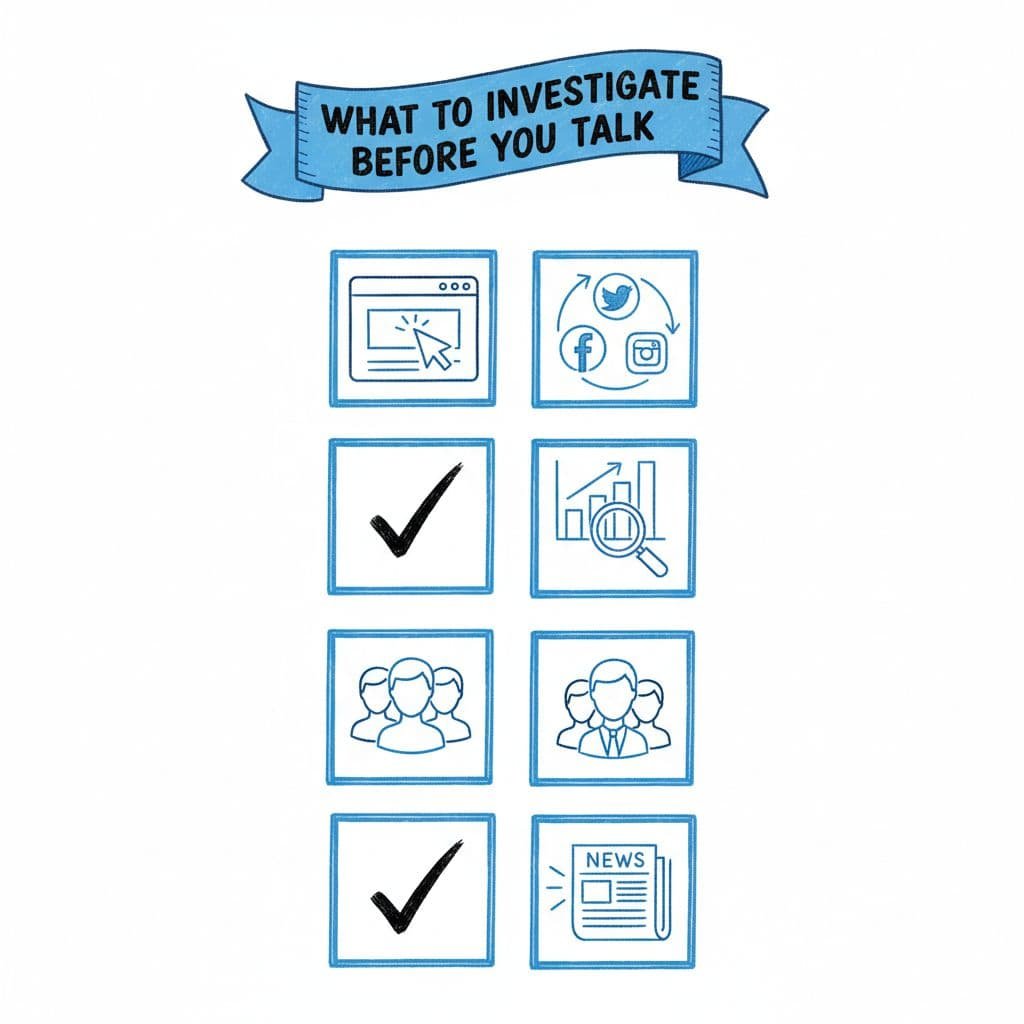
Begin on the company website. Read the homepage, the About page, and the specific products and services offered. Then compare that language with the job description. You are looking for repeated themes, such as growth, client service, speed, compliance, or product quality, while taking note of the organization’s mission and values. Purdue Global’s interview research guide covers the same basics and is a good quick check if you want a second source.
After that, look for recent movement. Read the newsroom, press releases, or blog. Check the LinkedIn company page and recent posts, or look into their broader social media presence to see how they engage with the public. A short LinkedIn note on company questions makes a useful point: know why the company exists, who its customers are, and where it sits within the competitive landscape. Those three points shape better interview answers than a memorized founder story.
Next, scan leadership and team context. You do not need a full org chart. You only need enough to understand the executive team and browse a few leadership bios to see if the company talks like a startup, a large enterprise, a mission-led nonprofit, or a sales-driven business. That changes how you frame your own experience. Consider what the hiring manager might be prioritizing, as understanding the internal culture helps you tailor your approach.
If you can explain how the role connects to customers or current business goals, you are ahead of most applicants.
Keep your notes short. One line on the company, one line on the role, one line on recent news, and one line on what you can help with is enough.
A focused 30-minute company research plan
A short sprint works better than a messy hour. Use this structure and stop when the timer ends.
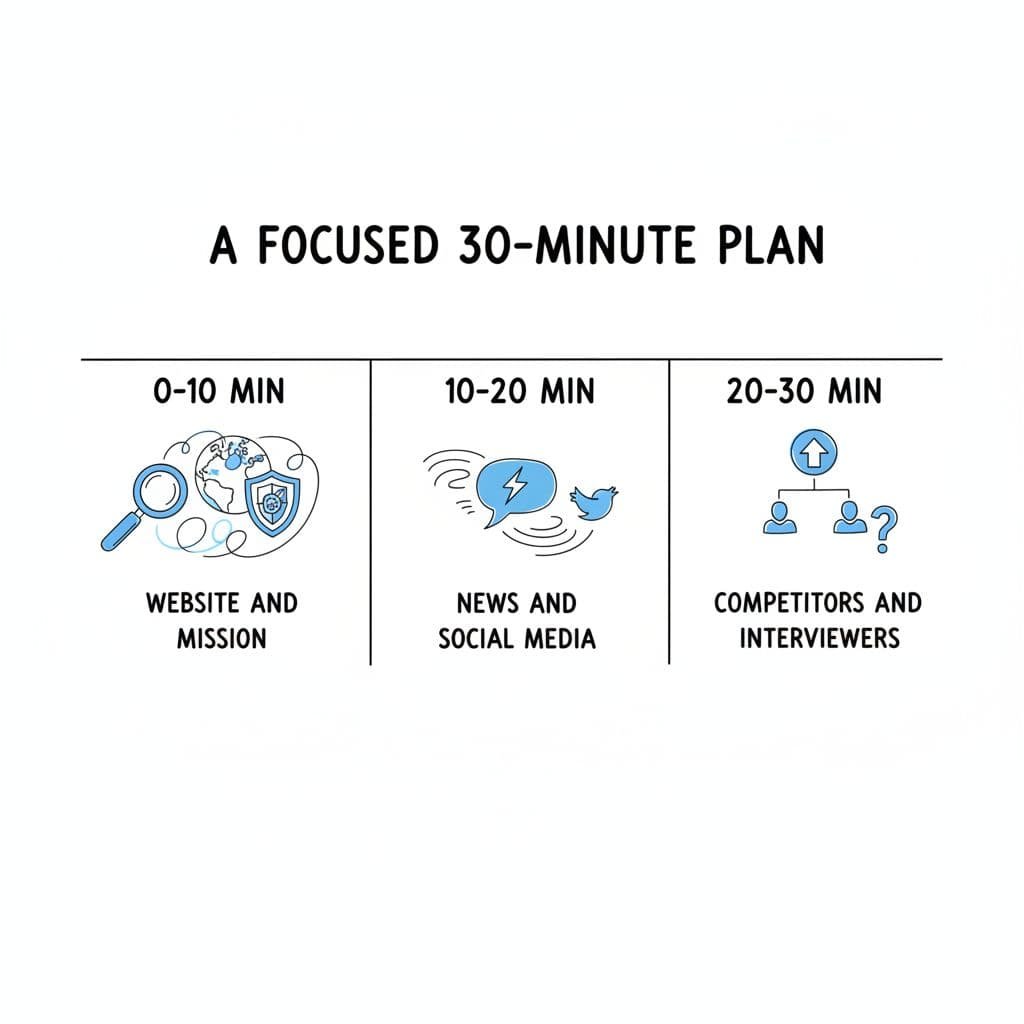
Here is a simple plan you can follow before almost any interview:
| Time block | Where to look | What to capture |
|---|---|---|
| 0 to 10 minutes | Company website and job description | Mission, products and services, customer, repeated terms in the role |
| 10 to 20 minutes | Newsroom, Google News search, recent news releases, LinkedIn page | Recent launch, hiring trend, market focus, company tone |
| 20 to 30 minutes | Investor relations, quarterly earnings call, competitive analysis, interviewer profile | One competitor, interviewer background, two tailored questions, one proof story |
In the first 10 minutes, read fast and compare wording. If the job post repeats terms like cross-functional, client-facing, or process improvement, underline them. Those are clues about what the hiring team cares about.
In the next 10 minutes, look for fresh context. Use a Google News search or recent news releases to see if the company has launched a product, entered a new market, or posted about a hiring push. Checking a Crunchbase profile also provides insight into recent funding and overall financial health. Even one current detail tells the interviewer you did specific research rather than generic prep.
Use the final 10 minutes to make your notes usable. Perform a quick competitive analysis to identify a key rival. Review the interviewer’s LinkedIn profile if you have their name, and scan their investor relations page or a recent quarterly earnings call transcript if the company is public. Then, write two smart questions and one short example from your own work that matches the company’s needs.
This is also where support tools help. If you are preparing fast, CareerScribeAI.com can keep your application and interview story aligned. Its AI Resume Builder and Cover Letter Generator can mirror the same priorities you found in the job post, while the Interview Prep Tools can turn your notes into tailored interview responses and STAR-style answer prompts.
The key is to finish with a one-page brief for yourself. Use four mini-headings: What the company cares about, what this role likely solves, my proof, and questions to ask. That page is exactly what you should review five minutes before the call to effectively research company interview talking points.
Turn research into stronger answers and smarter questions
Research only helps if it changes how you communicate during your meeting. Facts alone do not impress hiring managers; relevance does.
For example, avoid broad lines like, “I’m excited about your company culture.” That vague statement could fit almost any firm. A stronger answer sounds like this: “I noticed your company culture emphasizes cross-departmental collaboration. In my last role, I improved output by 18 percent by streamlining handoff steps between sales and support.” Now, your answer connects your findings to a tangible result.
The same rule applies when answering, “Why do you want to work here?” Mention one specific business detail, then connect it to your own experience. If you are researching a potential employer the right way, you should be able to articulate why this role makes sense for both sides.
Many applicants stop at company history. While those basics are worth knowing, they are not enough. Your goal is to show strategic thinking rather than simple recall. Digging into industry trends or looking at Glassdoor reviews can provide deeper employee insights. By exploring these resources, you can better understand the reality of work-life balance, overall job satisfaction, and opportunities for professional development at the firm.
When it is time to ask your own interview questions, use the information you gathered to drive the conversation forward. These interview questions show you did your homework:
- I noticed the company has been talking about expansion in this area. How does this role support those industry trends?
- Beyond the job description, what are the primary goals for this position in the first 90 days?
- What separates someone who thrives on this team from someone who struggles in this company culture?
- Based on my research into the company’s recent growth, how do you see the team evolving over the next year?
These interview questions do two jobs. They show you paid attention, and they help you determine if the role is a genuine fit for your career goals.
If you freeze during meetings, write out one or two structured STAR stories before you arrive. Match each story to a specific need you found in your research, such as growth, process improvement, or client trust. By preparing these stories alongside your list of interview questions, your prep will feel cohesive rather than scattered.
Frequently Asked Questions
Do I need to know the company’s entire history to be prepared?
No, you do not need to memorize the founder’s story or every past milestone. Focus your energy on current business goals, the company’s recent news, and how your specific role helps the team achieve its future objectives.
What should I do if I cannot find much news about the company?
If you cannot find recent press releases, check the company’s LinkedIn page, their blog, or recent job postings to see where they are currently focusing their energy. Even if they are quiet in the media, understanding their products, services, and core mission is often enough to have a high-quality conversation.
How can I make my interview answers sound less scripted?
Avoid reciting company facts you found online and instead connect those facts to your own professional experience. By framing your response as a solution to a problem you identified in your research, you move from sounding like a memorized script to appearing like a collaborative, strategic thinker.
Final thoughts
Thirty minutes will not make you an insider, but it will give you enough context to speak clearly, show cultural fit, and avoid generic answers.
That is the point of focused research. When you research a company interview, you should look beyond the surface level. Take a moment to review the mission and values to understand their core philosophy, and scan the latest annual report to get a clear sense of their long-term outlook. You can also supplement your 30-minute plan by reaching out to your personal network for additional insights into the team culture. By identifying what the company is trying to achieve, understanding where your role fits, and highlighting the specific parts of your background that provide solutions, you will be well prepared to impress.