


Job posts in 2026 often read like a shopping list for long-term career growth. Some items are deal-breakers. Others are “wouldn’t it be great if…” ideas that somehow became bullets in the same section.
Here’s the bottom line: treat job skills in a posting as two different buckets, must-have skills (to clear screening and do the job) and nice-to-have skills (to stand out). When you separate them, you’ll apply faster, tailor smarter, and stress less.
This guide shows how to spot the difference, how to reflect it in your resume and cover letter, and how to prove it in interviews. Tailoring for these requirements is essential for a strong resume objective when applying for competitive roles in 2026.
What “must-have” and “nice-to-have” really mean in 2026 job descriptions
A job description has two audiences: humans and systems. Hiring managers want someone who can deliver quickly. Meanwhile, an ATS often looks for matching terms (ATS keywords) to sort applicants into “review” and “maybe later.”
That’s why “must-have” usually means core competencies tied to outcomes, often consisting of hard skills and technical skills. If you don’t have them, the role becomes risky for the team. Nice-to-have skills, often listed as “preferred qualifications,” are the extras that reduce training time or expand scope, frequently leaning toward soft skills.
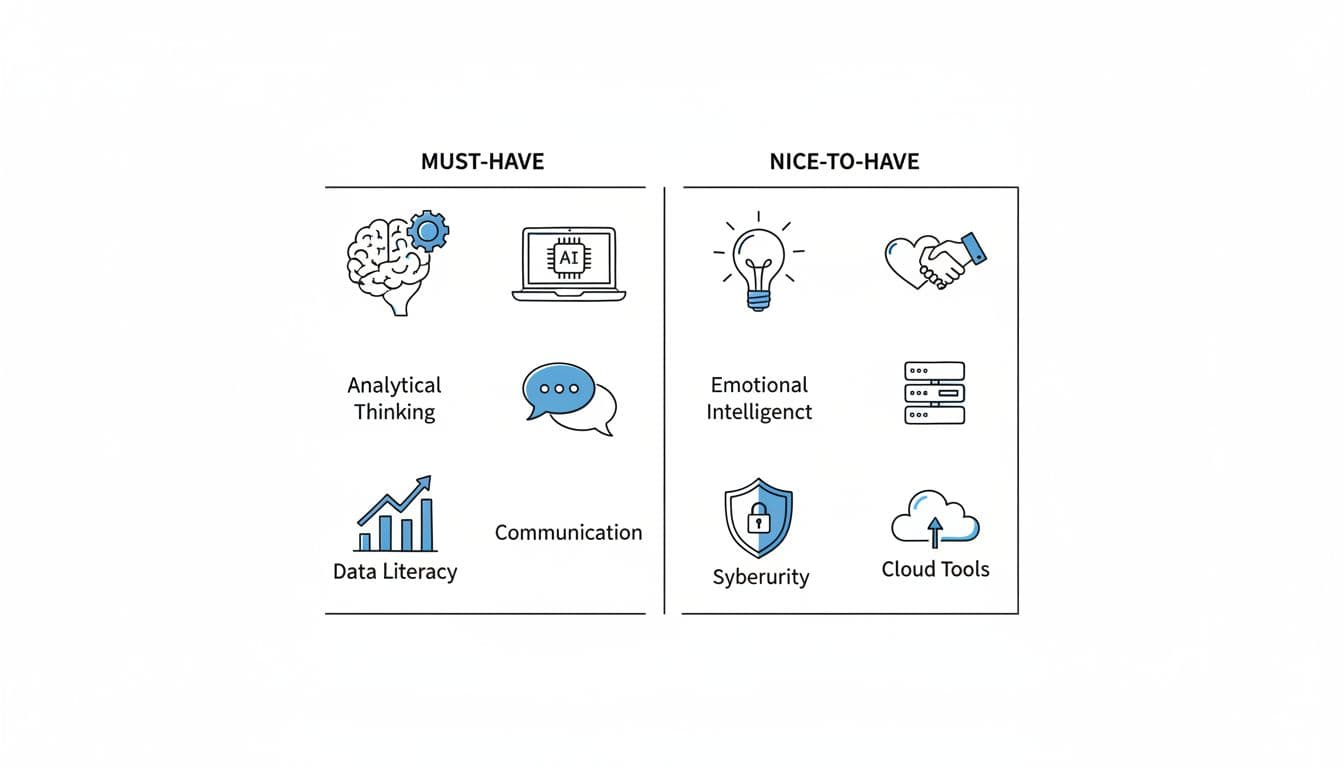
In many 2026 postings, must-haves cluster around a few themes: critical thinking, communication skills, data analysis, and comfort using AI and automation tools. Nice-to-haves often include domain knowledge, specific platforms, and “bonus” strengths like basic cybersecurity awareness or advanced reporting.
Here’s a quick way to read the signals. Use this table as your translator when the language gets fuzzy.
| Posting language | Usually means | How to respond |
|---|---|---|
| “Required,” “Minimum qualifications,” “You must” | True must-have skills | Mirror these in your resume bullets and skills section |
| “Experience with…” tied to main duties | Likely must-have | Prove it with a quantified achievement |
| “Preferred,” “A plus,” “Nice to have” | Nice-to-have skills such as teamwork and emotional intelligence | Address in cover letter or projects section |
| “Familiarity” or “Exposure” | Trainable | Show adjacent tools and fast learning examples |
| “Bonus” or “Ideal candidate” | Wish list | Apply if you meet the core requirements |
One more reality: many teams over-list requirements to reduce applicant volume. Employer-side guidance often recommends separating essentials from preferences for clarity. If you’re curious why that matters, see Kuubiik’s advice on writing clearer job descriptions, which echoes the “required vs preferred” structure you can use as a reading clue.
If a posting says “preferred,” treat it as negotiable unless the daily work clearly depends on it.
How to spot must-have job skills fast (and avoid guessing)
When you’re tired, every bullet can feel equally important. Instead, use a simple filter: must-haves connect directly to the job’s outputs. They show up in more than one place, and they map to the responsibilities.
This five-pass scan keeps it quick and repeatable.
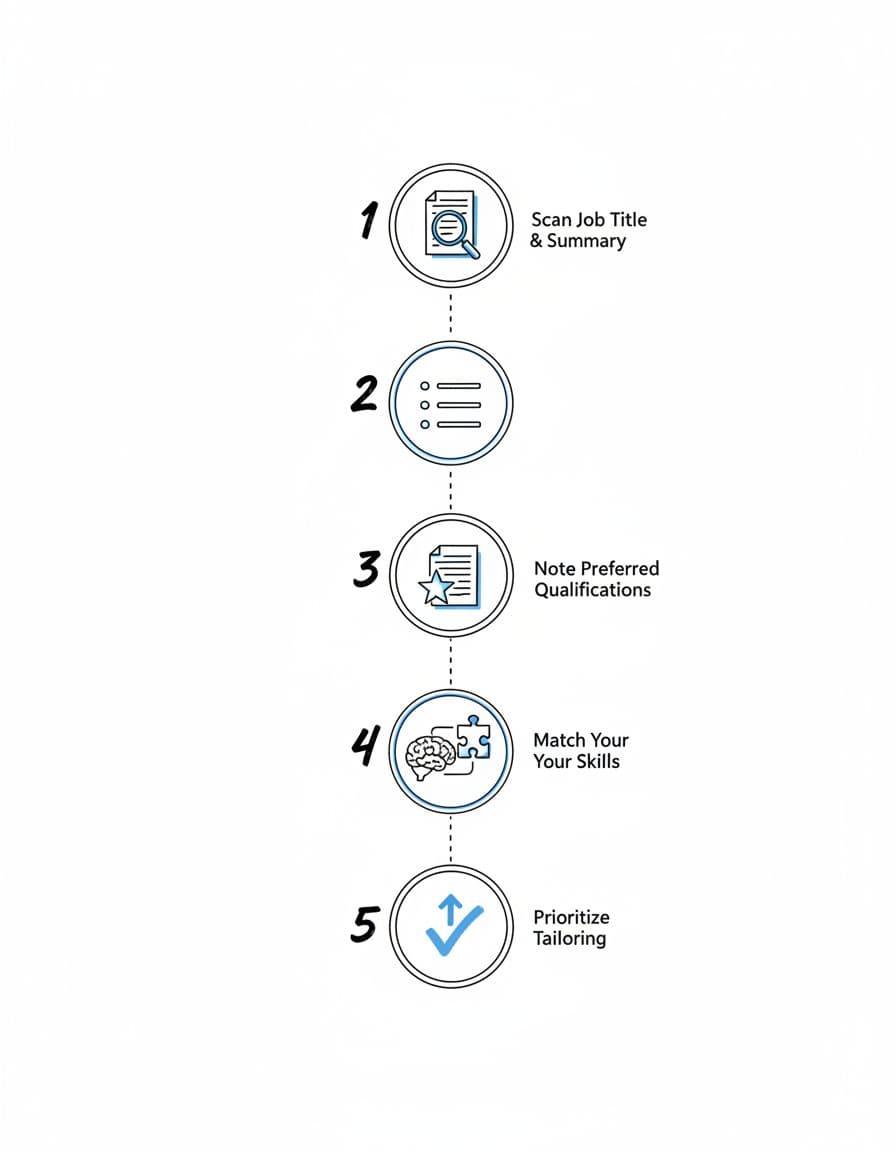
First, read the top third only (title, summary, first responsibility block). That section usually contains the real job. Next, circle the verbs that imply outcomes, like “build,” “manage,” “forecast,” “improve,” or “ship,” as well as those pointing to outcomes such as problem solving and leadership skills. Then match each outcome to the skill needed to deliver it.
After that, go to the qualifications section and split it into two lists: job requirements and preferred qualifications. Finally, check repetition. If a tool or skill appears 3+ times (or appears in both responsibilities and requirements), it’s probably a must-have.
If you want a deeper walkthrough of breaking down postings into skill buckets and keywords, ResuTrack shares a solid framework in their job description analysis guide.
A practical checklist you can use for any posting
Use this as a quick “apply or park it” test:
- I meet 70 to 90 percent of must-have job skills (especially the ones tied to daily tasks).
- I can prove the must-haves with results, not just claims.
- At least one nice-to-have is close (a similar tool, industry, or workflow).
- The gaps, such as soft skills like adaptability and time management, are learnable in 30 to 60 days (upskilling through a course, project, or mentorship).
- My transferable skills cover what I don’t have directly (for example, client communication from support to customer success).
- The posting doesn’t hide a deal-breaker (like a required license you can’t get soon).
One caution: “X years of experience” isn’t always a must-have skill. It’s often a proxy for complexity. If you’ve done the work through projects, contracts, or adjacent roles, you may still be competitive.
How to apply when you have the must-haves but not all the nice-to-haves
Think of the must-haves as the ticket to enter. Nice-to-haves are the reasons someone remembers you after the interview loop. So your application should do two things: (1) match the required skills cleanly, and (2) reduce anxiety about your gaps.
Make your resume do the heavy lifting (without keyword stuffing)
Start by tailoring your skills section and first few bullets under each role to reflect the must-haves, especially high-income skills that align with the company’s workplace culture. Keep the language close to the posting, because ATS keywords matter, but stay honest. “Similar” is fine. “Expert” isn’t, if you’re not.
A structured tool can help you keep this tidy. CareerScribeAI’s AI Resume Builder is useful for aligning bullets to a posting’s must-have skills, while keeping your resume readable and ATS-friendly. Formatting helps too. If your resume layout fights the system, your skills may never get seen. Use a clean, one-column approach like the guidance in Lever ATS resume formatting for 2026.
Use your cover letter to neutralize gaps
A cover letter works best when it addresses the “preferred” list without sounding defensive. CareerScribeAI’s Cover Letter Generator can help you turn nice-to-have gaps into a forward-looking plan, especially when you pair it with proof (a project, certification, or measurable result).
Here are a few copy-ready lines you can adapt:
- “While I haven’t used generative AI yet, I’ve shipped similar work in Python, and I’m already completing a short course to ramp up.”
- “Your posting mentions preferred experience in industry Z. I bring transferable strengths from industry A, including stakeholder management and compliance-heavy work.”
- “I can contribute immediately in must-have area, and I’m actively upskilling in nice-to-have area through hands-on projects.”
Don’t apologize for a “preferred” gap. Replace apology with a plan and a related win.
Prove skills in interviews with tight STAR stories
Nice-to-haves often decide the final pick, but only if you can show them in action. Build two STAR examples for each must-have skill like problem solving, and one STAR example that demonstrates continuous learning (that’s the best way to bridge nice-to-haves). For interpersonal skills, draw on examples of teamwork, remote collaboration, and conflict resolution. Show communication skills by highlighting active listening in your stories, and tie decision-making to technical skills outcomes for stronger impact.
CareerScribeAI’s Interview Prep Tools can help you practice that mapping, so your resume, cover letter, and answers all point to the same job requirements, including more teamwork examples. Also, keep your resume parse-safe across systems. If you’re applying through platforms that vary by employer, this Recruitee ATS formatting guide is a helpful reference for the copy-paste test and common formatting failures.
Conclusion: Treat job posts like two lists, not one
When you separate must-have skills from nice-to-have skills, the posting gets simpler fast. Focus your resume on the must-haves, use the cover letter to frame the “preferred” items, and prove everything with short, specific stories. Mastering the balance between job skills and soft skills is the key to career growth. In 2026, clear evidence beats vague claims, especially when ATS keywords and human reviewers both play a role. Choose one role you’re targeting this week, split the job requirements into two buckets, and tailor your job skills story to match. Identify your transferable skills before your next application to ensure you present a complete profile to both ATS and humans.