


Ever feel like a job posting is a “simple list,” yet the interview reveals a dozen expectations nobody wrote down? That gap is the hidden requirements problem, and in 2026 it’s more common because hiring moves fast, with Applicant Tracking System algorithms often contributing to why job descriptions feel automated. Teams reuse old templates, add new tools, and let AI assist with job descriptions that sound clear but leave key details implied.
A good job description analyzer helps you read between the lines. It turns vague phrases into practical targets, the skills to prove, the keywords to mirror (without stuffing), and the stories you’ll need for competency-based interviews. The goal isn’t to guess, it’s to reduce surprises.
Why job descriptions hide requirements in 2026 (and how that affects you)
Many job descriptions describe tasks, not outcomes. Yet hiring managers decide based on outcomes: ship faster, reduce risk, improve retention, cut costs, raise conversion, keep systems stable. So the real requirements often sit in the subtext.
In 2026, three trends make this worse:
- AI screening and Applicant Tracking System filters reward clear matches as they scan job descriptions, even when the JD is messy. Keyword gaps can sink a strong candidate. To understand how Applicant Tracking System-centered workflows operate today, see a 2026 guide to modern Applicant Tracking System use.
- Skills-based hiring shifts focus from titles to evidence. JDs may say “collaborate,” but the hidden requirement is “influence without authority.”
- Hybrid and remote signals get coded. “Comfort with ambiguity” can mean “async work, limited hand-holding, write strong updates.”
Infographic: Explicit vs Implicit Requirements (what the JD says vs what it expects).
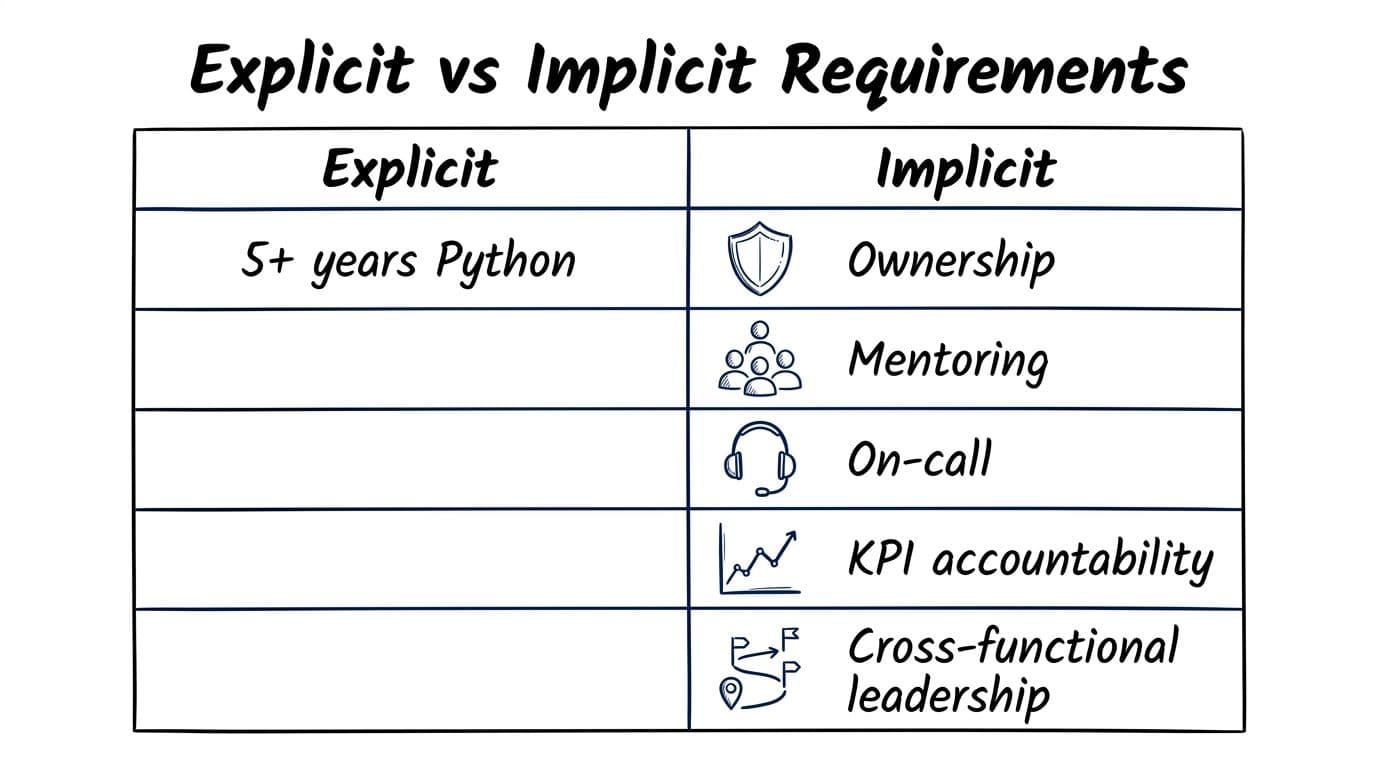
Treat a job description like a movie trailer. It shows highlights, not the hard parts.
The 2026 job description analyzer checklist (what to extract and label)
Infographic: 2026 Job Description Analyzer Checklist (use this as your quick scan).
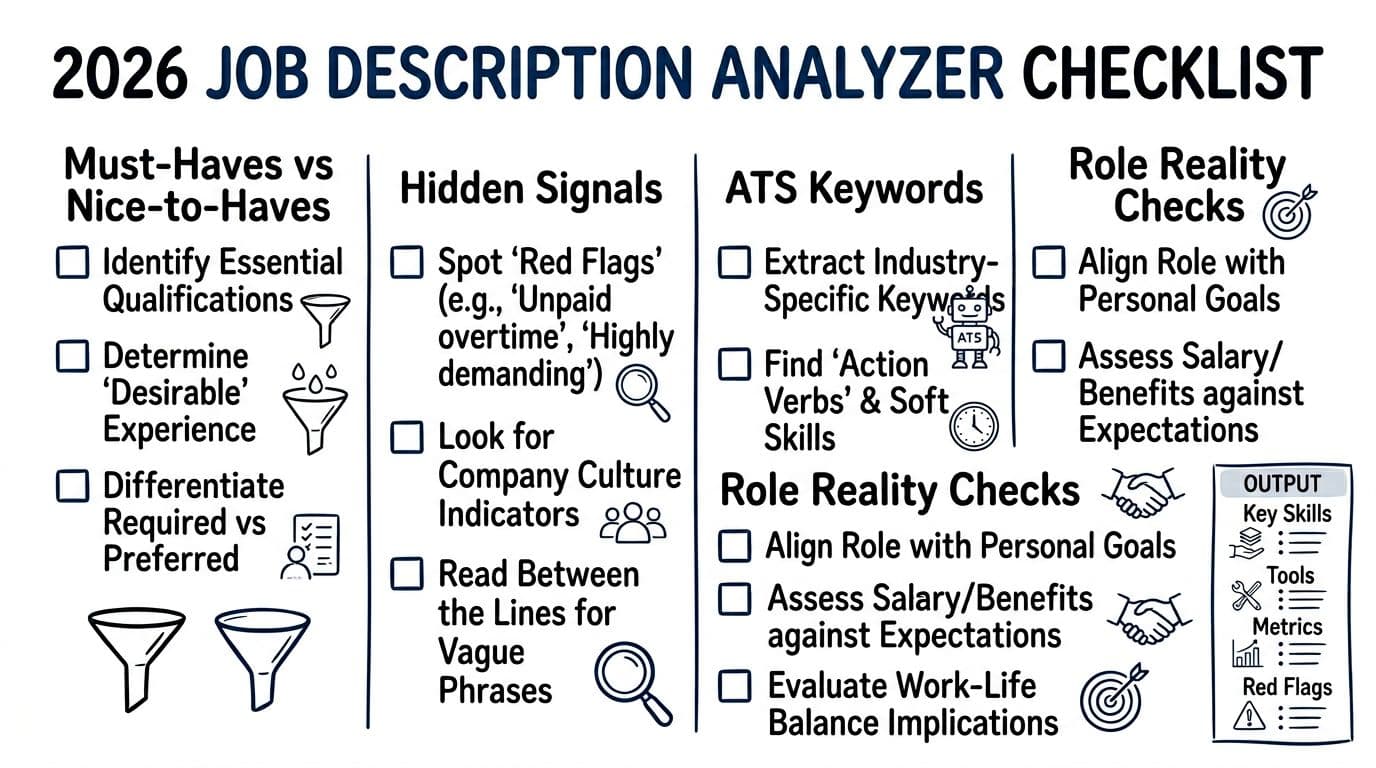
A practical job description analyzer checklist sorts the post into four buckets. You’re building a one-page “truth map” before you tailor anything.
Must-haves vs nice-to-haves (so you don’t undersell)
Start by separating hard gates from preferences. Qualifications and experience such as degrees, certifications, work authorization, clearance, and regulated experience belong in the gate bucket. In 2026, security and privacy requirements show up more often, even in non-security roles (SOC 2 awareness, data handling, access controls).
Also watch for “equivalent experience.” It’s often real, but only if you prove outcomes. If you’re a career changer, keyword alignment matters even more. This article on aligning resumes with JD keywords in 2026 gives a useful framework for mapping transferable skills to the JD’s language.
Hidden signals (the phrases that reveal day-to-day work)
Hidden requirements often live inside innocent wording. A few examples:
- “Own” or “drive”: you’ll be judged on results, not effort.
- “Partner with stakeholders”: expect negotiation, tradeoffs, and conflict.
- “Comfort in ambiguity”: unclear requirements, shifting priorities, fewer processes.
- “Bias for action”: fast decisions, incomplete data, higher accountability.
- “Global team”: async updates, written comms, time-zone overlap expectations.
ATS-friendly keywords (mirror the tool and skill language)
Once you know the must-haves, extract keywords by collecting the exact spellings of tools and technologies, methods, and deliverables. Don’t guess “CRM,” use “Salesforce” if that’s what they wrote. Keep a short keyword list and place it where it fits naturally (skills, bullets, projects).
If you need a reference for keyword categories and examples, this ATS resume keywords guide is a helpful starting point. For a quick extraction approach, tools like a job description keyword finder, such as Teal’s job description keyword finder, show how to pull repeated phrases.
Once you identify keywords, it’s time for role reality checks.
Role reality checks (spot risk before you apply)
Before you commit, look for clues about what the job is really like:
- On-call, incident response, or “24/7 operations” hints at after-hours load.
- “Fast-paced” paired with vague scope can mean shifting goals and thin staffing.
- “Build from scratch” may mean no documentation and few constraints (good or painful).
- “Hybrid” without details can hide strict office days.
Here’s a simple way to translate signals into proof points you can add to your application:
| JD signal | Likely hidden requirement | Proof to show in resume/interview |
|---|---|---|
| “Own end-to-end delivery” | Accountability for outcomes and tradeoffs | Metric-based wins (time saved, revenue, defects reduced) |
| “Partner with Legal/Security” | Compliance-aware work habits | Examples of access reviews, data handling, audit support |
| “Influence cross-functionally” | Stakeholder management | Conflict-resolution story, alignment doc, decision log |
| “Operate in ambiguity” | Self-direction and prioritization | How you clarified scope, set milestones, reduced churn |
CareerScribeAI’s Job Description Analyzer approach (must-haves, nice-to-haves, red flags, and a match view) fits well here because it forces structure before you start rewriting.
Turn hidden requirements into resume bullets, cover letters, and interview answers
Resume optimization begins with a job description analyzer that uncovers what the posting really demands.
Infographic: How to extract keywords and identify keywords from a JD to uncover hidden requirements (from scan to proof).
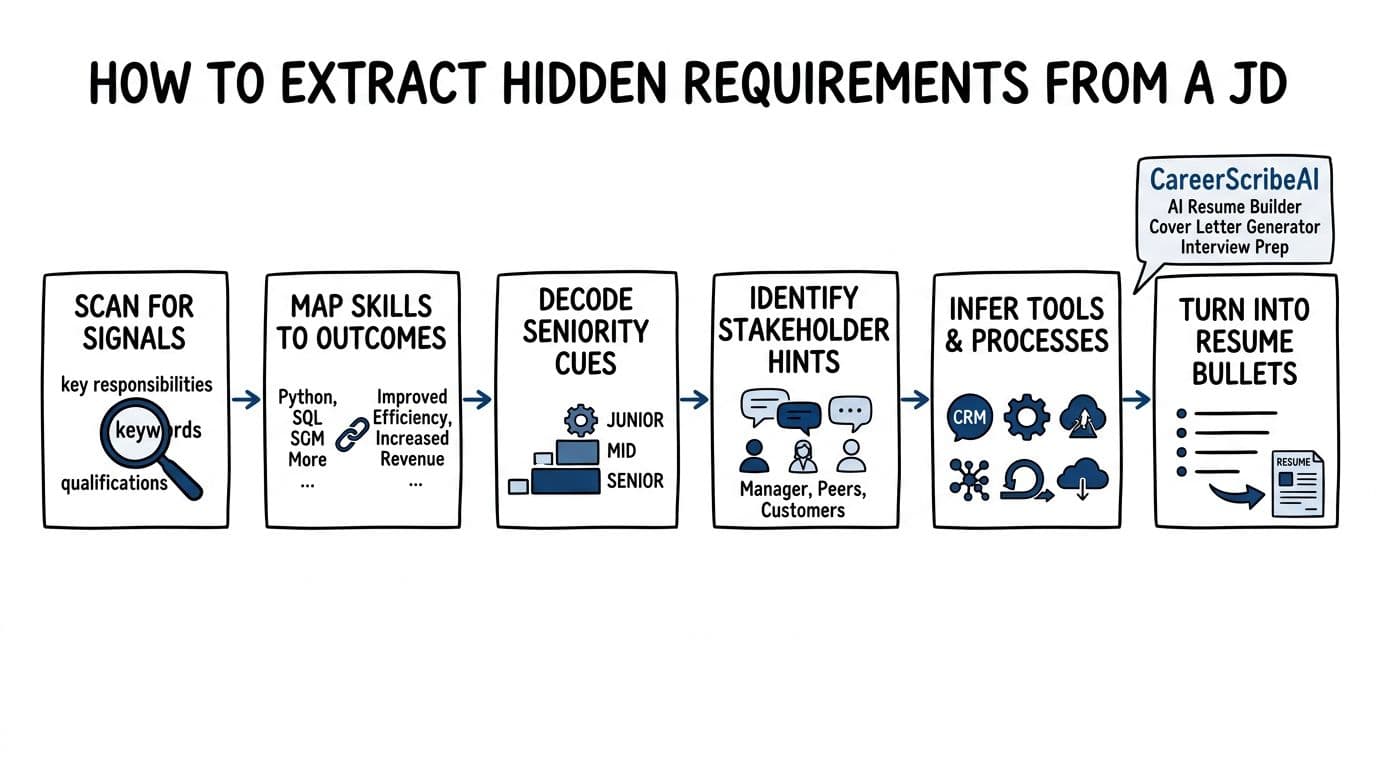
Once you’ve labeled the hidden requirements, convert them into three deliverables. Each one does a different job in the hiring funnel.
Resume: prove outcomes, not responsibilities
Hiring teams skim for evidence. So convert implied needs into quantified bullets. If the JD hints at KPI ownership, show KPIs. If it hints at stakeholder work, show decisions, alignment, and results. Tailor your resume with ATS-friendly keywords using action verbs to create professional bullet points.
This is where CareerScribeAI’s AI Resume Builder can help: take a hidden requirement like “reduce cycle time,” then turn your raw task into a bullet that names the metric, tool, and outcome. Keep it honest and verifiable.
A resume bullet is a receipt. It should show what changed because you were there.
Cover letter: address the “why you” that isn’t written
A strong cover letter doesn’t repeat your resume. It answers the implied questions: Why this team, why now, and how you’ll handle the hard parts. If the JD signals hybrid friction (office days, time-zone overlap), acknowledge how you work async and how you keep visibility high.
CareerScribeAI’s Cover Letter Generator is useful when the JD is vague because it can frame your experience around the implied needs, like change management, compliance, or customer-facing communication, while highlighting relevant skills.
Interviews: prepare for competency-based questions tied to subtext
Hidden requirements drive interview questions. “Influence” becomes “Tell me about a time you disagreed with a stakeholder.” “Ambiguity” becomes “How did you prioritize with incomplete information?” Many companies now score these as competencies, and AI-powered tools often utilize machine learning algorithms and NLP technology to evaluate candidates.
CareerScribeAI’s Interview Prep Tools can help you build STAR stories that match those competencies. Pair that with a realistic view of AI screening patterns and recruiter behavior. This article on AI resume screening insights gives context on what automated and semi-automated review often rewards, especially target keywords during Applicant Tracking System review in the broader recruitment process.
Apply with fewer surprises, starting with your next JD
Using a job description analyzer (or job analysis tool) is essential for resume optimization. Hidden requirements won’t disappear in 2026, but you can stop treating them like a trapdoor. Tailor your resume by using a job description keyword finder to perform keyword extraction, scan job descriptions for industry-specific keywords and resume keywords, and translate candidate attraction signals into proof that meets job requirements. Then support it with a cover letter that addresses implied needs and interview stories that match competency scoring. Follow these optimization suggestions for target keywords and resume keywords, and the next time a JD feels “simple,” look again; the real job is usually in the hints, with fewer surprises during your search.