

Recruiters and hiring managers don’t “read” your profile like a novel. They skim it like a movie trailer. In 2026, your LinkedIn profile summary (the About section, a decision acceleration tool) has one job: help the right recruiter decide, fast, that you’re worth a message.
If your LinkedIn profile summary, a key personal brand asset, sounds like everyone else, you’ll blend in. If it sounds like a real person who delivers results, you’ll get replies. The difference is structure, proof, and a clear ask.
What recruiters screen for first (and why your first lines matter)
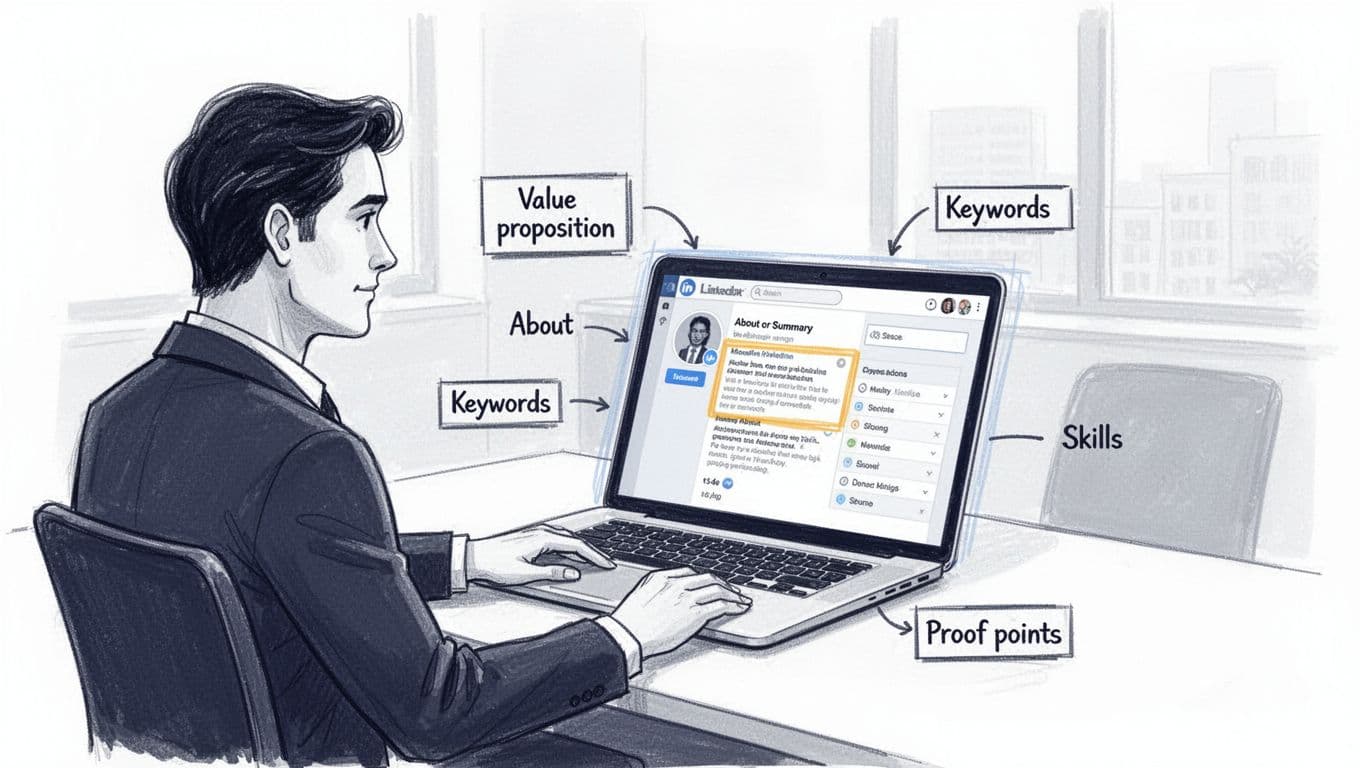
The About section is still one of the highest-signal parts of your profile because it’s where you connect titles, skills, and outcomes in plain language. It also carries keywords that help you show up in recruiter search, making it crucial for ATS optimization and Keywords for SEO.
Most people miss the real bottleneck: the preview. Only the first few lines of your mobile-first opening show before someone clicks the See More button. That means your opening needs to carry your target role, niche, and proof of relevant experience. For a quick breakdown of character limits and the See More button preview, see these LinkedIn summary length and preview tips.
Recruiters also think in constraints. They’re matching:
- role fit (title, seniority, industry)
- skill fit (tools, systems, methods)
- relevant experience (results similar to the job’s goals)
- intent (are you open to this kind of role right now?)
So don’t start with your personality traits. Start with your offer.
A strong opener looks like a storefront sign. It tells the right person, “Yes, this is what you’re looking for.” A weak opener reads like a generic business card.
If your first 2 to 3 lines don’t say “what you do” and “how you measure success,” you’re asking recruiters to guess.
To keep your summary aligned with your resume, pull your best bullets and translate them into 2 to 3 outcome-focused lines. Tools like CareerScribeAI’s AI Resume Builder can help you extract role keywords from a job post, then turn your achievements into metrics-forward statements you can reuse on LinkedIn.
The 2026 Summary Formula that earns replies (plus why it works)
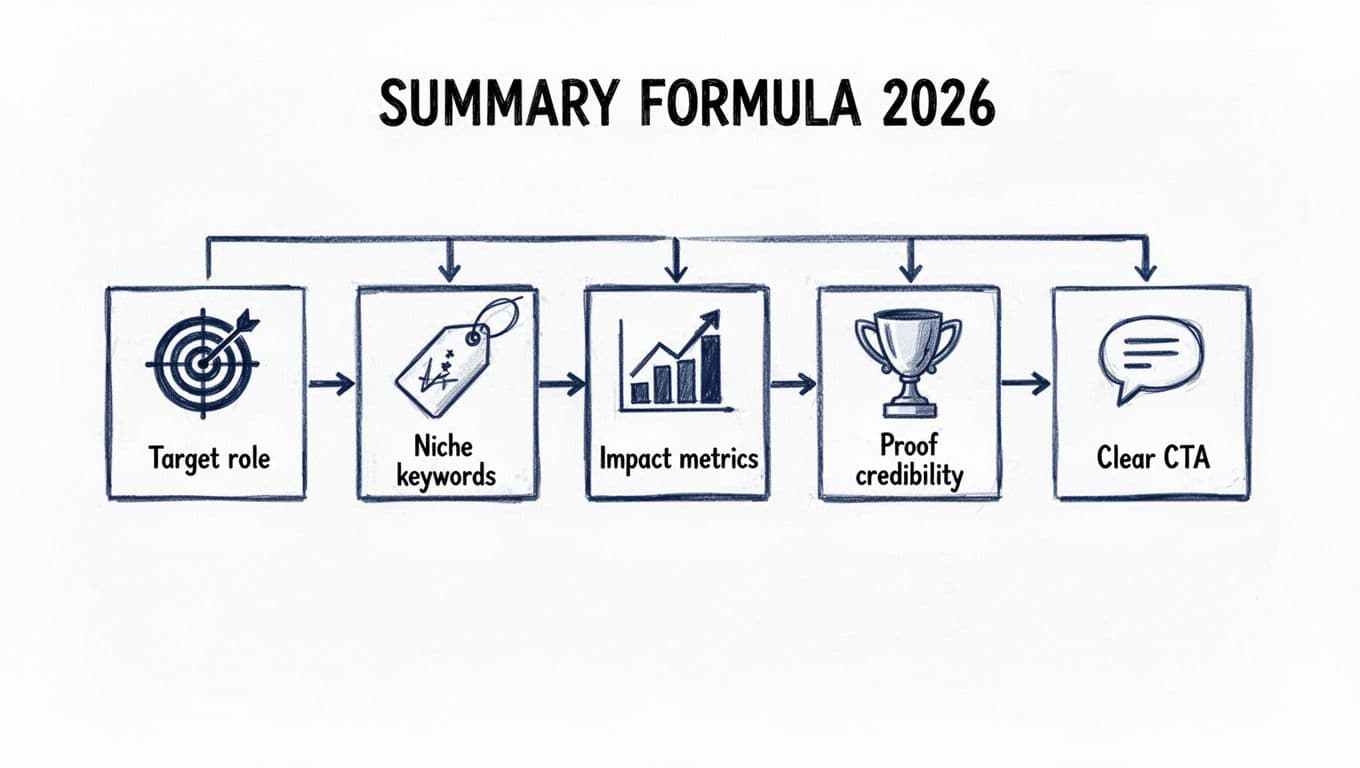
Use this five-part framework. It works because it mirrors how recruiters search and how humans build trust: clarity first, proof next, then an easy next step.
Step-by-step process (infographic-ready)
- Target role (1 line): “I’m a [target title] who helps [who] achieve [business result].” Align this with your headline optimization for a consistent profile.
- Niche keywords (1 to 2 lines): Add 6 to 10 keywords for SEO (tools, domains, methodologies) you want to rank for.
- Quantifiable results (3 to 5 lines): Prove you’ve done the work with numbers.
- Proof and credibility (1 to 2 lines): Add context: industries, scale, certifications, awards, notable projects, or social proof.
- Clear CTA (1 to 2 lines): Tell the recruiter exactly what to do next.
Examples of quantifiable results statements
Start these with action-oriented verbs. Quantified lines feel concrete because they answer “how much” and “how fast.” Keep them simple.
- “Reduced onboarding time from 14 days to 9 days by rebuilding SOPs and training.”
- “Grew paid search pipeline 32% in one quarter while holding CAC flat.”
- “Shipped 6 customer-facing features in 10 weeks, and cut support tickets 18%.”
- “Closed $1.4M in net-new ARR across 2 enterprise accounts in 90 days.”
Want help turning vague bullets into quantifiable results? CareerScribeAI’s Interview Prep Tools can also help you recall metrics by walking you through role-specific questions, then capturing strong, measurable talking points for your profile and interviews.
For more general guidance on writing a better About section that still sounds human, this Forbes piece on LinkedIn About guidelines is a solid reference.
LinkedIn summary templates (fill-in-the-blank) for different career stages
You don’t need to write from scratch. As part of a broader job search strategy, start with a template, then replace every bracket with something real. These templates help define your career trajectory for various stages.
Before vs after (quick comparison)
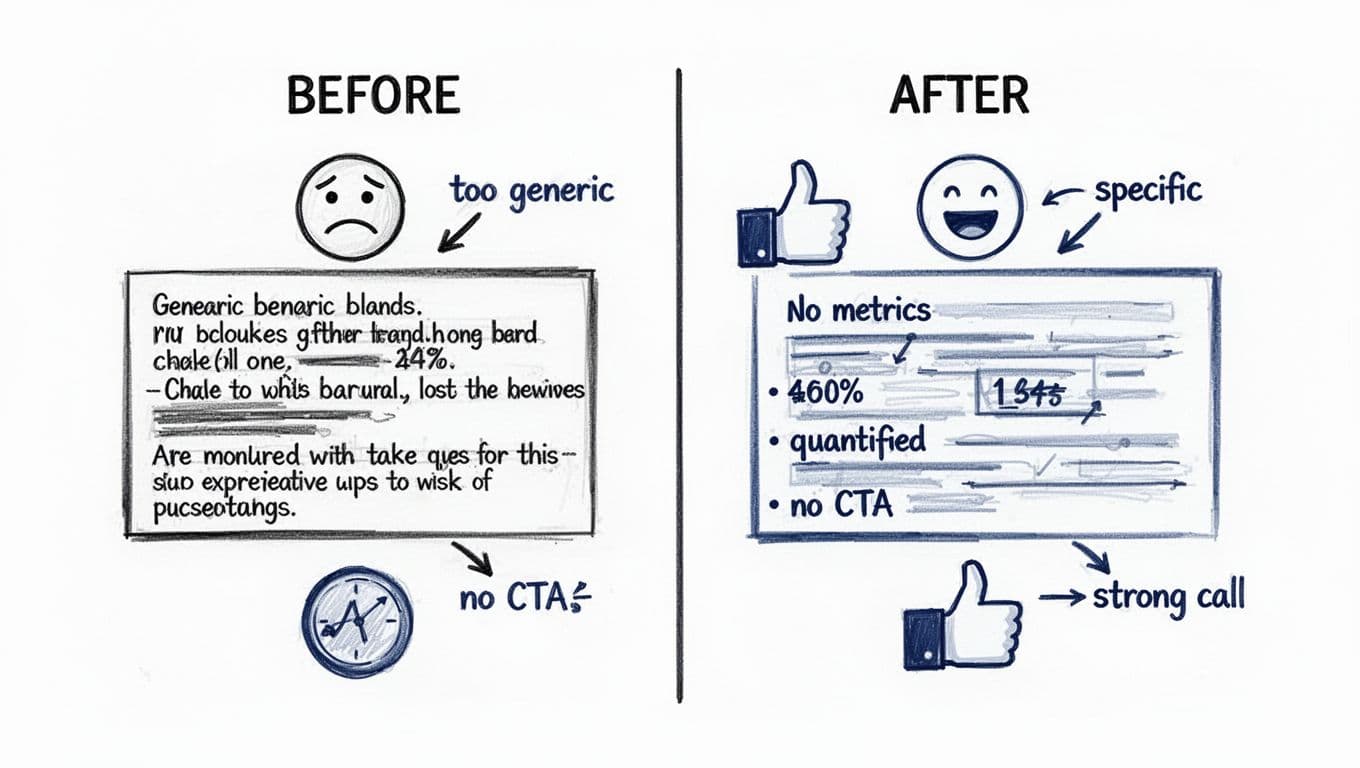
Here’s the pattern to follow.
| Element | Before (low reply rate) | After (higher reply rate) |
|---|---|---|
| Opener | “Results-driven professional.” | “Customer Success Manager focused on renewals and expansion in B2B SaaS.” |
| Proof | “Strong communicator and leader.” | “Owned $2.8M book, improved GRR from 86% to 92% in 2 quarters.” |
| CTA | “Open to opportunities.” | “Open to CSM roles (Mid-Market, Remote). Message me with team size and segment.” |
Template 1: Entry-level or new grad
“I’m a [major or focus] graduate targeting [role] roles in [industry]. I’m strongest in [skill 1], [skill 2], and [tool].
Recently, I [relevant experience: project action] that led to [metric or outcome]. I also [second relevant experience: project] and learned [relevant method].
I’m looking for [role type] where I can help [team goal]. If you’re hiring for [role], message me with the top priority for the first 90 days.”
Template 2: Career switcher
“I’m transitioning from [past field] into [target role]. I bring [transferable strength] from [context], plus hands-on work in [tools/skills].
Highlights: [achievement with number], [achievement with number], and [project outcome].
I’m currently focused on [niche area]. If your team needs help with [problem], I’d love to compare notes.”
Tip: This template facilitates connections in the networking ecosystem by emphasizing transferable skills and clear next steps.
Template 3: Mid-career specialist
“I’m a [target title] who helps [audience] improve [result] using [skills/tools]. My work centers on [niche keywords].
Recent results include: [metric], [metric], and [metric]. I’ve done this in [industry types] with teams from [size] to [size].
Open to [roles] in [location/remote]. Message me if you need [outcome] in the next [timeframe].”
Template 4: Manager or lead
“I lead [function] teams that deliver [business outcome]. My style is simple: clear goals, fast feedback, and measurable results.
In my last role, I [impact 1 with metric]. I also [impact 2 with metric], while supporting [stakeholders]. Tools I use include [tools].
If you’re hiring a [role] to improve [KPI], send a note with the role scope and I’ll reply within 24 hours.”
Warning: Avoid excessive industry jargon to remain accessible to recruiters and non-specialists.
Strong CTA examples that feel natural (not needy)
- “If you’re hiring for [role], message me the top 2 priorities for the first 60 days.”
- “Recruiters: I’m open to [titles]. Please include comp range and location so we can move fast.”
- “Best way to reach me: LinkedIn message. I respond weekdays.”
- “If your team is rebuilding [process], I’m happy to share a quick 10-minute plan.”
To keep your story consistent across materials, you can draft your About section from your resume summary, link About section results to your Featured section for extra impact, then use CareerScribeAI’s Cover Letter Generator to match tone and keywords for each application.
For additional profile optimization ideas beyond the About section, this LinkedIn profile optimization checklist pairs well with the formula above.
Recruiter Reply Checklist (final polish in 10 minutes)
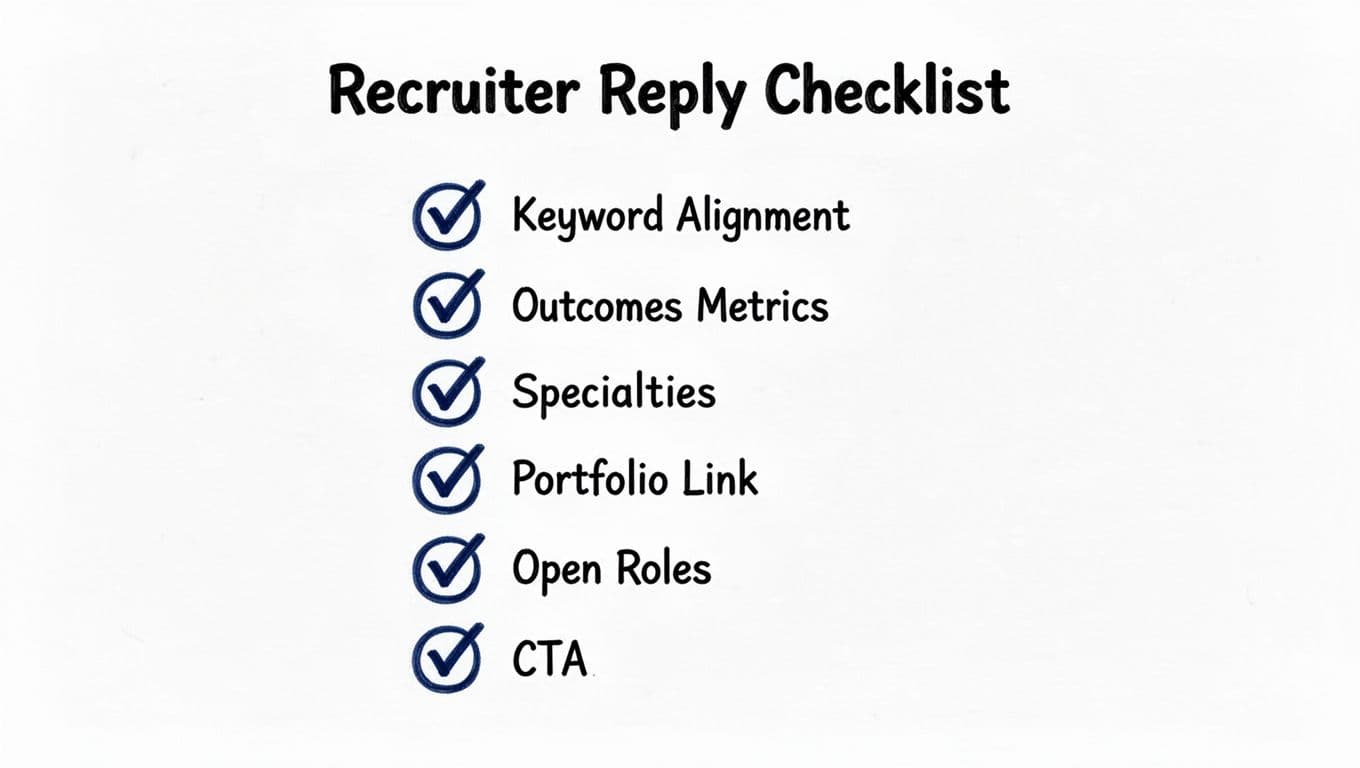
Before you hit save, ensure strategic thinking is evident in the summary’s structure, then scan against these points:
- Target role appears early, not buried.
- Keywords match the jobs you want (tools, domain, methods).
- At least 2 metrics show real outcomes.
- Scope is clear (team size, budget, book of business, user volume).
- Credibility shows up (industries, certification, notable work).
- Tone sounds like you, not a template dump.
- Human-centric writing ensures the profile doesn’t sound like a bot.
- Open to Work setting is clear (what, where, and level).
- Call to Action tells recruiters what to send (role scope, location, comp band).
Also, keep it skimmable. Use short lines, and avoid huge text blocks. A recruiter should understand you in 10 seconds, then want to read more. This turns your profile into a lead generation pipeline for career opportunities.
Conclusion
Recruiters’ replies come from clarity plus proof, not fancy wording. Put your target role and keywords up front, then back them with outcomes and scope. End with a CTA that makes it easy to contact you. Update your LinkedIn Profile Summary (your primary Positioning statement) every time your target role changes. LinkedIn acts as a Search engine for talent, so optimize your About section, and treat it like a living asset, not a one-time bio.