


If your private-sector resume is a highlight reel, a USAJOBS federal resume is closer to a work sample plus a compliance document. That difference is why strong candidates still get “not qualified” or never make it past the assessment screen.
In 2026, the rules are stricter on length, but the expectations for detail did not disappear. The win is learning how to expand your experience into federal language, then compress it into a two-page submission that still proves specialized experience, KSAs/competencies, and keywords from the announcement.
What changed for the USAJOBS federal resume in 2026 (and what didn’t)
The biggest change, driven by hiring reforms in Executive Order 14170 and the September 2025 deadline, is the two-page resume limit for resumes submitted through USAJOBS for most Job Opportunity Announcement listings at GS-5 through 15 levels. USAJOBS states that agencies only accept resumes up to two pages, and the strict resume page length rules mean longer resumes can block you from applying. See the official guidance on the USAJOBS resume page limit and OPM’s document on the two-page resume limit guidance, part of the broader Merit Hiring Plan.
What didn’t change is what hiring teams want to see: proof. Federal hiring still revolves around whether you meet specialized experience and how well your resume supports your answers in the assessment questionnaire. If your resume is thin, your questionnaire answers can look inflated. If your resume is rich but off-target, you can miss the keywords and core duties the announcement is screening for.
That’s the private sector to federal resume mindset shift. You’re not trying to impress with brevity. You’re trying to document relevant scope, results, and methods, using the language in the announcement.
One more reality check: some roles (often in Title 38 positions and Hybrid Title 38 tracks) may not follow the two-page rule yet. Always follow the announcement instructions, not a generic template.
Federal resume required information that recruiters and HR screens look for
The fastest way to lose points is to omit required information. USAJOBS is clear about what belongs on a federal resume, including start and stop dates, hours per week, and education. Start with the official checklist in USAJOBS guidance on what to include, then tighten it for your situation.
Federal resume required information checklist
- Job title (match your official title, add a plain-language equivalent if helpful)
- Employer name (company or agency)
- Location (city, state)
- Start and stop dates (month/year to month/year, include “Present” if current)
- Hours per week (this matters for eligibility and experience calculations)
- Pay or salary (include if requested in the announcement)
- Supervisor name (or title), plus contact permission (Yes/No) if requested
- Series and grade (if you have prior federal service, or if the announcement requests it)
- Accomplishments with metrics (volume, dollars, cycle time, error rate, satisfaction)
- Tools/tech and methods (systems, platforms, frameworks, equipment)
- Training, certifications, licenses (job-related, current status and dates)
- Relevant education and certifications (degrees, job-related training, current status and dates)
- Awards, publications, languages (only if relevant or requested)
Employment history consistency is vital for passing the HR manual review.
To keep the federal resume format ATS-friendly, stick to clean headings, simple fonts, and text that can be scanned. Avoid columns, text boxes, and graphics in the resume you upload. Using the USAJOBS resume builder ensures you produce a searchable resume for the USAJOBS database; confirm your final output still reads well and stays under two pages.
A private sector resume often lacks these specific data points. Here’s a quick comparison to show why private sector resumes often “feel complete” but still fail federal screens:
| Detail area | Typical private sector resume | Federal resume expectation (2026) |
|---|---|---|
| Dates | Years only | Month/year to month/year |
| Time | Not listed | Hours/week required |
| Scope | Implied | Stated (volume, budget, population served) |
| Keywords | General skills | Mirrors announcement language |
| Compliance | Minimal | Supervisor/contact, series/grade when applicable |
The private-sector-to-federal rewrite that works in 2026 (expand first, then trim)
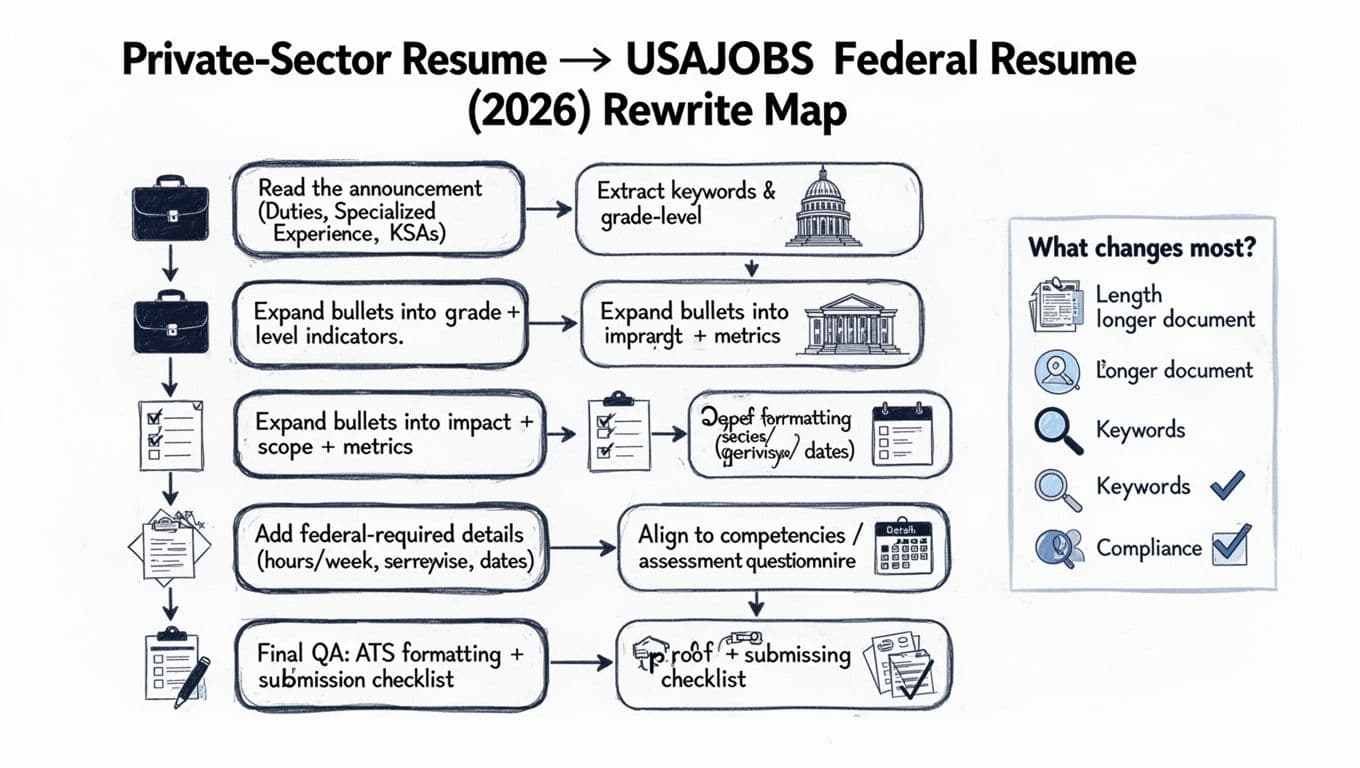
Even with a two-page cap, the best workflow is a two-stage rewrite.
Stage 1 is expansion. Treat it like building a “case file” version of your relevant work experience: duties, tools, metrics, and outcomes tied to the announcement’s specialized experience and competencies. Document all relevant work experience here and specifically highlight at least 52 weeks of experience at the next lower grade level to meet eligibility requirements. This is where a private-sector bullet becomes a fuller story with enough context to be credible.
Stage 2 is compression. Tailor your resume to the qualifications and duties listed in the posting; you keep the proof, but you remove anything that doesn’t support the announcement. This helps ensure you end up on the best qualified list. Think relevance, not completeness.
This is also where tools can help without turning your resume into generic text. CareerScribeAI.com can be useful as a drafting partner when you’re stuck, especially for:
- AI Resume Builder: rewrites bullets into federal-friendly impact statements and helps with keyword alignment to the announcement.
- Cover Letter Generator: produces announcement-specific letters that mirror duties and competencies without copying the posting.
- Interview Prep Tools: turns the same competencies into behavioral prompts, so your resume, questionnaire, and interview examples match.
For federal writing style examples, NIH’s HR office also shares solid, practical guidance in its federal resume tips.
1-page vs 5-page example snapshot (examples)
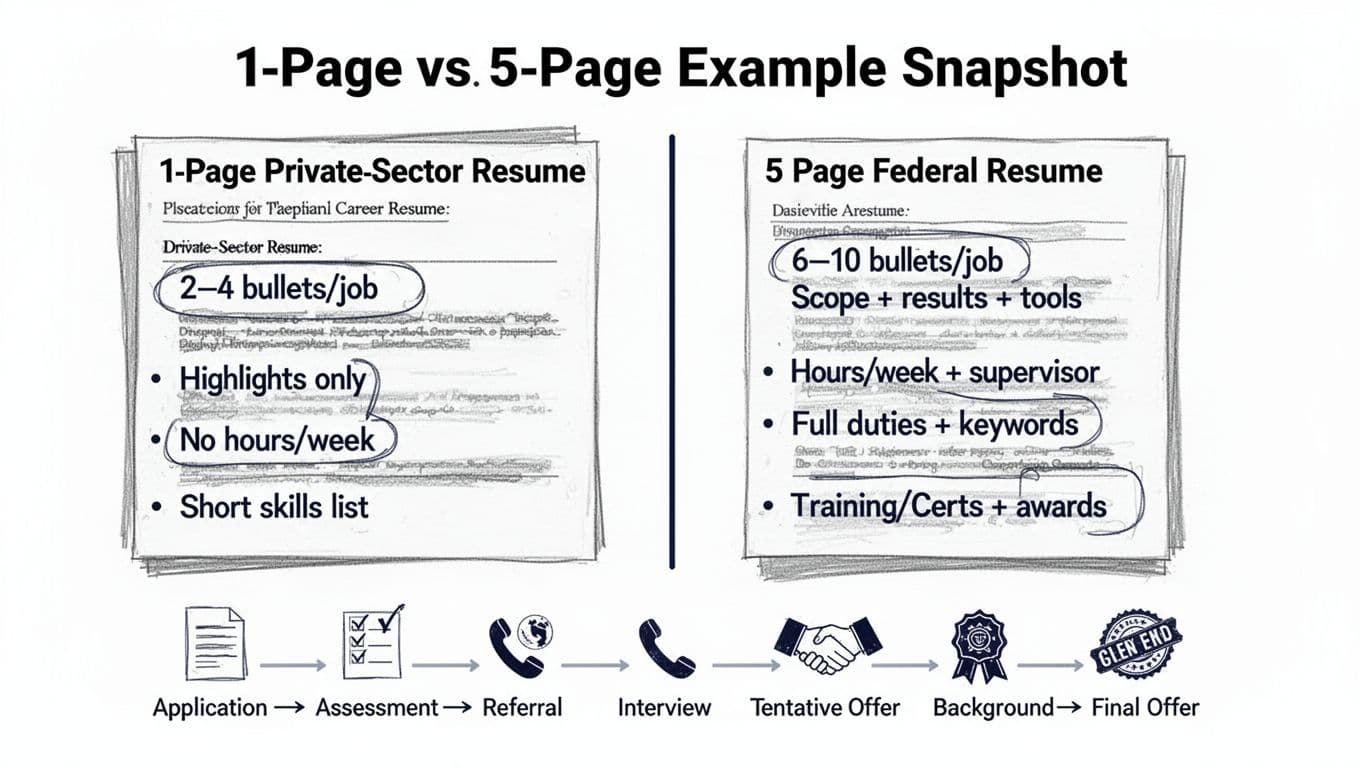
Example private-sector bullet (1-page style):
- Reduced month-end close time by 30% by improving reporting and team workflows.
Example federal-style expansion (legacy 5-page detail level):
- Led month-end close process for a 7-person finance team supporting 4 business units (approx. $85M annual revenue), analyzed bottlenecks across reconciliations, journal entries, and approval routing.
- Built standardized close checklists and updated SOPs, trained staff, and set quality controls that reduced rework (cutting post-close corrections from 18 to 6 per cycle).
- Implemented reporting improvements using Excel (Power Query), ERP modules, and KPI tracking; reduced close cycle from 10 business days to 7 (30% improvement) while meeting internal audit requirements and deadlines.
Notice what changed: scope, tools, compliance language, and proof points. That expanded version is how many candidates used to write a multi-page federal resume.
How to turn the “5-page” detail into a 2-page USAJOBS submission
Start by choosing 2 to 4 accomplishments per role that map directly to specialized experience. Then compress without losing evidence:
- Keep numbers and nouns (systems, tools, deliverables), cut filler.
- Combine “what you did” and “result” in one tight bullet.
- Prioritize the last 5 to 10 years unless older experience is required for the announcement.
- Reuse the announcement’s terms for KSAs/competencies, but only when you’ve actually done the work.
- Sanity-check against the assessment questionnaire. If you claim “expert,” your resume should show repeated, high-scope examples.
Two pages is enough when every line earns its space.
Conclusion
Mastering the federal hiring process in 2026 with a strong USAJOBS federal resume requires balancing depth with the two-page resume limit, not cramming more in. Successful federal job applications prove the right things with clean, verifiable detail over fluff. Follow the required fields, mirror specialized experience, and treat the assessment questionnaire as part of the same package. Build long once, then trim with purpose to maintain the proper resume page length using USAJOBS tools effectively. The question to keep asking is simple: does this line help HR and the hiring manager say “yes” faster?