


That job interview question can feel harmless, but it sets the tone fast. It also helps you make a great first impression. A strong tell me about yourself answer gives the hiring team a reason to stay engaged.
In 2026, the best answers are short, work-focused, and backed by proof. Think of your response like a movie trailer, not a memoir. Once you know the structure, the question gets much easier.
Why this question matters more than most candidates think
Interviewers rarely ask this job interview question to hear your life story. They want a quick read on three things: your communication skills, what you choose to highlight, and how well your professional background fits the role.
Recent 2026 advice, including Resumeway’s 2026 examples, keeps landing on the same point. Keep it to about 60 to 90 seconds, focus on job-related wins, and connect to the role in front of you.
Before the interview, scan the “job description” and pull out the top needs. If you’re not sure what matters most, this guide to spotting essential vs preferred qualifications helps you pick the right themes for your answer.
If your answer sounds like a biography, you’re making the interviewer work too hard.
A weak response often includes personal details like childhood stories, hobbies with no job link, or a line-by-line recap of the resume. A strong one does less, but says more. It gives the interviewer a clean summary, a few facts, and a reason you’re here.
That shift matters because the rest of the interview often follows your opening. Start with focus, and the conversation usually gets better from there.
The simplest structure still works: present past future format
The easiest framework for a clear tell me about yourself answer is still the present past future format. It works because it sounds natural and keeps you from rambling.
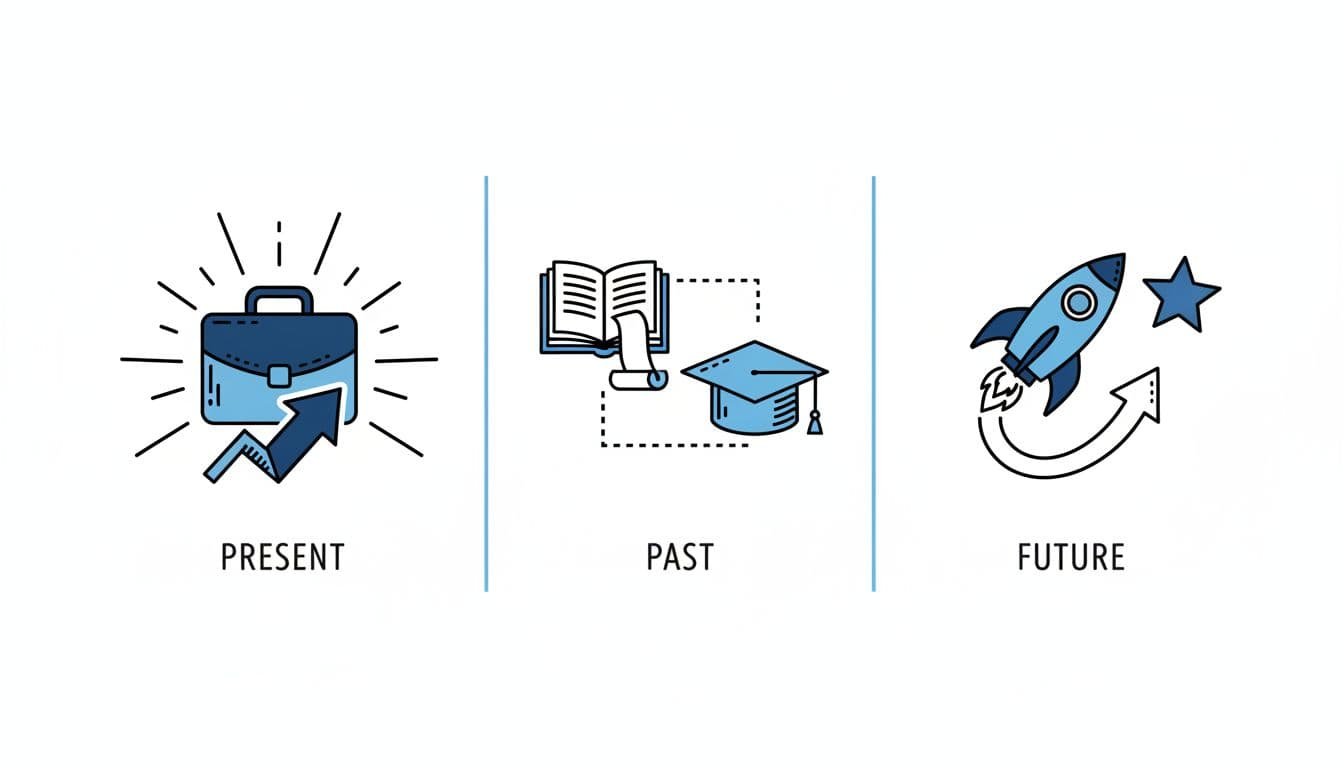
Use this 3-step formula to shape your structured response:
| Part | What to say | Simple starter |
|---|---|---|
| Present | Your current role, focus, and one result | “Right now, I’m…” |
| Past | Your relevant experience that prepared you | “Before that, I…” |
| Future | Why this role makes sense | “Now I’m looking for…” |
Here’s what that sounds like in plain English. Start with your current job or situation. Then name one result with numbers if you can. After that, go back only far enough to explain how you built the right skills. Finally, end with why this company or role feels like the next step.
For example: “Right now, I’m a customer success specialist managing mid-market accounts, and I helped lift renewals by 14% last year. Before that, I worked in support, where I built strong product knowledge and learned how to solve client issues quickly. Now I’m looking for a role where I can use that mix of relationship building and problem-solving in a larger SaaS team.”
That’s short, specific, and easy to follow.
CareerScribeAI’s Interview Prep Tools can help with interview preparation by letting you rehearse this opening and build matching STAR stories for later questions. It also helps when your resume, cover letter, and interview all tell the same story. That’s where the AI Resume Builder and Cover Letter Generator can support the bigger picture.
Tell me about yourself answer templates by career stage
Tailor your answer using these sample answers by career stage. These tell me about yourself answer templates work best when you swap in one real result, one relevant skill, and one reason you want the role.
Recent graduate or entry-level roles
If you’re a recent graduate targeting entry-level roles, lead with education, internships, projects, or part-time work that matches the job.
Template: “I’m a recent graduate in [field], and I’ve built hands-on experience through [internship, project, campus role]. In my most relevant experience, I [specific result or task]. That helped me build [skill], and I’m excited about this role because it gives me the chance to grow in [area tied to the job].”
Mid-career professional
If you already have solid experience, start with your standout achievements and technical expertise. Then connect your career path to what comes next.
Template: “Right now, I’m a [title] with [X] years in [industry or function]. In my current role, I’ve focused on [main responsibility] and recently [measurable win]. Before that, I built a strong base in [relevant background], so I’m ready to bring that experience to a team like yours.”
Career changer
For a career transition, show logic, not apology. Your goal is to link transferable strengths to new work.
Template: “I started my career in [previous field], where I built strong skills in [transferable strengths]. Over the last [time period], I’ve added [new skill, training, project, or certification], including [proof]. Now I’m looking for a role where I can combine my background in [old strength] with my newer experience in [new field], which is why this job stood out.”
These templates help you build a cohesive professional story that highlights your career history.
If you want more role-specific phrasing, Zilo’s role-based examples can give you extra ideas without making your answer sound canned.
Practice it until it sounds like you
Don’t memorize every word. Memorize the shape.
Write a first draft at about 120 words. Then say it out loud and trim anything that sounds stiff. Most people improve fast once they hear themselves. A phone recording helps because it catches filler words and awkward pacing.
Next, make sure your answer matches the documents you submitted. If your resume highlights growth in one area, your opening should support that theme. A clean Lever ATS one-column resume format also helps your written story stay clear before you ever reach the interview. Double-check consistency between your resume and response for a seamless narrative.
Finally, practice one version for live interviews and one for recorded interviews. The structure stays the same. Your tone should sound calm, direct, and human in both, showcasing soft skills like clear communication.
The strongest opening answer isn’t the fanciest one. It’s the one that’s easy to follow, easy to remember, and easy to believe, especially in a fast-paced environment.
A good tell me about yourself answer does one job well. It shows your professional background, where you are, how you got there, and why this role fits.
Pick one template, add one measurable result, and rehearse it tonight. Clarity beats length every time.