


Ever read a job description that screams “team player,” then stare at your resume and think, “Everything I did was with other people”? That’s normal. Most real work happens in groups, from product launches to incident response to customer onboarding.
The trick is writing resume bullet points that prove you drove results while staying honest about shared wins. In 2026, hiring teams still want collaboration, but they also look for ownership and measurable outcomes. You can show both, as long as your bullets are built the right way for applicant tracking systems.
The mindset shift: stop “claiming,” start “scoping”
Team project accomplishment statements fail in two common ways:
Over-claiming: You make it sound like you single-handedly shipped the product, saved the account, and cured latency. Recruiters can sense the stretch, and interviewers will probe.
Under-selling: You hide behind weak action verbs like “assisted” and “helped,” so your work reads like background noise.
A strong team-project bullet works like a movie credit, it names your role, your scenes, and the box office result. You’re not trying to be the entire cast. You’re proving you were a key reason the outcome happened.
For more on showing impact without inventing numbers, this piece on writing a technical resume without making up metrics is a solid reference point.
A simple X-Y-Z formula for team project work experience bullets
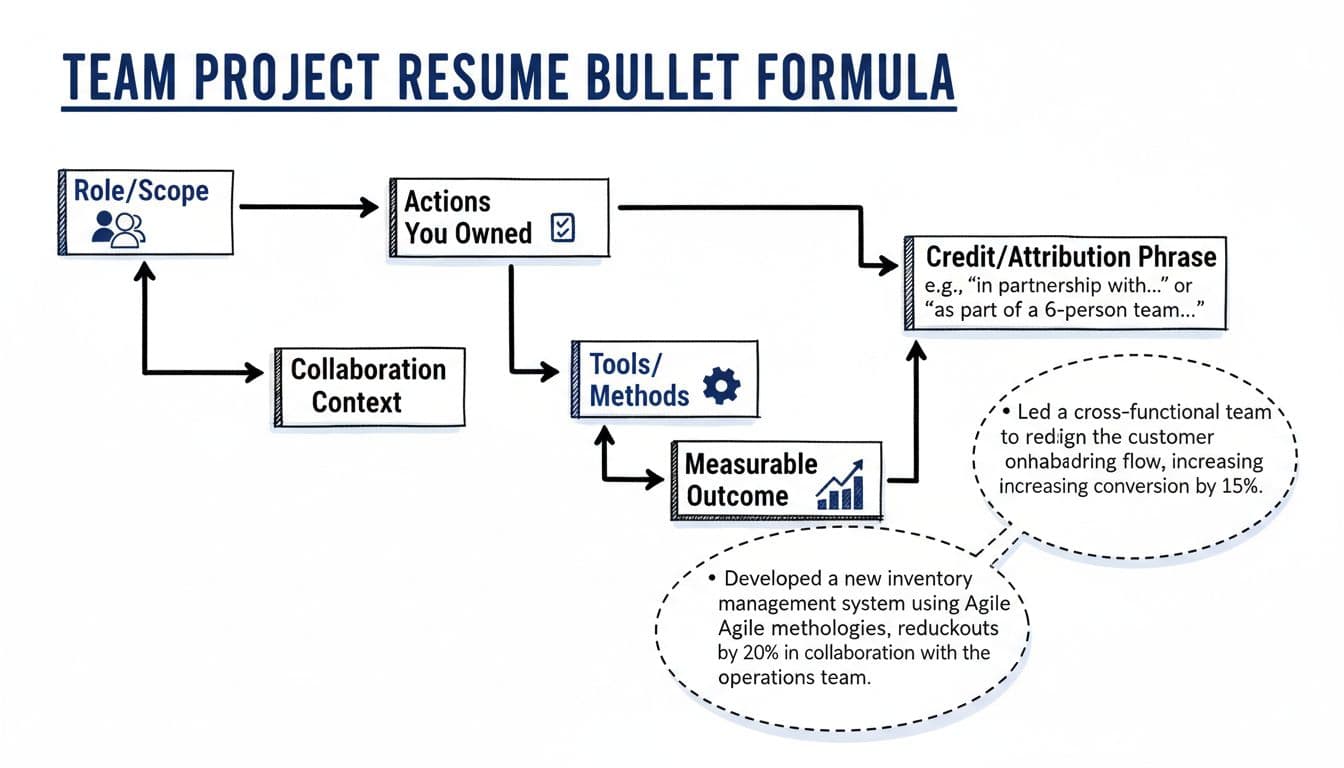
When your experience comes from group work, use a consistent structure so it stays clear and believable:
Role/scope + action you owned + collaboration context (project management) + tools/methods + outcome + attribution
Example skeleton (fill in your details):
Owned [your component] within [team/project], using [tools], resulting in [measurable outcome], in partnership with [team/function].
This keeps the focus on what you controlled to quantify your impact, while still acknowledging the group effort.
If you’re early-career and your best examples come from school, volunteer work, or internship experience, the approach is the same. This guide on documenting group projects for your portfolio has helpful framing for separating team outputs from individual contribution.
Attribution phrases that add honesty (without weakening impact)
Attribution doesn’t have to sound timid. The problem isn’t “as part of,” it’s using it as an excuse to avoid specifics.
Use attribution phrases after your owned action, not instead of it:
Good places to add attribution
- After the main verb: “Built X…, working with Design and Data.”
- Before the outcome: “Implemented X…, enabling the team to reduce Y.”
- In the scope: “In a cross-functional team of 6, owned X…”
Strong attribution phrases (that still read confident)
- In cross-functional teams of [#]: anchors scope quickly.
- Owned [component/workstream]: signals clear responsibility.
- Partnered with [functions] to (or collaborated with): shows collaboration with intent.
- Co-led [initiative] by: honest shared leadership that highlights leadership experience.
- Supported [workstream] by: fine when followed by a concrete deliverable.
Recruiters value these phrases because they demonstrate strong communication skills without diluting your impact.
Avoid leading with soft verbs when you did real work. “Contributed to” can be accurate, but it’s vague. “Designed the QA plan for…” is clearer and stronger.
If you want fast iterations, CareerScribeAI can help you turn rough notes into crisp bullets. Its AI Resume Builder is useful for turning “we launched a thing” into scoped work experience bullets, and its Cover Letter Generator can echo the same team-impact stories with more context. Interview Prep Tools help you practice defending your ownership cleanly when someone asks, “So what exactly did you do?”
Over-claiming vs accurate ownership (quick rewrites you can copy)
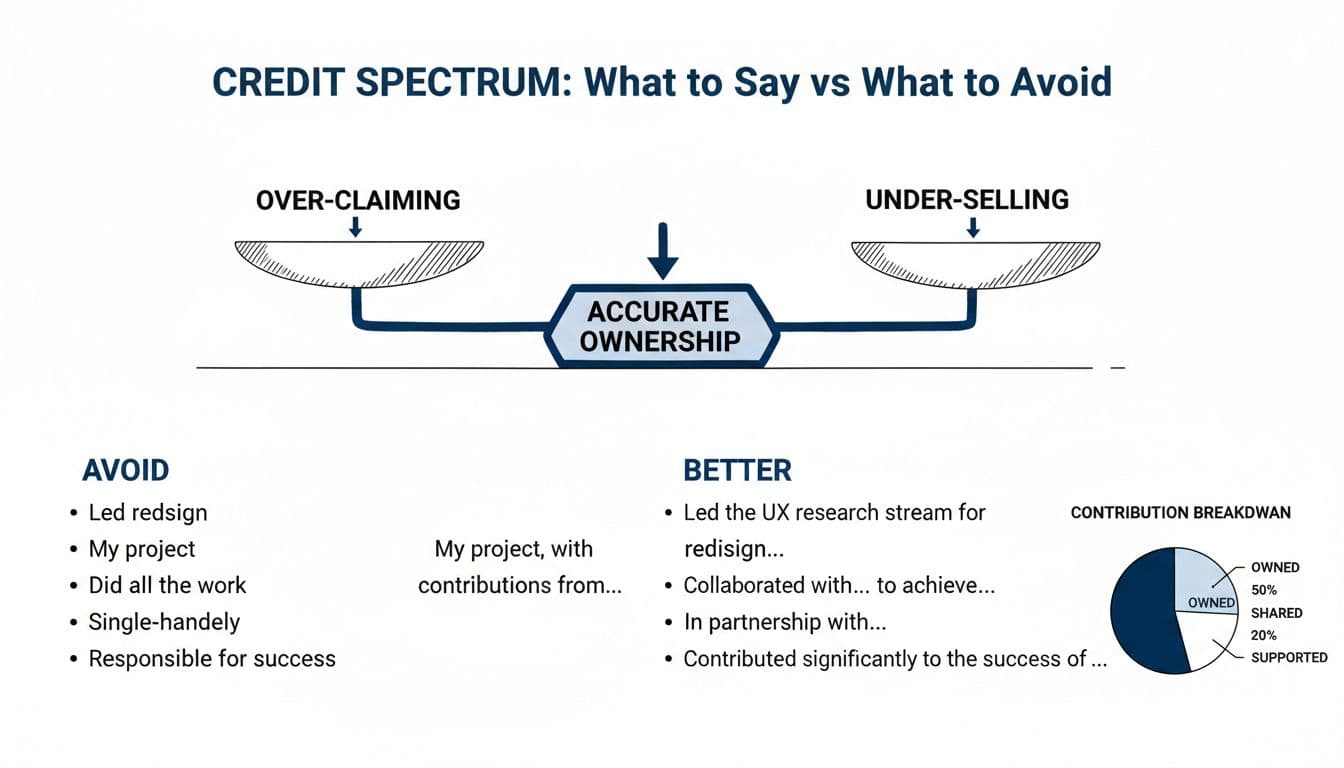
Here’s a rewrite table you can use as a reality check before you submit applications, packed with strong action verbs and measurable results.
Over-claimingAccurate ownership (still strong)Led the product redesign that increased conversions.Led the user research workstream for the redesign, synthesizing 18 interviews into prioritized fixes that contributed to a conversion lift.Built an automated reporting system for the company.Built the automated dashboard pipeline for the RevOps team (SQL + BI tool), delivering process improvement by cutting weekly reporting effort and improving data consistency.Managed the migration to the new platform.Owned the API integration and cutover checklist for the migration, coordinating with SRE and Support to reduce launch-day issues.Improved customer retention through a new program.Partnered with Customer Success to pilot a renewal playbook for at-risk accounts, improving follow-up speed and reducing churn drivers.Designed the marketing strategy for the launch.Owned lifecycle email strategy for the launch, coordinating with Product Marketing on messaging during product development and measuring lift in trial-to-paid conversions.Reduced outages by implementing monitoring.Implemented service-level alerts and runbooks with SRE input, reducing time-to-detect and speeding incident response.
Examples such as the API migration and monitoring implementation illustrate accurate ownership in software projects.
If you need inspiration for outcome-focused phrasing, Jobscan’s roundup of resume accomplishments examples is a handy idea bank.
Plug-and-play template: 10 team project resume bullet examples (by role)
Use these specific examples as patterns, then swap in your tools, scope, and attained results to showcase quantifiable achievements these 10 examples illustrate. Keep each bullet to 1 to 2 lines on the page.
- Software engineering: Led a team owning the payment webhook handler within a 5-person squad, adding idempotency checks and retries that reduced duplicate charges and lowered support tickets.
- Data/analytics: Built the weekly KPI dataset (SQL, dbt) for a cross-functional growth team, improving metric consistency and cutting manual spreadsheet updates.
- Product management: Co-led sprint planning for a new onboarding flow, aligning Design and Engineering on acceptance criteria and shipping the MVP on schedule.
- Design/UX: Led usability testing for the settings redesign, turning findings into prioritized UI changes that reduced user confusion and improved task completion.
- Marketing: Owned launch email sequence and A/B tests in partnership with Product Marketing, increasing click-through rate and driving higher trial activation.
- Operations: Created the vendor intake checklist and approval workflow with Legal and Finance, reducing cycle time and preventing missing compliance steps.
- Customer success: Partnered with Support and Product to roll out a churn-risk playbook, improving response speed for at-risk accounts and standardizing escalation paths.
- IT/Systems: Implemented device onboarding steps with Security and HR, reducing setup delays for new hires and improving policy compliance.
- Early-career (intern/new grad): Owned QA test cases for the release candidate, logging high-signal defects and verifying fixes before launch with the dev team.
- Project/program coordination: Coordinated status updates across Engineering, Sales, and Ops, maintaining a single source of truth that reduced stakeholder churn and missed handoffs.
Want more teamwork language options without repeating “collaborated” five times? This guide on how to write teamwork skills on a resume can help vary phrasing while staying specific.
When you don’t have numbers: metric ideas that stay honest
Not every team project comes with a neat dashboard. You can still quantify your impact and add proof, using measurable proxies and honest metrics:
Volume and throughput: tickets/week, users onboarded, accounts touched, incidents handled.
Time saved: hours/week reduced, reduced costs, steps removed, faster handoffs, shorter cycle time.
Quality signals: defect count, rework reduced, fewer escalations, fewer duplicate tasks, customer satisfaction.
Risk reduction: prevented outages, improved compliance, reduced access issues.
Adoption: internal users migrated, percentage of team using the new process, training completion.
Confidence framing (without guessing): use “reduced,” “increased,” like increased revenue, “improved” paired with what changed (not an invented percent).
If you do have partial data, be precise about the window and scope (team, region, one product line). Accuracy beats a flashy number that won’t hold up in an interview.
Mini checklist: edit your bullets before you hit submit
Before you send your resume, scan each work experience bullet (your accomplishment statements) and confirm:
- One clear owner (you) and one clear action with action verbs.
- Named scope (feature, workstream, module, region, customer segment).
- Team context included (cross-functional partners, team size, or “in partnership with”).
- Outcome present (measurable results like metrics, proxy metrics, or concrete business results).
- No fuzzy verbs (“helped,” “assisted”) unless followed by a deliverable.
- Passes the interview test: you could explain it in 60 seconds.
Conclusion: credit well is a career skill
Team projects aren’t a resume problem, they’re the norm. The goal is simple: show what you owned, show who you worked with, and show what changed because of it, while respecting non-disclosure agreements for confidential work. When your resume bullet points balance impact and attribution, you sound credible on paper and calm in the interview. Mastering this builds transferable skills with long-term value.
Pick one team project from your last role, like market research, rewrite two bullets using the formula, then practice explaining them out loud. If the story stays consistent, you’ve got accurate ownership that still sells, highlighting the leadership experience from when you led a team.