


Most resumes lose power in the bullet points. Hiring managers and recruiters scan your software engineer resume bullets for impact and value, but many just mention tickets, features, and standups without showing it.
These bullets should accurately reflect your work experience and professional experience. In 2026, hiring teams want proof of speed, scale, ownership, and business results. They should read like mini case studies, not a sprint log.
What strong software engineer resume bullets look like in 2026
Hiring managers and recruiters scan your one-page resume like a dashboard, not a novel. That means your best bullets, starting with powerful action verbs, need to show what you changed, how you did it, and what improved after your work shipped.
Current hiring trends also push engineers to show more than coding basics. Hiring managers want system design, cross-team work, AI-assisted development tools, technical skills, and measurable outcomes. Recruiters at many large employers now run AI screening before a human review, so vague bullets get filtered fast. If your format is shaky, start with a clean layout that parses in Lever so your content survives upload.
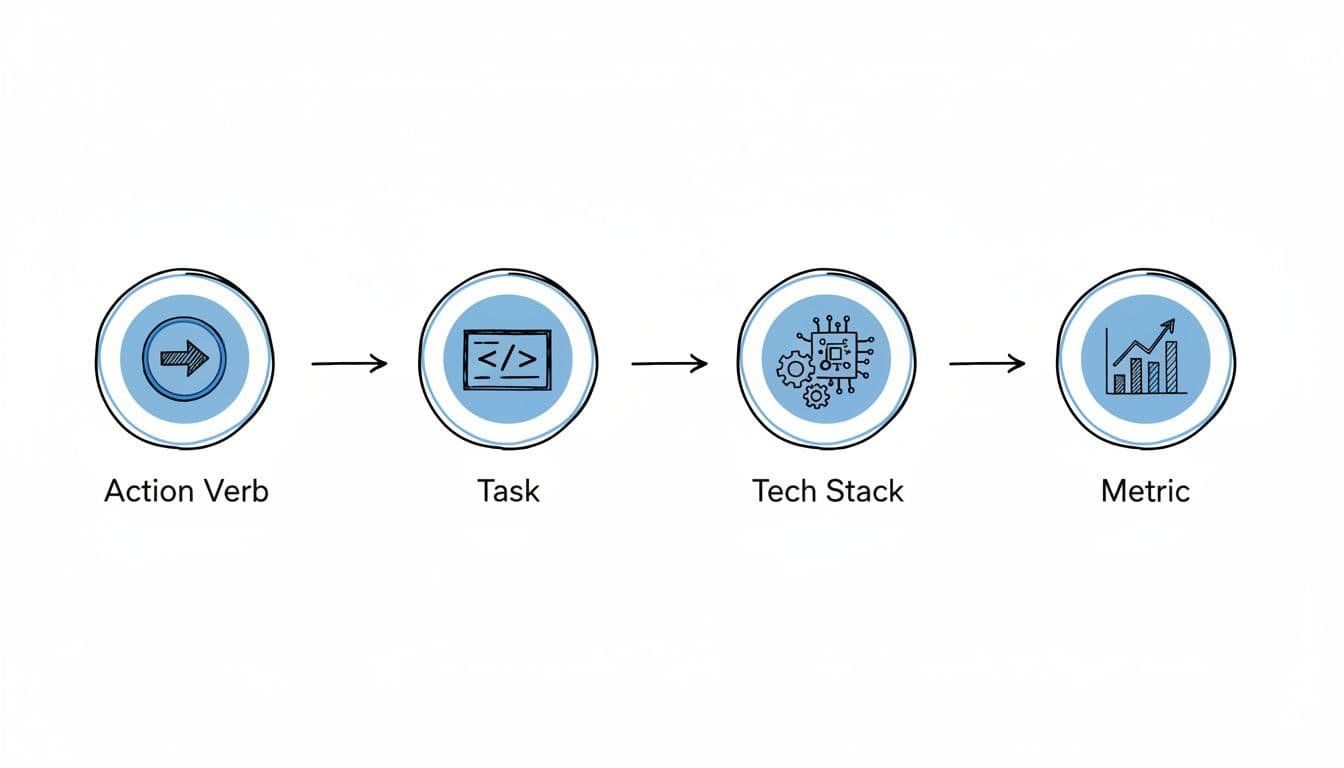
The simplest formula, inspired by the Laszlo Bock formula and using active language, still works:
Action verb + project or task + tech stack + metric or outcome
For example, compare these two bullets:
- Built backend services for billing platform.
- Built Go and PostgreSQL billing services with specific technologies like these programming languages, cutting invoice processing time 48% and reducing payment failures 17%.
The second one gives scope, tools, and a result. That’s what strong software engineer resume bullets do. They prove value in one line.
If a bullet has no outcome, it reads like a job description.
Also, use exact tool names when they matter, including specific technologies and programming languages. “Improved deployment process” is weak. “Automated GitHub Actions and Terraform deploys” is clearer. When tailoring your resume to the job description, match the required technical skills so your software engineer resume bullets resonate with recruiters and hiring managers. For more role-specific patterns, software engineer resume examples for 2026 can help you spot how strong bullets frame impact.
Software engineer resume bullet examples with metrics by role
The best examples feel concrete because they are. They sound like work that happened in production, with numbers attached.

Here are realistic resume bullets you can adapt for various employment history and work experience sections, including professional experience at different levels, software engineering internships, personal projects, and open source contributions. Each delivers quantifiable results that prove impact and value:
From professional experience in backend roles:
- Reduced API latency 42% by rewriting high-traffic Java Spring Boot endpoints and adding Redis caching for 1.8M monthly requests.
- Automated Kubernetes deploys with GitHub Actions and Terraform, dropping release time from 45 minutes to 8 minutes and improving uptime to 99.95%.
- Led a microservices migration for senior professional experience on a team, lowering infra costs $85K annually and supporting 3x traffic growth without incident.
From frontend and full-stack work experience:
- Rebuilt React checkout flows, lifting mobile conversion 14% and cutting page load time from 3.9s to 2.1s.
- Shipped a full-stack self-serve onboarding feature in Node.js and React, using proficient languages to increase trial-to-paid conversion 11% in one quarter.
From mobile and entry-level professional experience:
- Cut Android crash rate 37% by fixing memory leaks, adding test coverage, and improving offline sync reliability for 120K users.
- Built internal QA scripts in Python as an entry-level engineer, reducing manual regression time 20 hours per sprint.
From a software engineering internship:
- During a software engineering internship, optimized database queries in proficient languages like SQL and Go, boosting query performance 28% for a reporting dashboard used by 50 stakeholders.
- In a software engineering internship project, integrated CI/CD pipelines with Jenkins, shortening build times 55% and enabling daily releases for the team’s work experience.
From personal projects:
- In personal projects, developed a real-time chat app with Socket.io and Vue.js, achieving 99.9% message delivery and attracting 5K GitHub stars.
- For personal projects showcasing quantifiable results, engineered a ML model in TensorFlow that predicted user churn with 92% accuracy, deployed via Docker.
From open source contributions:
- Through open source contributions to a popular Kubernetes operator, refactored code in Go to cut resource usage 30%, merged by maintainers and used in 200+ repos.
- Via open source contributions, enhanced a React library’s accessibility features, increasing adoption 40% and earning 150 community endorsements with clear quantifiable results.
Notice the pattern across this employment history and diverse work experience. Each bullet shows ownership, technical stack with proficient languages, and outcome. Hiring managers and recruiters scan for this because metrics turn “helped with” into “moved the needle,” grabbing a hiring manager’s attention instantly. Recruiters appreciate how these details from professional experience highlight what you deliver, while hiring managers value the context from internships, personal projects, or open source that proves you thrive in real scenarios. That’s why these resonate with every hiring manager and recruiter reviewing your work experience.
In 2026, it’s also smart to show AI tools if you used them in real work. Employers increasingly expect engineers to work faster with tools like GitHub Copilot or Cursor. A bullet such as “Used GitHub Copilot to speed test creation, raising unit test coverage from 62% to 81%” feels current because it ties the tool to a result. For a broader view of how engineering resumes are changing, this guide on writing a software engineer resume in 2026 maps the shift well.
If you’re rewriting old bullets, CareerScribeAI’s AI Resume Builder can help turn task-heavy lines into quantified achievements. Then the Cover Letter Generator and Interview Prep Tools help keep the same stories consistent after you apply.
Which metrics matter most, and how to keep bullets ATS-friendly
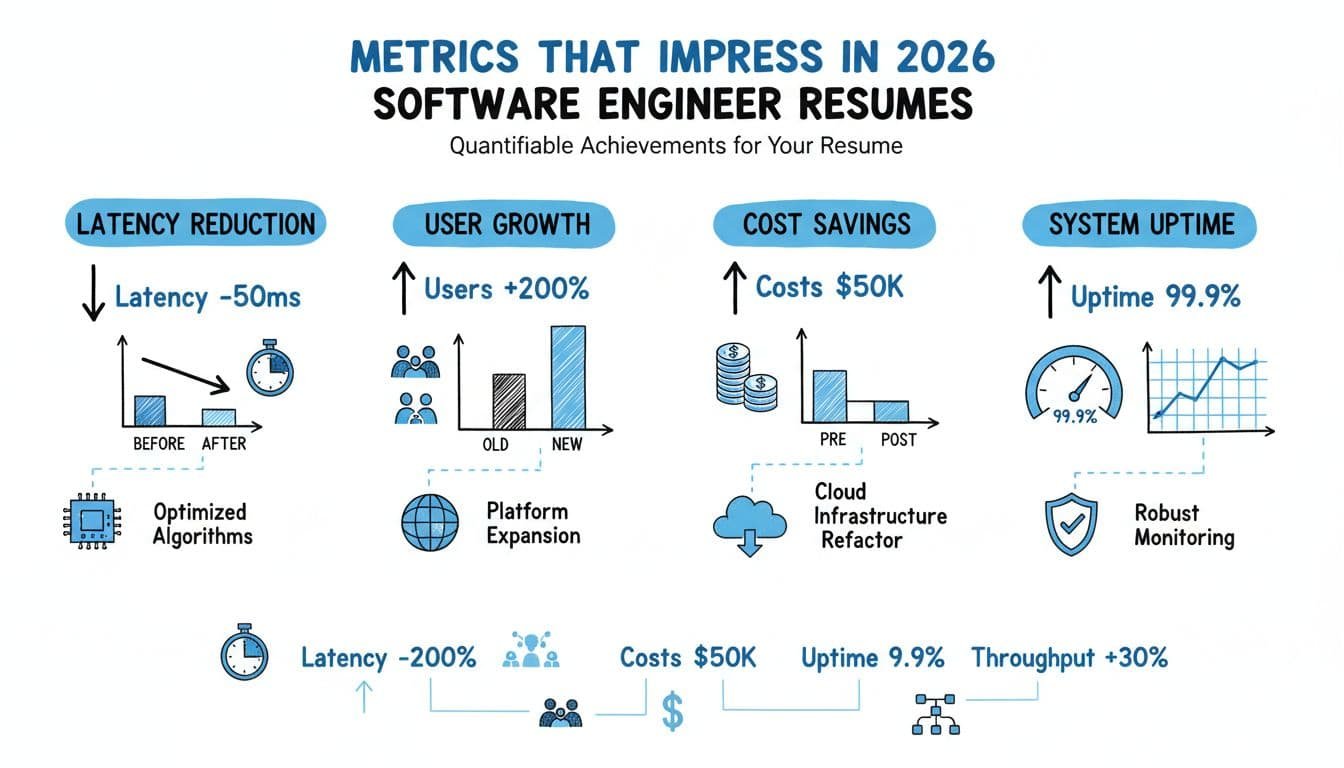
Not every bullet needs revenue. Engineers can measure impact in many ways, and recruiters know that. The strongest metrics usually fall into a few buckets:
- Performance, such as latency, load time, throughput, or query speed.
- Scale, such as users served, requests handled, or data processed.
- Reliability, such as uptime, crash rate, incident count, or rollback rate.
- Delivery, such as release frequency, deploy time, or cycle time.
- Cost and quality, such as cloud spend, defect rate, or test coverage.
If you don’t have hard numbers, estimate with care. Use team dashboards, sprint reports, uptime logs, Jira history, or release notes. A safe estimate beats a blank bullet, but only if you can defend it in an interview.
Then keep the structure ATS-friendly with a holistic resume template that uses standard headings, plain text, and a one-column format. Make sure your contact information stands out for easy accessibility to recruiters and hiring managers. Put exact technical skills in the work experience section when they match the job post, since keyword filters in ATS systems scan for those technical skills. Many ATS tools now group related terms, so naming both the core tool and the work context helps your work experience descriptions shine. For junior roles, beef up the education section with relevant coursework to catch recruiter eyes. If you want a second formatting check, this Recruitee ATS resume format guide shows how to test your resume with a simple copy-paste review. You can also compare your layout against ATS resume examples for 2026.
Good bullets win attention. Clean formatting lets them get seen.
The best software engineer resume bullets don’t try to sound impressive. They prove something changed because of your work in the work experience or personal projects sections, helping hiring managers spot your career progression and paving the way to a phone interview. High-quality work experience bullets, paired with personal projects details, often land that first phone interview with recruiters. Use a resume template that highlights this across your resume sections, from education section to work experience.
Pick five old bullets today and rewrite them with one action, one stack detail, and one metric. Tailor your resume to the job description, run a final check with hiring managers or recruiters in mind, then export. That’s often the difference between a resume that gets skimmed and one that gets interviews.